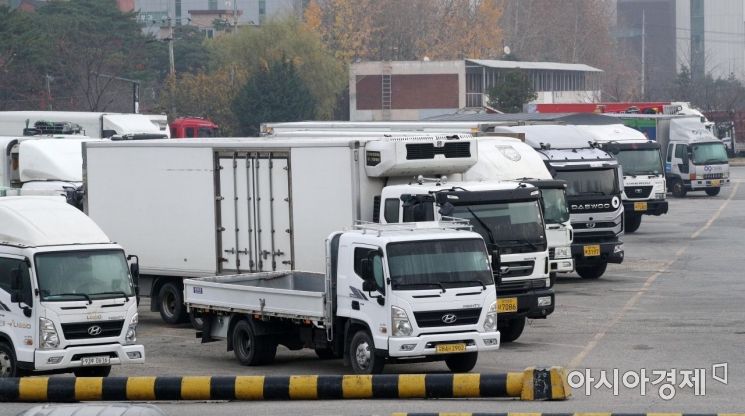
 On the 22nd, two days before the general strike of the Cargo Solidarity under the Korean Public Service and Transport Workers' Union of the Korean Confederation of Trade Unions, cargo trucks were parked at the Western Truck Terminal in Yangcheon-gu, Seoul. Earlier, the Cargo Solidarity announced an indefinite full strike starting from midnight on the 24th, citing that the safe freight rate system has still not been established on the ground. The government plans to explain its position and response measures regarding the Cargo Solidarity's collective transport refusal policy at 3 p.m. at the Government Seoul Office Building on the same day. Photo by Kim Hyun-min kimhyun81@
Cargo Solidarity Union: "Government Fails to Honor Agreement... Blocking Deterioration"
Ministry of Land, Infrastructure and Transport Says Expanding to All Items Is Difficult
Possibility of Longer Strike Than in June Increases
[Asia Economy Reporter Kim Min-young] The Cargo Solidarity Headquarters of the Korean Confederation of Trade Unions (KCTU) is set to resume collective transport refusal after five months. This time, they have taken a firm stance not to back down until the sunset clause of the Safe Freight Rate System is abolished and the scope of applicable vehicles and items is legally expanded, raising concerns that the strike could last longer than the transport refusal incident in June.
According to the KCTU National Public Transport Workers' Union, the Cargo Solidarity plans a general strike starting at midnight on the 24th, with 25,000 union members demanding the prevention of deterioration of the Safe Freight Rate System, abolition of the sunset clause, and expansion of vehicle types and items. The strike will be conducted by blocking major logistics hubs such as steel, cement, shipbuilding equipment, and automobile parts industries, refusing transport.
The Cargo Solidarity claims that the reason for the indefinite strike is the government's failure to fulfill the agreement. Earlier in June, the government and Cargo Solidarity agreed to end an eight-day strike on the condition of continuing the Safe Freight Rate System and pursuing legal amendments. However, Cargo Solidarity views the Ministry of Land, Infrastructure and Transport as directly denying the purpose of introducing the Safe Freight Rate System and breaking the agreement.
Lee Eung-joo, Director of the Organizing Department of the National Public Transport Workers' Union, stated, "The three demands are abolition of the sunset clause, expansion of vehicle types and items covered by the Safe Freight Rate System, and blocking government attempts to deteriorate the system. In particular, the deletion of shipper responsibility is a representative case of deterioration, which undermines the shipper's willingness to take responsibility for sustaining the Safe Freight Rate System."
However, the Ministry of Land, Infrastructure and Transport maintains that it cannot accept Cargo Solidarity's demands. The continuation of the Safe Freight Rate System agreed upon in June is not a permanent implementation but a temporary extension of the application period. It is also known that there is a strong sentiment against accepting the expansion to all items demanded by Cargo Solidarity.
If the two sides fail to find common ground, concerns are rising that the strike could last longer than in June. Cargo Solidarity insists that this time, legal procedures guaranteeing the abolition of the Safe Freight Rate System must be secured before they take the wheel again. Specifically, they are demanding the passage of the amendment to the Safe Freight Rate System proposed by Representative Choi In-no of the Democratic Party. Director Lee said, "This time, we will not end the strike until we receive a clear answer on the abolition of the sunset clause of the Safe Freight Rate System."
With the transport refusal incident repeating after five months, the industry is on edge. The steel and chemical industries require timely supply of materials, and in the worst case, this could lead to shutdowns. The subsequent recovery costs would also be significant. The business community expects that the economic damage caused by this strike will exceed the 2.08 trillion won loss suffered by the entire industry?including steel, automobile, and cement sectors?during the Cargo Solidarity strike in June.
© The Asia Business Daily(www.asiae.co.kr). All rights reserved.
![Clutching a Stolen Dior Bag, Saying "I Hate Being Poor but Real"... The Grotesque Con of a "Human Knockoff" [Slate]](https://cwcontent.asiae.co.kr/asiaresize/183/2026021902243444107_1771435474.jpg)
















