Client's 'Multi-Foundry' Strategy
4-5nm Process May Be Seen as Samsung Client Loss
Competitive 3nm Offers More Opportunities Than TSMC
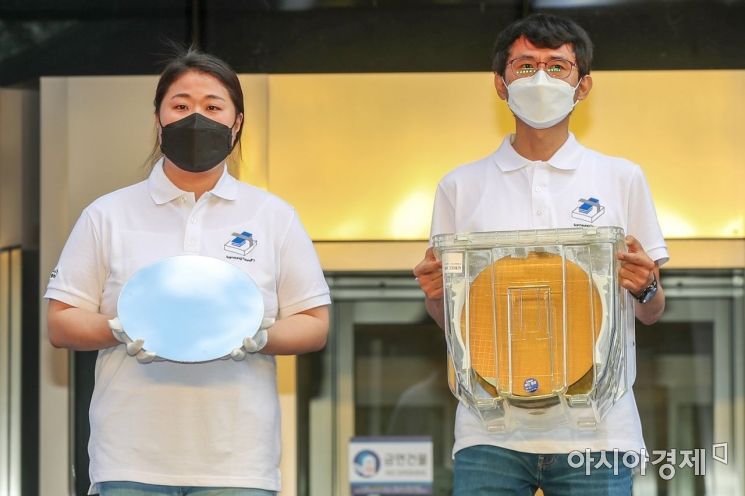 At the 'World's First GAA-based 3nm Mass Production Shipment Ceremony' held at Samsung Electronics Hwaseong Campus in Hwaseong-si, Gyeonggi-do, Samsung Electronics officials are unveiling the 3nm wafer. Photo by Hyunmin Kim kimhyun81@
[Asia Economy Reporter Park Sun-mi] Samsung Electronics, competing with TSMC in leading-edge foundry (semiconductor contract manufacturing) processes, is in a difficult position due to a series of customer departures in the 4~5 nanometer (nm) process. However, there is also hope that customers' 'multi-foundry' strategies will help Samsung secure clients in the sub-3nm processes, where Samsung started earlier and has competitive advantages compared to TSMC.
On the 23rd, Taiwanese media reported that Tesla has entrusted orders for next-generation Full Self-Driving (FSD) semiconductors to TSMC instead of Samsung. Tesla previously produced the first-generation FSD chips at Samsung's Austin, USA plant, but rumors are widespread in the industry that Tesla has placed large-scale orders with TSMC for the next-generation FSD chip production. The next-generation FSD chips are said to be produced using TSMC's 4 and 5nm processes.
The rumor that Tesla has entrusted chip production to TSMC coincides with TSMC's recent announcement that it will begin chip production using advanced 3nm processes at its new plant in Arizona, USA. TSMC is investing $12 billion to build a semiconductor factory in Arizona. After starting 5nm processes, it plans to expand production into the more advanced 3nm process.
In the semiconductor industry, it is seen that if TSMC, which has mainly secured customers from IT companies like Qualcomm and Apple, acquires Tesla as a new customer this time, it could mark a new turning point by expanding into the automotive semiconductor market. In fact, this is the first time TSMC has secured an electric vehicle manufacturer as a top-tier customer. At the same time, Samsung Electronics has also announced plans to actively target high-performance, low-power semiconductor markets such as automotive semiconductors, HPC, 5G, and IoT, aiming to increase the sales proportion of product lines excluding mobile to over 50% by 2027, indicating overlapping target customer groups.
From Samsung Electronics' perspective, the ongoing customer departures are unwelcome. Samsung has been producing Qualcomm's 'Snapdragon 8' first-generation semiconductors. However, Qualcomm entrusted the production of 'Snapdragon 8+ first generation' to TSMC in May, and recently, Qualcomm also assigned the production of the second-generation 'Snapdragon 8' made with 4nm processes entirely to TSMC, intensifying the issue of Samsung's customer loss.
Even if the distribution of orders among multiple global foundries like Samsung and TSMC is part of stable supply chain management rather than customer departure, Samsung Electronics is not in a favorable position considering Qualcomm's latest smartphone application processor (AP) production was entrusted to TSMC after evaluating foundry capacity, transistor power, performance, and price. Another major Samsung customer, Nvidia, also chose TSMC over Samsung for manufacturing its next-generation graphics processing unit (GPU) 'RTX40' series launched last September. Nvidia's new products are expected to be produced using TSMC's 4nm process.
An industry insider explained, "Given the semiconductor industry's characteristic of not dealing with only one foundry, even if new product orders are placed with TSMC, it does not necessarily mean Samsung Electronics is losing customers," adding, "There is a competitive structure between Samsung Electronics and TSMC in leading-edge processes, so whenever new orders come in, there are customer departure issues on one side, but it should be viewed from the perspective of diversification."
Considering customers' 'multi-foundry' strategies, there is still a possibility that customers will return to Samsung, which has competitive advantages in sub-3nm processes ahead of TSMC. Samsung succeeded in mass-producing 3nm process semiconductors for the first time in the world last June and has significantly improved yields to a level that secures customers. TSMC originally planned to start 3nm process mass production in September but postponed it to within this year.
Shim Sang-pil, Vice President of Samsung Electronics' Foundry Business Division, recently stated at an investor briefing that Samsung aims to triple foundry production by 2027 to compete directly with TSMC, adding, "Although we are behind TSMC in 4~5nm technology, there is still an opportunity to catch up with more advanced nodes."
© The Asia Business Daily(www.asiae.co.kr). All rights reserved.
![Clutching a Stolen Dior Bag, Saying "I Hate Being Poor but Real"... The Grotesque Con of a "Human Knockoff" [Slate]](https://cwcontent.asiae.co.kr/asiaresize/183/2026021902243444107_1771435474.jpg)
















