Produced popular models like Leganza and Prince since its completion in 1962
Ultimately closed after the global financial crisis
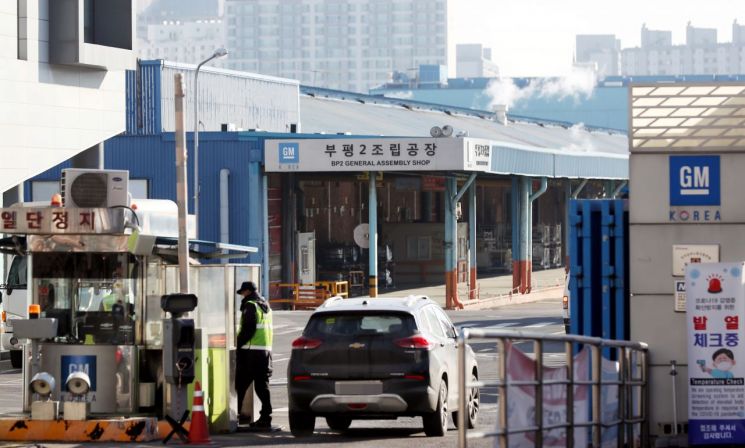
[Asia Economy Reporter Hyunseok Yoo] Korea GM Bupyeong Plant 2 will cease production and close on the 26th.
According to the completed car industry on the 22nd, Korea GM Bupyeong Plant located in Cheongcheon-dong, Bupyeong-gu, Incheon, began in 1962 with the completion of the Bupyeong Plant of Saenara Automobile, a domestic automobile manufacturer.
Saenara Automobile utilized the closed factory in Bupyeong, which had previously produced Japanese military vehicles, to establish the first modern automobile assembly line in Korea. From November of the same year, it produced the Nissan Bluebird.
Saenara Automobile, which relied on imported vehicle parts, faced production difficulties and eventually closed after about a year. Since then, the Bupyeong Plant has undergone various changes with several ownership transfers.
After acquiring Saenara Automobile in 1965, Shinjin Automobile expanded the Bupyeong Plant to 1,652,000㎡ and, in joint venture with Japan's Toyota, produced buses, trucks, and passenger cars such as the Publica, Corona, and Crown.
In 1972, Shinjin Automobile established GM Korea (GMK) by jointly investing capital with the American General Motors (GM), marking the first connection with GM. However, due to poor sales caused by the oil shock the following year, it eventually went bankrupt. During the process of the Korea Development Bank acquiring Shinjin Automobile's shares in GMK, the company name was changed to Saehan Automobile.
Later, Daewoo Group acquired Saehan Automobile, marking the era of Daewoo Motors. Daewoo Motors established a technology research center at the Bupyeong Plant in 1983 and took over all remaining GM shares in 1992 to pursue an independent path.
In 1986, with the establishment of Bupyeong Plant 1, the existing facilities were classified as Bupyeong Plant 2. From the 1970s to the 1990s, Bupyeong Plant 2 produced models such as the Royal Series, Prince, Espero, and later the Leganza, Magnus, and Tosca.
The Bupyeong Plant experienced ups and downs including restructuring and production halts during the 1997 International Monetary Fund (IMF) foreign exchange crisis and the 2008 global financial crisis.
In 2002, GM signed a memorandum of understanding with the Daewoo Group, which was at a crossroads, and launched a new corporation, GM Daewoo. In 2011, the company name was changed to Korea GM, and the vehicle emblem was replaced with Chevrolet, continuing to the present.
After the global financial crisis, Bupyeong Plant 2's operating rate steadily declined but seemed to rebound with the production of the 9th generation new Malibu. However, it did not receive additional assignments for successor models or new car production, and with the discontinuation of the Trax and Malibu vehicles, it will be temporarily closed after the 26th.
About 1,200 workers belonging to Bupyeong Plant 2 will be reassigned, with approximately 700 moving to the Changwon Plant and about 500 to Bupyeong Plant 1. Although Bupyeong Plant 2 will close, Bupyeong Plant 1 will continue to operate. Korea GM plans to produce 500,000 vehicles annually, focusing on Bupyeong Plant 1, which produces the Trailblazer, and the Changwon Plant, which is preparing next-generation crossover utility vehicles (CUVs).
© The Asia Business Daily(www.asiae.co.kr). All rights reserved.
![Clutching a Stolen Dior Bag, Saying "I Hate Being Poor but Real"... The Grotesque Con of a "Human Knockoff" [Slate]](https://cwcontent.asiae.co.kr/asiaresize/183/2026021902243444107_1771435474.jpg)















