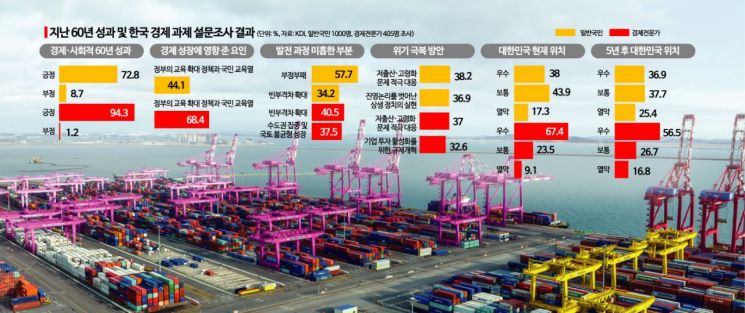
[Asia Economy Sejong=Reporter Kim Hyewon] ‘72.8→38.8→36.9%’.
The public’s expectations regarding the past, present, and future of our economy are rapidly declining. While seven out of ten citizens positively evaluated the economic and social achievements South Korea has made over the past 60 years, fewer than four out of ten believed that the overall national status would be excellent five years from now. In contrast, 6 to 7 out of 10 economic experts responded that Korea’s economic position is excellent, showing a gap in perception with the public. This is according to the results of a public survey announced by Ko Young-sun, Acting President of the Korea Development Institute (KDI), at a commemorative meeting for the 60th anniversary of the Five-Year Economic Development Plan on the 21st.
In the evaluation reflecting on South Korea over the past 60 years, both the public (73%) and economic experts (94%) overwhelmingly responded ‘positive.’ However, their assessments diverged when asked about the current and future state of the Korean economy. Less than 40% of the public chose ‘excellent,’ whereas economic experts recorded a relatively higher response rate of 50-60%. The public’s evaluation that the Korean economy is ‘poor’ worsened from 17.3% currently to 25.4% five years later. The same trend was observed among economic experts (9.1% → 16.8%). This suggests a shared recognition that our economy will face crises in political, economic, and industrial aspects going forward.
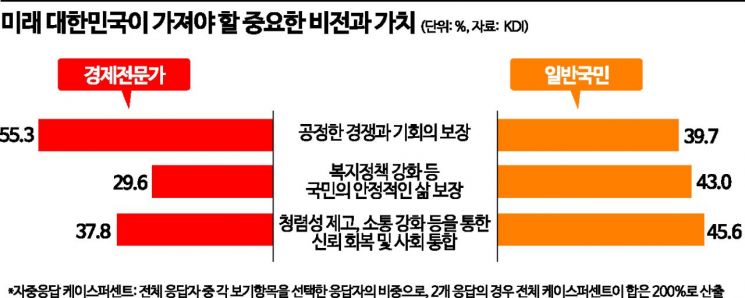
The public identified corruption (57.5%) and widening income inequality (34.2%) as shortcomings in the past economic and social development process, while they cited restoring trust and social integration through enhanced integrity and strengthened communication (45.6%) and ensuring citizens’ stable lives through strengthened welfare policies (43%) as important values for future development. Economic experts ranked widening income inequality (40.5%) as the top past shortcoming but showed a significant gap with the public on corruption (29.1%). Additionally, more than half of the economic experts chose fair competition and guaranteed opportunities (55.3%) as an important vision for the future. The public’s response rate to the same question was 39.7%. This can be interpreted as the public aiming for a society that is honest and stable without corruption rather than expecting more emphasis on the hot topic of ‘fairness.’
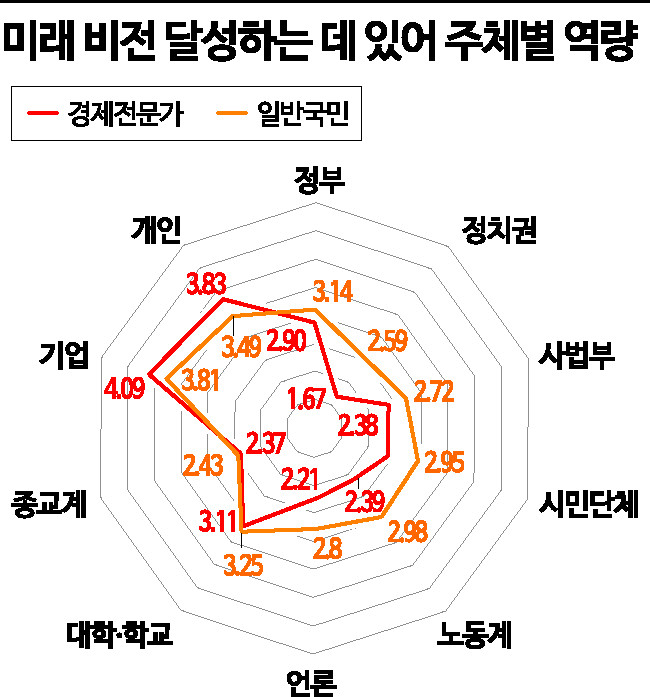
When scoring the capabilities of different actors in achieving the future vision of the Korean economy on a scale of 1 to 5, the public gave the lowest score to the religious sector (2.43 points), while economic experts gave the lowest score to the political sector (1.67 points). Notably, economic experts also rated the religious sector low at 2.37 points. This appears to reflect negative public opinion surrounding the religious sector, including controversies over group selfishness and political interference. Both groups gave the highest scores to ‘corporations’ (public 3.83 points, economic experts 4.09 points). Both sides gave relatively favorable evaluations to the capabilities of corporations, individuals, and universities/schools, while showing less favorable views toward the political sector, judiciary, and labor groups. This is analyzed as reflecting perceptions that the lack of cooperation in a divided National Assembly, judicial overreach, and labor’s bias are intertwined factors hindering economic development.
Choo Kyung-ho, Deputy Prime Minister and Minister of Economy and Finance, emphasized, “Overcoming the complex crisis requires a whole-of-government effort,” adding, “We must simultaneously pursue structural reforms to enhance the productivity and growth potential of our economy, such as bold regulatory reforms and adjustments to the corporate tax system to promote a private-sector-led economy.” The Ministry of Economy and Finance plans to hold an international conference around May next year, inviting domestic and foreign experts to analyze once again the achievements and challenges of our economy over the past 60 years and to discuss future visions and directions.
© The Asia Business Daily(www.asiae.co.kr). All rights reserved.



















