American Nationals Caught Transporting 166 Artifacts by Cargo Truck
On the 10th, Attempted Smuggling of 2 Stone Engravings to the U.S.
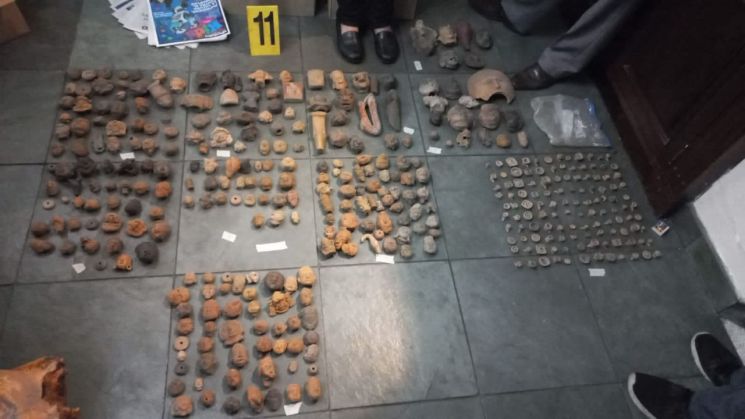
[Asia Economy Reporter Kim Hyunjung] A few days ago, more than 160 Maya-era artifacts were secretly transported in their vehicle, and an additional 1,200 artifacts were discovered at the residence of the Americans involved.
According to foreign media on the 18th (local time), Guatemalan prosecutors and police found over 1,200 Maya-era artifacts on the 17th at the residence of Stephanie Allison Zolluck (49, female) and Giorgio Salvador Rosili (62) in Antigua Guatemala, Sacatep?quez Department. Among these were 722 sculptures made from various materials, many of which are known to have significant archaeological value. The prosecutors and police confiscated the artifacts along with the two individuals' laptops, mobile phones, and a taxidermied 'Quetzal,' the national bird of Guatemala.
The American nationals were caught on the evening of the 13th transporting 166 artifacts by truck on a road about 45 km from Guatemala City. Approximately 90% of these artifacts were confirmed to be genuine Maya-era items with archaeological significance. Some of the artifacts are said to be over 1,000 years old. They were released after each paying a bail of 50,000 quetzales (about 8.6 million KRW). Earlier, on the 10th, Zolluck was caught by customs officers at La Aurora International Airport in Guatemala attempting to smuggle two large Maya stone carvings in her bag to the United States. These artifacts, believed to be sacred axes, were made between 600 and 900 AD. At that time, Zolluck claimed she had purchased them at a market in Antigua. Charged with national treasure smuggling, she was released on conditions including a travel ban but was caught again three days later while moving artifacts. She describes herself in her Instagram bio as a photographer, designer, and entrepreneur based in Antigua, Guatemala.
The Guatemalan prosecutors plan to investigate the two regarding the circumstances of their antique collection and their plans for disposal. Considering the evidence that Zolluck attempted to smuggle cultural assets, a wide-ranging investigation including the sales channels will be conducted. In Guatemala, archaeological artifacts, including those from the Maya era, are registered as national cultural heritage, so even unintentional trafficking can result in punishment.
The Maya civilization flourished for about 3,800 years from 2000 BC to the 17th century AD. Its peak period was from 250 BC to 900 AD. The Maya civilization was based in southeastern Mexico, Guatemala, Belize, parts of Honduras, and El Salvador.
© The Asia Business Daily(www.asiae.co.kr). All rights reserved.

















