Symbol of Korea's Uniform Price Business Asung Daiso Chairman Park Jeong-bu's Management Book
Startup Story at Forty-Five + 'The People's Store Selling 3 Trillion Won with 1000 Won' Management Philosophy
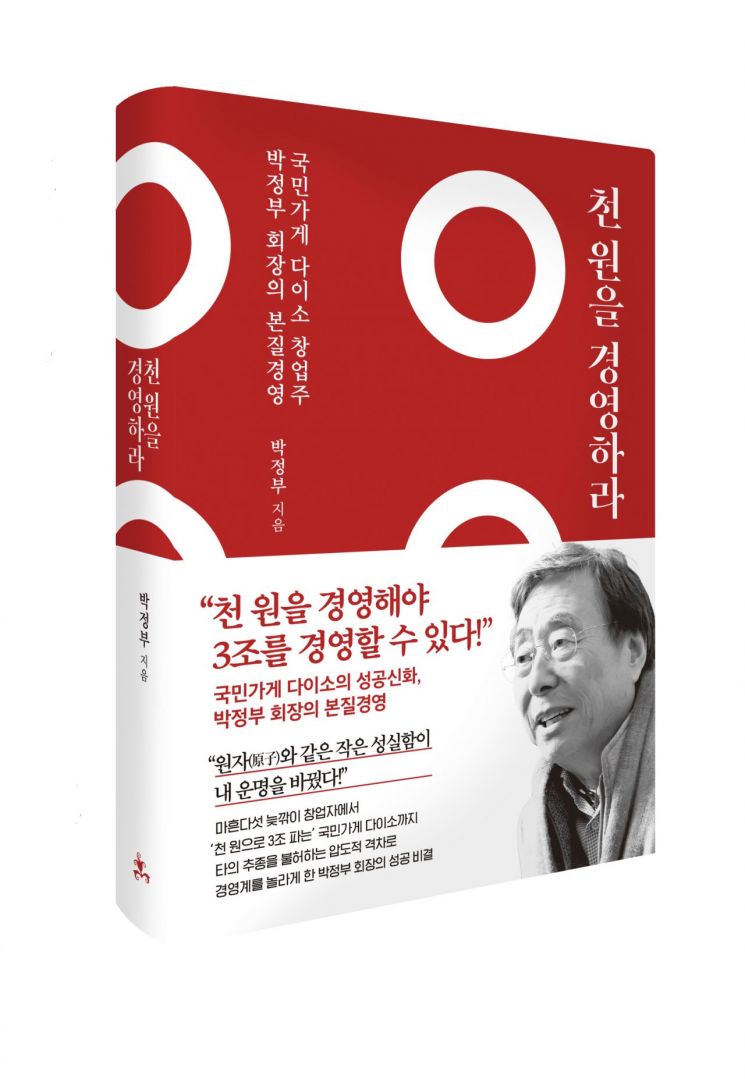
[Asia Economy Reporter Yuri Kim] Asung Daiso announced on the 18th that Chairman Park Jung-bu has published his first management book, "Manage with 1,000 Won."
Chairman Park is known as a symbol of Korea's fixed-price business, having created the myth of the "People's Store Daiso." He started in the trading business at age 45 and, after 10 years of preparation, opened the first store in Cheonho-dong, Seoul, in 1997. Now, 25 years later, the company launches about 600 new products every month, and 1 million customers visit its 1,500 stores nationwide daily.
The new book "Manage with 1,000 Won" is the first management book in which Chairman Park directly reveals the founding story of Asung Daiso, his 35 years of management philosophy, and the secrets behind Daiso's success. It contains Chairman Park's management philosophy that "managing 1,000 won well can lead to managing 3 trillion won."
The book is divided into three parts. Part 1 covers the founding story and the passion that overcame several major crises. Part 2 focuses on the essence of the fixed-price business, the "value of 1,000 won," and the "essential management" that concentrates only on the core. Part 3 shares Chairman Park's on-site management philosophy that the basic is to repeatedly execute simple daily tasks, and nothing in the world can beat such consistency.
For him, who started his business late at age 45, passion was desperation and a point of no return. He began his business diligently by exporting high-quality daily necessities to Japan through trading. Chairman Park said, "For me, passion was desperation and an ultra-focus with nowhere else to retreat," adding, "Passion has no expiration date or validity period."
After nearly 10 years of preparation, the opening of a 13-pyeong (approximately 43 square meters) store in Cheonho-dong in 1997 marked the beginning of Daiso. Asung Daiso's number of stores, which was around 100 in the early 2000s, increased to 300 by 2005 and surpassed 500 by 2008. As the number of stores and products exceeded 20,000, millions of products were sold daily, and the repetitive task of restocking required extraordinary measures for logistics. Although investing 100 billion won to earn 10 won from selling a 1,000-won product was viewed negatively by others, Chairman Park decided to invest.
He invested about 120 billion won to build a state-of-the-art logistics hub center with an advanced operating system in Napsa-eup, Yongin-si, Gyeonggi Province, but the system was unstable and could not be properly operated. Only 30% of the products requested by stores were shipped, and the Namsa hub center rather created a crisis. Believing that "haste makes waste," the system was reset over six months to stabilize logistics and overcome the crisis. This significantly reduced logistics costs relative to sales, and the reduced costs were reflected in the cost price, increasing profit margins. This investment eventually became the foundation for supplying products to 1,500 stores visited daily by 1 million customers.
He chose a strategy of making good products that 1 million people would choose and earn profits rather than making a 10% profit from 100,000 people. To this end, he eliminated all unnecessary bubbles and excess that raised costs. He focused on the essence of the fixed-price business, which is to set the price first and then develop the product. He emphasized, "Consumers feel even 1,000 won is expensive if the quality is poor," adding, "The idea that quality can be poor because the price is low does not work. Quality is not something to compromise."
Chairman Park viewed retail as a battle against customers' "boredom." He stressed, "Stores must always be full of vitality and energy. Stores that customers want to visit often are those where basics such as product display, organization, and service are well maintained."
The management book "Manage with 1,000 Won" is available at bookstores nationwide and online at Yes24 and other retailers.
© The Asia Business Daily(www.asiae.co.kr). All rights reserved.
![Clutching a Stolen Dior Bag, Saying "I Hate Being Poor but Real"... The Grotesque Con of a "Human Knockoff" [Slate]](https://cwcontent.asiae.co.kr/asiaresize/183/2026021902243444107_1771435474.jpg)
















