2018 Allocation 3rd Year Compliance Check
Allocation Cancellation Decision Due to Failure to Meet Minimum Standards
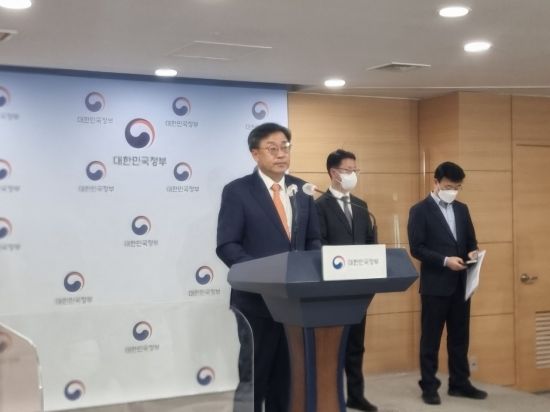 The Ministry of Science and ICT announced the results of the compliance inspection procedure for the allocation conditions imposed during the 2018 5G frequency allocation on the 18th. The photo shows Park Yoon-kyu, the 2nd Vice Minister of the Ministry of Science and ICT, conducting a briefing at the Government Seoul Office on the 18th. Photo by Cha Min-young
[Asia Economy Reporter Cha Min-young] Following a three-year performance review of the 5G 28 GHz frequency allocation, the government has imposed a reduction in usage period on SK Telecom and canceled the allocations for LG Uplus and KT. While all operators fulfilled the allocation conditions for the 5G 3.5 GHz band, the 28 GHz band failed to meet the standards. After a hearing procedure in December, if the cancellation is finalized, one of the two canceled bands will find a new owner.
The Ministry of Science and ICT announced the results of the compliance inspection procedure for the allocation conditions imposed during the 2018 5G frequency allocation on the 18th.
When allocating 5G frequencies in 2018, the Ministry accepted requests from the three telecom companies and allocated both the 3.5 GHz and 28 GHz bands. At that time, the condition was to build 22,500 base stations for the 3.5 GHz band and 15,000 devices for the 28 GHz band within three years, but some operators failed to meet the minimum standards.
For the inspection, the Ministry received compliance performance reports from the three telecom companies in April this year. The compliance inspection procedure consisted of a document and on-site inspection by the Korea Communications Agency (KCA), followed by an evaluation by an assessment committee. After the evaluation, KCA reported the results to the Ministry, concluding the process.
The inspection results showed that all three operators scored above 70 points for the 3.5 GHz band, thus fulfilling the conditions. In contrast, for the 28 GHz band, where all operators’ network construction performance fell significantly short of the mandatory quantity, SK Telecom scored 30.5 points, LG Uplus 28.9 points, and KT 27.3 points.
The Ministry of Science and ICT today pre-notified all three telecom operators of the inspection results along with the corresponding sanctions. As stated in the allocation announcement, allocations are canceled if the score is below 30 points. Accordingly, LG Uplus and KT received cancellation notices, while SK Telecom, which scored above 30 points, was notified of a 10% reduction (6 months) in the usage period (5 years) and that failure to build the originally allocated 15,000 devices by May 31, 2023, before reallocation application, would result in cancellation. The Ministry plans to cancel SK Telecom’s allocation if it fails to meet the conditions by next May.
However, considering the assessment committee’s opinion and the public interest in maintaining continuous service to the public, the Ministry informed SK Telecom, which avoided cancellation, to continue the construction and operation of the currently underway 28 GHz Wi-Fi facilities and equipment in subways, which are intended to be provided free of charge to all citizens.
The final sanctions for the three operators will be confirmed after a hearing procedure in December. If two operators’ allocations are canceled following the hearing, the Ministry plans to actively promote the entry of new operators for one of the canceled frequency bands.
Given the uncertain domestic and international economic conditions, attracting new investors to the 5G 28 GHz band may be challenging, so support measures will also be devised. For example, the Ministry plans to supply anchor frequencies necessary for signal control in the 28 GHz band in more market-preferred bands, consider new allocation methods allowing operators to choose frequency usage units (nationwide, regional, etc.) to reduce investment burdens and enhance competitiveness for new operators, and review support measures for interconnection and facility provision among licensed telecom operators.
Additionally, if the 28 GHz frequency is supplied to new operators, the remaining one band will be supplied through competition after a certain period, which may restrict frequency supply to one of the two operators whose allocations were canceled.
The Ministry of Science and ICT will announce policy directions for promoting new operator entry into the two canceled bands and for the remaining one band at the final decision in December to revitalize the domestic 5G ecosystem. It also plans to prepare institutional measures such as enforcement penalties to impose economic disadvantages on operators who fail to fulfill allocation conditions, in line with promises made to the public.
The government expressed regret over these results despite various support efforts to revitalize the domestic 28 GHz band ecosystem. It judged that the immature domestic 28 GHz band ecosystem, compared to overseas markets, could pose problems as millimeter wave usage is expected to increase in future 6G mobile communications.
Park Yoon-gyu, the 2nd Vice Minister of the Ministry of Science and ICT, said, “The government has continuously encouraged the three mobile carriers to fulfill allocation conditions and supported them in various ways, but we regret this outcome. Going forward, the government will promote policies to revitalize 5G through competition among operators, such as encouraging new operator entry and allowing frequency use to only one of the existing operators.”
© The Asia Business Daily(www.asiae.co.kr). All rights reserved.
![Clutching a Stolen Dior Bag, Saying "I Hate Being Poor but Real"... The Grotesque Con of a "Human Knockoff" [Slate]](https://cwcontent.asiae.co.kr/asiaresize/183/2026021902243444107_1771435474.jpg)















