First Introduced at Severance Hospital in 2005
Easy Visualization and Access to Deep Body Areas
Small Incision Size Improves Patient Quality of Life
Active Research on Surgical Outcomes and New Technologies
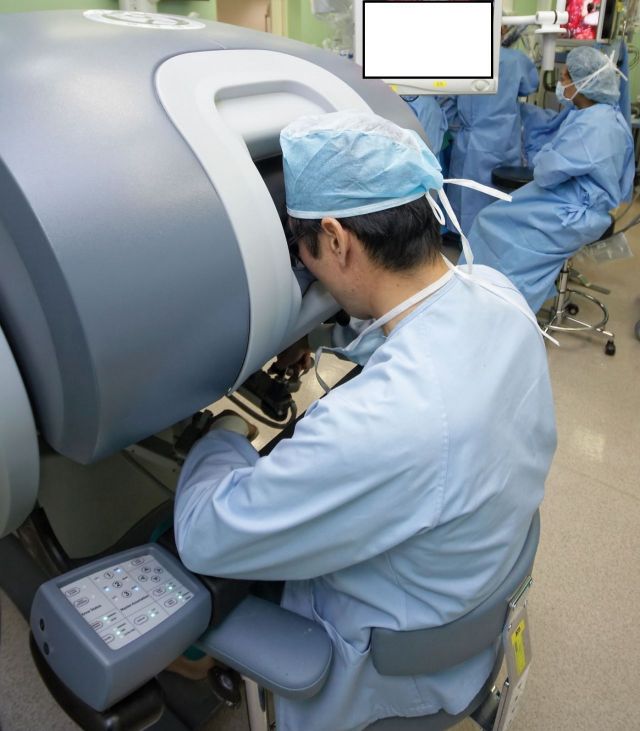 Professor Choi Young-deuk of the Department of Urology at Yonsei Cancer Hospital is performing robotic surgery for prostate cancer. This year, Professor Choi became the first in Asia to achieve 5,000 cases of robotic prostate cancer surgery.
 [Photo by Yonsei Medical Center]
[Asia Economy Reporter Lee Gwan-ju] Since Severance Hospital first introduced the surgical robot 'Da Vinci' in July 2005, 17 years ago, robot surgery has officially taken off and is evolving further. With the advantages of easy securing of the surgical field and the ability to perform delicate and precise surgery even in hard-to-reach areas, robot surgery can improve patients' quality of life with minimal incisions. Therefore, the number of cases using robot surgery is expected to increase steadily. Truly, the golden age of robot surgery has arrived.
Robot Surgery Applicable in Various Fields
Robot surgery literally refers to surgery using surgical robots. It can replace traditional open surgery and conventional laparoscopic surgery. Sometimes, due to the term 'robot,' there is a misunderstanding that the robot performs the surgery automatically, but since the surgeon controls the surgical instruments, a high level of skill is required.
The advantage of robot surgery is primarily the ease of securing the surgical field. High-definition 3D imaging allows accurate visualization of the surgical area, enabling precise surgery. Using robots with joints, it is possible to reach areas inaccessible to human hands, and the ability to use both hands freely is another feature. Above all, compared to open surgery, the smaller incision reduces bleeding, infection, and pain to a minimum. This shortens hospital stays and significantly improves postoperative quality of life. Despite the burden of high surgery costs due to lack of health insurance coverage, robot surgery is actively performed because of its many benefits.
Robot surgery is currently utilized in various fields. Severance Hospital, which achieved the world's first 30,000 robot surgeries in June last year, performed robot surgery in 17 clinical departments including surgery (47%) and urology (37%), as well as otolaryngology, obstetrics and gynecology, thoracic surgery, with about 90 doctors performing robot surgeries. At Seoul St. Mary's Hospital, which surpassed 10,000 robot surgeries last month, the main diseases treated by robot surgery were uterus (29%), prostate (20%), kidney (11%), hepatobiliary and pancreatic (8%), colon-rectum and thyroid (6%), among others.
 On October 18, the surgical team and staff, including Professor Song Gyo-young, head of the Robotic Surgery Center and professor of gastrointestinal surgery at Seoul St. Mary's Hospital (eighth from the left), visited the hospital room of the 10,000th robotic surgery patient to deliver messages of encouragement and gifts in a commemorative ceremony wishing for a speedy recovery.
 [Photo by Seoul St. Mary's Hospital]
Active Research on Robot Surgery Prognosis and New Techniques
New surgeries using robots are also ongoing. Professor Seo Ho-seok of the Department of Gastrointestinal Surgery at Seoul St. Mary's Hospital recently succeeded in Korea's first gastric tumor resection using a single-port robot. The two patients operated on by Professor Seo had tumors in difficult-to-access locations such as the gastroesophageal junction, the lesser curvature (short part of the stomach), and the posterior wall. After making an incision of only about 2.7 cm, the single-port robot provided a wide field of view and free instrument movement, allowing precise surgery in the narrow and deep surgical area. Professor Seo explained, "It is meaningful that the single-port robot left a small scar while preserving the stomach's function as much as possible for gastric tumors located in difficult-to-resect areas."
The urology team of Professors Ahn Han-jong, Jung In-gap, and Seo Jun-gyo at Asan Medical Center published research showing that robot surgery demonstrates long-term excellent outcomes even in stage 3 prostate cancer with seminal vesicle invasion. They followed 510 patients who underwent robot or open surgery for stage 3 prostate cancer, and found that 66.7% of patients in both groups survived without cancer metastasis for 10 years. Professor Ahn said, "We confirmed that the long-term results of robot surgery are by no means inferior to open surgery even in stage 3 prostate cancer, which is known to have a poor prognosis. Further research is needed to thoroughly verify the effectiveness and safety from various perspectives such as oncological outcomes, side effects, and patients' quality of life."
© The Asia Business Daily(www.asiae.co.kr). All rights reserved.
![Clutching a Stolen Dior Bag, Saying "I Hate Being Poor but Real"... The Grotesque Con of a "Human Knockoff" [Slate]](https://cwcontent.asiae.co.kr/asiaresize/183/2026021902243444107_1771435474.jpg)
















