Cargo Solidarity Demands Extension and Expansion of Safe Freight Rate System
Five Related Amendment Bills Currently Submitted to the National Assembly
Auto Parts Industry: "Safe Freight Rate Burden Will Be Passed on to Consumers"
Standardized Safe Freight Rate System Difficult to Apply Due to Car Carrier Characteristics
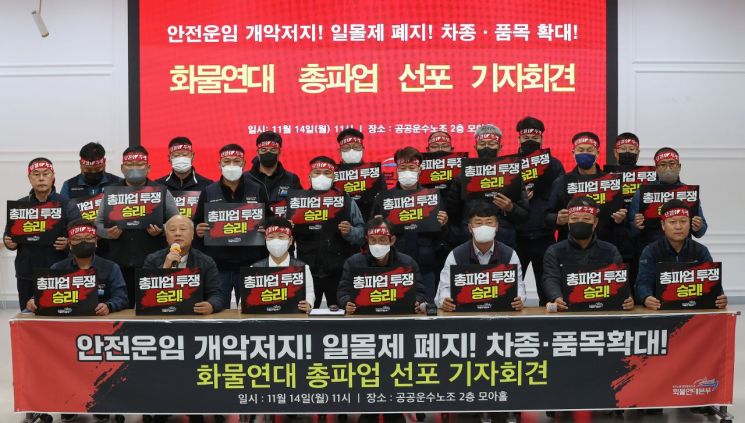
[Asia Economy Reporter Kwak Minjae] As the Cargo Solidarity Union has announced a general strike on the 24th, an emergency alert has been issued across the industrial sector, which suffered damages of about 1.6 trillion won during the logistics crisis last June. What is noteworthy is that the targets they have marked for impact include the entire national key industries such as automobiles, steel, petrochemicals, and cement. In particular, with the consecutive proposals of amendments to the Freight Transport Business Act to expand the safety freight rate system items to include automobiles, anxiety in the automobile parts industry is intensifying.
According to the related industry on the 18th, the automobile parts industry is in a state of utter despair over the Cargo Solidarity Union's strike announcement. The concern arises even before the strike begins because of the precedent of massive damage caused by the Cargo Solidarity Union's strike last June. At that time, five completed car manufacturers including Hyundai Motor experienced production disruptions amounting to 5,720 vehicles due to the strike, which in turn caused a blow to the sales of the automobile parts industry that supplies parts to these completed cars.
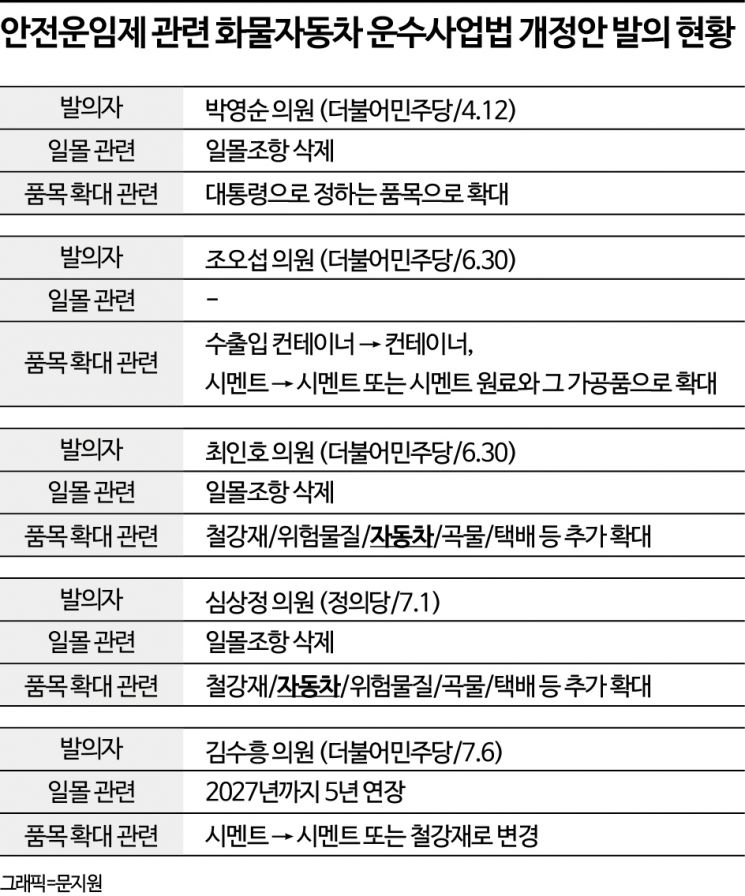
The reason the automobile parts industry is more alert to this Cargo Solidarity Union strike is that they are demanding the extension of the safety freight rate system along with the expansion of applicable items to include automobiles. The Cargo Solidarity Union insists that the scope of application should first be expanded to five items: ▲automobiles ▲steel products ▲hazardous materials ▲feed and grains ▲parcel delivery main and branch lines. Currently, related amendments to the Freight Transport Business Act containing these provisions have been consecutively proposed in the National Assembly. The amendments proposed by Choi In-ho of the Democratic Party and Sim Sang-jung of the Justice Party in June and July of this year respectively include extending the safety freight rate system (removal of the sunset clause) and additionally expanding the items covered by the safety freight rate system to automobiles, steel products, hazardous materials, grains, and parcel delivery.
The problem is that the application of the safety freight rate system will continuously increase the freight charges for car carriers transporting automobiles, which is likely to pass costs on to consumers. If car carrier drivers demand higher freight charges every year through the safety freight rate system, the increase will lead to higher delivery costs, ultimately burdening consumers already suffering from rising prices. Given the frequent strikes in the automobile industry due to annual wage and collective bargaining negotiations, the application of the safety freight rate system is also feared to act as a trigger for continuous strikes in the future. A representative from the Korea Automobile Industry Cooperative said, “Although automobiles were not subject to the safety freight rate system last June, the logistics of automobile production plants were disrupted, causing collateral damage to the automobile parts industry,” adding, “If automobiles become subject to the safety freight rate system in the future, the damage to the parts industry will spread even further.”
There is also an analysis that frequent strikes could lead to a decline in the overall competitiveness of the automobile industry ecosystem, as the automobile parts industry's performance has worsened due to deteriorating business conditions and a fragile profit structure. According to data analyzing the management performance of domestic automobile parts companies by the Korea Automotive Technology Institute last year, 36.6% of all automobile parts companies had an interest coverage ratio (operating profit/interest expense) below 1. An interest coverage ratio below 1 means that the cost of interest payments exceeds the profit earned from operating activities in that year. Although this is a decrease from 43.1% the previous year, considering that last year was during the COVID-19 pandemic, it is the highest level in the past 10 years.
The industry claims that despite the difficulty of applying a standardized safety freight rate system due to the characteristics of car carriers, the Cargo Solidarity Union is demanding an unreasonable expansion of applicable items. A representative from the Korea Automobile Industry Association explained, “Car carriers are not standardized like export-import containers or cement trucks and come in various forms,” adding, “Since the loading capacity of car carriers varies depending on the vehicle type, it is also difficult to uniformly apply transportation conditions.”
There are also claims that this goes against the original purpose of introducing the safety freight rate system. The safety freight rate system was introduced to reduce accidents caused by overwork and speeding due to low freight charges forcing freight drivers into excessive transportation. However, automobile freight transport workers are already receiving higher freight charges than those under the safety freight rate system. According to the Freight Transport Market Trends report by the Korea Transport Institute, the monthly freight charge for car carriers (automobile transport) is 5.54 million won, which is the highest compared to long-distance containers (3.73 million won), cement transport tractors (4.49 million won), tank lorries (4.76 million won), and general cargo (3.56 million won).
An official from the automobile parts industry said, “In the case of car carriers, a reasonable freight system is already in place that regularly reflects transportation costs by item and fuel price fluctuations, and in fact, car carrier freight charges are very high compared to other categories, so there is no reason to forcibly apply the safety freight rate system.”
© The Asia Business Daily(www.asiae.co.kr). All rights reserved.


















