Provocation Resumes After 8 Days... "Military Response Will Be Fierce"
ROK-US Conduct Aegis Ship Missile Defense Drill
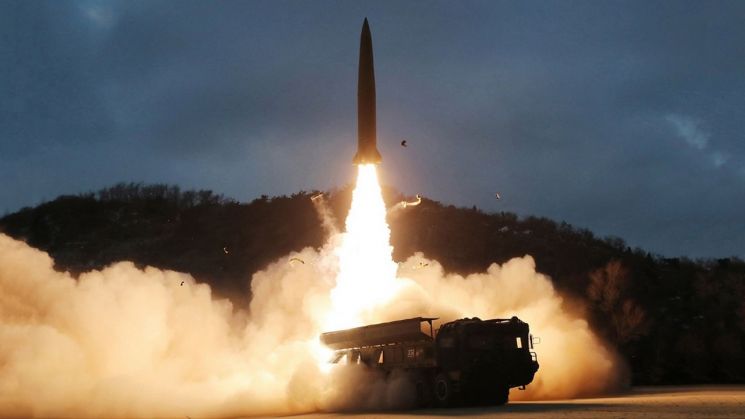
[Asia Economy Reporters Jang Hee-jun and Lee Ki-min] North Korea announced a statement opposing the trilateral policy of strengthening extended deterrence by South Korea, the United States, and Japan, and subsequently launched a short-range ballistic missile (SRBM) into the East Sea. In particular, North Korea threatened that "the United States is making a gamble it will surely regret," hinting at the possibility of strategic provocations including a seventh nuclear test and intercontinental ballistic missile (ICBM) launches. The Presidential Office and military authorities emphasized that "the combined defense posture of South Korea and the United States in preparation for North Korea's provocations remains steadfast."
According to the Joint Chiefs of Staff, North Korea launched one SRBM toward the East Sea from the Wonsan area in Gangwon Province at around 10:48 a.m. on the 17th.
The missile's flight distance was approximately 240 km, altitude about 47 km, and speed detected at Mach 4 (four times the speed of sound). Detailed specifications are being precisely analyzed by South Korean and U.S. intelligence authorities. The missile reportedly flew toward the uninhabited islet 'Alseom' off the coast of Kilju County in North Hamgyong Province and is said to be a KN-series missile using solid fuel recently developed by North Korea.
On the same day, South Korea and the U.S. conducted a joint missile defense exercise integrating multiple detection assets, including the ROKS Seoae Ryu Seong-ryong Aegis destroyer and U.S. Aegis destroyers. This exercise was conducted before North Korea's missile launch and is part of ongoing drills to prepare for recent successive ballistic missile provocations, according to military authorities. It appears North Korea did not detect this exercise.
A Joint Chiefs of Staff official stated, "The successive ballistic missile launches by North Korea are serious provocations that threaten peace and stability not only on the Korean Peninsula but also in the international community," adding, "They are clear violations of United Nations Security Council resolutions, and we strongly condemn them and urge immediate cessation."
He continued, "Our military will maintain a firm readiness posture by closely cooperating with the U.S. to monitor related developments in preparation for any further provocations by North Korea."
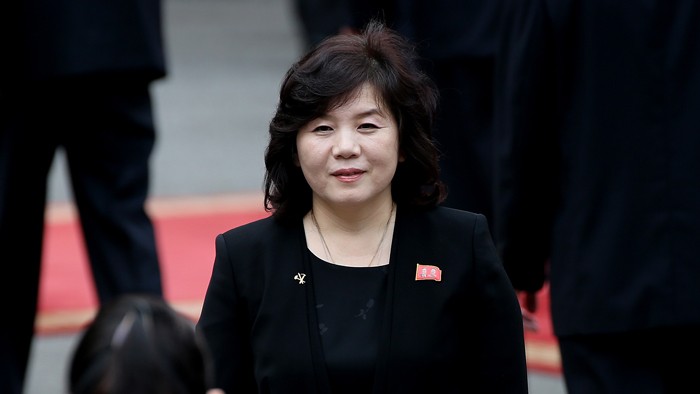
It has been eight days since North Korea resumed missile launches. Previously, on the 9th at 3:31 p.m., North Korea launched one SRBM toward the East Sea from Sukchon, South Pyongan Province, and remained quiet until this morning, when it carried out the provocation less than two hours after North Korean Foreign Minister Choe Son-hui issued a statement.
Foreign Minister Choe, who was promoted in June, released her first public statement. In it, she said, "The more the United States persists in 'strengthening the provision of extended deterrence,' and the more provocative and bluffing military activities are intensified on the Korean Peninsula and in the region, the more fierce our military response will be in direct proportion."
She also threatened, "A few days ago, the U.S., Japan, and South Korea held a trilateral summit and labeled our legitimate and justifiable military response measures, triggered by their aggressive war exercises, as 'provocations,' while rambling about 'strengthening extended deterrence' and 'strong and resolute responses.' We hereby issue a stern warning regarding this."
This appears to be a condemnation of the trilateral meeting held on the 13th in Phnom Penh, Cambodia, on the sidelines of the ASEAN (Association of Southeast Asian Nations) related summit attended by South Korean President Yoon Seok-yeol, U.S. President Joe Biden, and Japanese Prime Minister Fumio Kishida. At that time, the three countries issued a joint statement saying they would "cooperate to strengthen extended deterrence against North Korea" and warned that "if North Korea conducts a nuclear test, it will face a strong and resolute response from the international community."
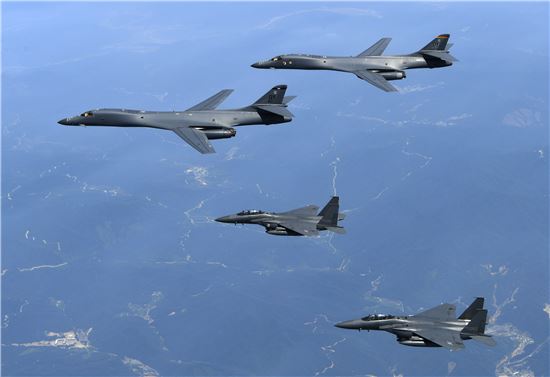 US Air Force Strategic Bomber B-1B
One of the U.S. extended deterrence means targeted by Foreign Minister Choe's statement is the deployment of the U.S. Air Force B-1B 'Lancer' strategic bomber and joint exercises around the Korean Peninsula. The B-1B was deployed to Guam last month, conducted training over the Korean Peninsula on the 5th of this month, and was forward-deployed to Misawa Air Base in Japan the day before, where it conducted field rapid refueling training, as disclosed by the U.S. Indo-Pacific Command.
Additionally, recent signs of refurbishment of the missile vertical engine test stand at the West Sea Satellite Launching Station in Dongchang-ri, Cholsan County, North Pyongan Province, have been detected, raising the possibility of long-range missile launches. Long-range missile launches capable of targeting the U.S. mainland are considered one of the cards to realize the "more fierce military response" mentioned by Foreign Minister Choe.
North Korea appears to be opposing the trilateral cooperation among South Korea, the U.S., and Japan while also signaling that it will not respond to South Korea's efforts to ease tensions. Previously, during the large-scale South Korea-U.S. joint air exercise 'Vigilant Storm,' North Korea strongly opposed by launching missiles crossing the Northern Limit Line (NLL) for the first time and firing about 35 missiles over four days from the 2nd to the 5th of this month.
However, the government strongly condemned North Korea's recent provocation but seemed to assign no special significance to it.
A senior official from the Presidential Office explained, "This is not a matter for a standing committee meeting," adding, "A security situation briefing meeting was held chaired by Lim Jong-deuk, the second deputy director of the National Security Office, and we are closely monitoring for any additional provocations." The Presidential Office previously held security situation briefing meetings instead of National Security Council (NSC) meetings during past missile launches, such as the rocket artillery launch on June 12 and the cruise missile launch on August 17.
Another official from the Presidential Office said, "We are analyzing North Korea's intentions," adding, "As always, we maintain a firm defense posture with the U.S. There is nothing particularly significant to assign meaning to."
© The Asia Business Daily(www.asiae.co.kr). All rights reserved.


















