[Asia Economy Reporter Kim Hyemin] The forecast that housing prices will decline in the first half of next year has been recorded at an all-time high level.
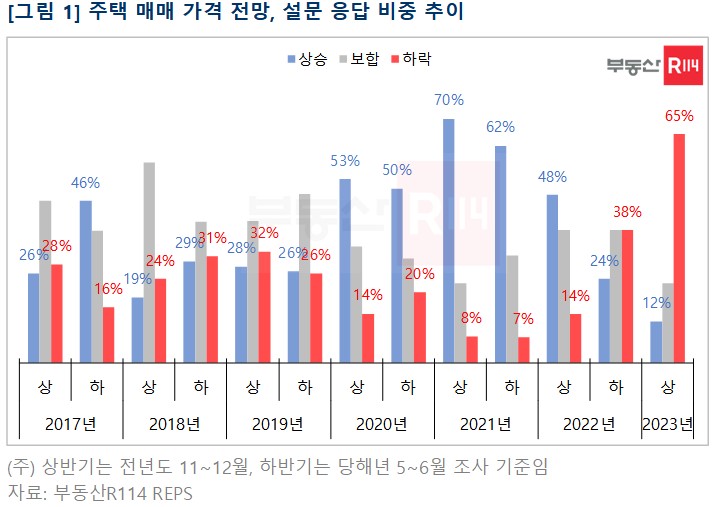
Real Estate R114 announced on the 17th that, based on a survey conducted from October 31 to November 14 targeting 1,738 people nationwide on the '2023 First Half Housing Market Outlook,' 6 out of 10 respondents predicted a decline in housing sale prices.
This is the highest level since related surveys began about 15 years ago in 2008. Compared to the same period last year and the previous survey, the proportion of respondents expecting a rise sharply decreased (48%→24%→12%), while those expecting a decline increased more than fourfold compared to the same period last year (14%→38%→65%). The proportion expecting stability was 22.7%, indicating a significant shift in consumer perspectives from expecting stability or increase to expecting a decline.
Among respondents who predicted a decline in sale prices, 32.4% cited the 'possibility of an economic recession,' and 30.8% pointed to the 'possibility of loan interest rate hikes' as the main reasons. This was followed by weakened buying demand due to loan regulations (12.4%), increased selling volume due to interest and tax burdens (11.7%), and transaction disappearance due to price burden (9.2%).
Among respondents forecasting a rise in housing prices, 30% cited a 'change in the rapid interest rate hike trend,' followed by price increases in high-end apartments in key areas (28.5%), influx of real demand mainly through urgent sales (9.7%), revitalization of redevelopment and reconstruction projects (8.7%), and expectations of government regulation easing (8.2%).
Regarding jeonse (long-term lease) prices, the forecast for decline (41.7%) exceeded that for increase (20.7%). However, the proportion expecting stability was also significant at 37.6%, indicating a relatively balanced outlook.
Those who chose a decline in jeonse prices cited 'risk of landlords returning tenant deposits' (23.8%) as the main reason. Real Estate R114 explained, "Concerns about 'empty jeonse' are growing in non-apartment housing such as villas, and in areas with many newly built units, the possibility of reverse jeonse is also increasing." On the other hand, among those expecting jeonse price increases, 42.7% anticipated that jeonse demand would rise due to weakened buying sentiment.
Respondents identified key variables affecting the housing market in the first half of next year as the Bank of Korea's decision on additional base rate hikes (23.5%) and external economic conditions such as the speed of domestic and international economic recovery (21.6%).
Yoon Jihae, Senior Researcher at Real Estate R114, stated, "With the U.S. Federal Reserve's giant step and the Bank of Korea's steady rate hikes, market mortgage loan interest rates have risen to around 7%, and further rate hikes are anticipated, increasing the burden of loan interest. Moreover, economic growth slowdown due to inflation and uncertainties in external economic conditions such as exchange rates and exports are significant."
Meanwhile, the margin of error for this survey is ±2.35 percentage points at a 95% confidence level.
© The Asia Business Daily(www.asiae.co.kr). All rights reserved.
![Clutching a Stolen Dior Bag, Saying "I Hate Being Poor but Real"... The Grotesque Con of a "Human Knockoff" [Slate]](https://cwcontent.asiae.co.kr/asiaresize/183/2026021902243444107_1771435474.jpg)
















