Sent Letter to Key US Congress Members and Cabinet Officials
Expressed Concerns Over Discriminatory Rules Against Foreign-Made Electric Vehicles in Purchase Tax Credit
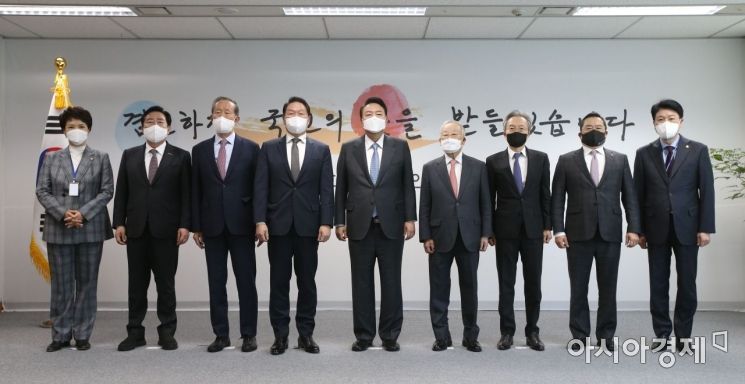 From the left, Kim Eun-hye, spokesperson; Kim Ki-moon, president of the Korea Federation of Small and Medium Business (Kbiz); Huh Chang-soo, chairman of the Federation of Korean Industries (FKI); Chey Tae-won, chairman of the Korea Chamber of Commerce and Industry (KCCI); President-elect Yoon; Sohn Kyung-shik, chairman of the Korea Employers Federation (KEF); Choi Jin-sik, chairman of the Korea Association of Mid-sized Companies; Koo Ja-yeol, chairman of the Korea International Trade Association (KITA); Jang Je-won, chief of staff.
 Photo by Asia Economy DB
[Asia Economy Reporter Han Ye-ju] As the U.S. midterm elections concluded last week, six major economic organizations sent a joint letter to key U.S. congressional leaders including House Speaker Nancy Pelosi (Democrat), Senator Mitch McConnell (Republican), and major executive branch ministers such as the Treasury and Commerce Departments. The letter expressed concerns over the discrimination against Korean-made electric vehicles in the U.S. Inflation Reduction Act (IRA), which took effect last August, and requested resolution through equal benefits for allied countries and a three-year implementation grace period.
The six economic organizations?Federation of Korean Industries (FKI), Korea Chamber of Commerce and Industry (KCCI), Korea International Trade Association (KITA), Korea Employers Federation (KEF), Korea Federation of SMEs, and Korea Federation of Medium-sized Enterprises?announced on the 17th that they sent a letter to key U.S. congressional leaders and ministers of the Treasury and Commerce Departments, expressing concerns about discriminatory provisions against Korean-made electric vehicles in the U.S. Inflation Reduction Act and requesting a resolution.
In the letter, the Korean business community emphasized that it has actively supported the expansion of economic cooperation between Korea and the U.S. from the signing of the Korea-U.S. FTA to participation in the Indo-Pacific Economic Framework (IPEF). Major domestic conglomerates such as Samsung Electronics, Hyundai Motor Company, SK, and LG Group have contributed not only by creating quality jobs and developing local communities in the U.S. through continuous investment but also by announcing large-scale investment plans this year, playing a pivotal role in bilateral economic cooperation.
They added that the current IRA provisions, which discriminate even against electric vehicles produced in allied countries, do not align with the spirit of strengthening cooperation between the two countries. They requested that the U.S. Congress and executive branch remove discriminatory elements so that the tax credit benefits, currently limited to North American-made electric vehicles and battery components, can be equally applied to companies from U.S. allied countries.
As an alternative, they requested the application of a "three-year grace period" for electric vehicle tax credit requirements, as proposed in a bill introduced by Senator Raphael Warnock and Representative Terri Sewell. They stressed that to continue greater cooperation between Korea and the U.S., the discriminatory electric vehicle tax credit issue must be resolved as soon as possible.
The Inflation Reduction Act was signed into immediate effect by President Biden on August 16. Accordingly, the tax credit benefits previously granted to all electric vehicles purchased in the U.S. now apply only to electric vehicles finally assembled in North America. Furthermore, starting in 2023, the U.S. Treasury Department guidelines require the use of a certain percentage of North American-made battery components, which poses a significant burden on domestic companies. This aspect of the IRA is known to potentially violate international trade norms and the Korea-U.S. FTA provisions.
Meanwhile, the joint letter from the six economic organizations was sent to 10 key members of the U.S. Congress and four cabinet ministers.
The Senate recipients included six members: Senator Chuck Schumer (Democrat), Senator Mitch McConnell (Republican), Senator Ron Wyden (Democrat), Senator Mike Crapo (Republican), Senator Patrick Leachy (Democrat), and Senator Richard Shelby (Republican). The House recipients included four members: House Speaker Nancy Pelosi (Democrat), Representative Kevin McCarthy (Republican), Representative Richard Neal (Democrat), and Representative Kevin Brady (Republican).
Key executive branch officials included Treasury Secretary Janet Yellen, Energy Secretary Jennifer Granholm, Commerce Secretary Gina Raimondo, and U.S. Trade Representative Katherine Tai.
© The Asia Business Daily(www.asiae.co.kr). All rights reserved.
![Clutching a Stolen Dior Bag, Saying "I Hate Being Poor but Real"... The Grotesque Con of a "Human Knockoff" [Slate]](https://cwcontent.asiae.co.kr/asiaresize/183/2026021902243444107_1771435474.jpg)















