Saudi Arabia, World's 2nd Largest Oil Producer, Exports 60%
Vulnerable to Global Oil Price Collapse... Trade Balance Down in 2020
Strengthening Exports in Non-Oil Construction and Manufacturing Sectors
Korea Expected to Rank 4th Among Saudi Trade Partners in Orders
〉
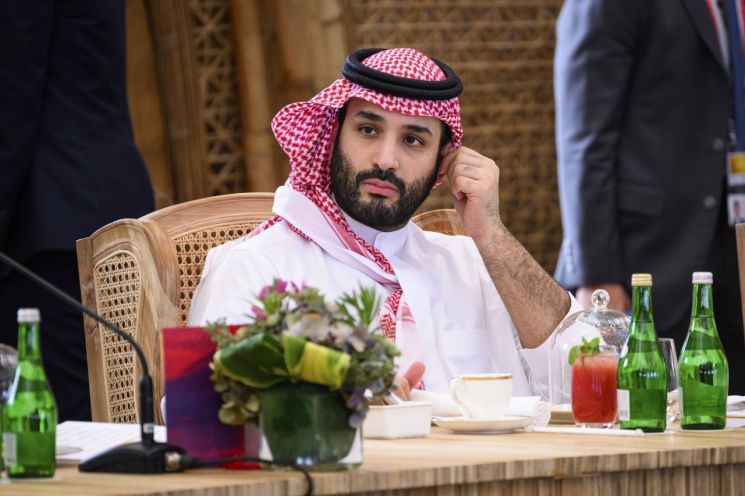
The recent visit of Crown Prince Mohammed bin Salman, the de facto ruler of Saudi Arabia, to South Korea aims to restructure the country's economy, which is heavily dependent on oil, and to lay the groundwork for next-generation growth engines suitable for the decarbonization era. The NEOM City construction project is a key initiative to secure a post-oil economic structure, represented by 'Vision 2030.' NEOM City is a nationwide project to build a futuristic eco-friendly city by investing $500 billion (approximately 668 trillion KRW) in a desert area of 26,500 square meters near the Red Sea. The residential and commercial city 'The Line,' operated entirely on renewable energy, and the offshore industrial city 'Oxagon' are expected to be about 44 times the size of Seoul.
The Saudi government's push for post-oil diversification stems from its traditionally vulnerable economic structure, which is highly sensitive to international oil price fluctuations. Saudi Arabia is the world's second-largest oil producer, with a daily crude oil production of 11.03 million barrels in 2020, accounting for 12.5% of global production. The oil sector accounts for more than 60% of total exports. In 2020, when international oil prices plummeted due to the COVID-19 pandemic, Saudi Arabia's imports fell by 9.9%, exports by 33.5%, and trade balance by 66.9% compared to the previous year, revealing the fragility of its economic structure.
It is analyzed that Crown Prince bin Salman, who ascended as the first heir to the throne in June 2017, is increasing engagement with major countries for the NEOM City project because he judged the recent recovery in international oil prices as an opportune moment to strengthen the project. In fact, Saudi Arabia's state-owned oil company Aramco recorded a net profit of $47.2 billion in the first half of last year, a 103% increase compared to the same period in 2020 ($23.2 billion), which was affected by the pandemic. Since Crown Prince bin Salman's rise, Saudi Arabia's non-oil economic indicators have also improved. According to the Saudi Statistics Authority, non-oil exports in the second quarter of last year reached $17.58 billion, up 9% from the previous quarter and 52% year-on-year. The number of new foreign investment licenses issued in the non-oil sector last year was 478, a 2.6% increase from the previous quarter, marking the highest level since 2005.
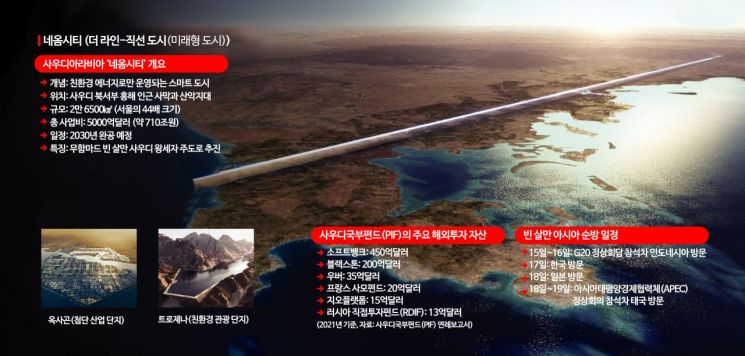
Saudi Arabia is restructuring its national economy by focusing on manufacturing sectors such as automobiles, shipbuilding, healthcare, defense, and ICT to replace oil. South Korea, along with the United States, China, Japan, and India, is named one of the five key partner countries for Saudi Arabia's 'Vision 2030' project to strengthen cooperation in top-tier technologies such as semiconductors, automobiles, and shipbuilding. South Korea (7.3%) ranks as Saudi Arabia's fourth-largest trading partner after China (19.4%), India (9.1%), and Japan (8.7%), and bilateral trade is expected to increase significantly following the NEOM City visit. As of January this year, South Korea's construction orders in Saudi Arabia amount to approximately $15.57 billion. The Saudi government is also strengthening efforts to attract foreign companies. Crown Prince bin Salman officially announced at the 'Future Investment Initiative Forum (FII)' last year that participation in government-ordered projects will require establishing a Middle East regional headquarters in Saudi Arabia. When establishing a regional headquarters, incentives such as economic zone residency, a 50-year corporate tax exemption, and a relaxed local employment quota for 10 years are offered.
On the 17th, coinciding with Crown Prince bin Salman's visit, the South Korean government and companies signed 25 investment and business memorandums of understanding (MOUs) with Saudi Arabia. The scale of projects agreed upon for cooperation between the two countries amounts to tens of trillions of won. The investment forum held at the Korea Chamber of Commerce and Industry International Conference Hall was attended by Lee Chang-yang, Minister of Trade, Industry and Energy, and Khalid Al-Falih, Saudi Minister of Investment. Notably, these MOUs are expected to directly benefit the domestic construction industry. According to market intelligence firm IHS Markit, while the global construction market is expected to grow by 4.0% next year compared to this year, the Middle East market is projected to grow by 14.4%. Additionally, major Korean companies such as Hyundai Rotem, cooperating on a 2.5 trillion KRW high-speed rail procurement project promoted by the Saudi Rail Authority, as well as Korea Electric Power Corporation, POSCO, and Samsung C&T in the hydrogen sector, along with future partner companies, are expected to benefit significantly.
© The Asia Business Daily(www.asiae.co.kr). All rights reserved.
![Clutching a Stolen Dior Bag, Saying "I Hate Being Poor but Real"... The Grotesque Con of a "Human Knockoff" [Slate]](https://cwcontent.asiae.co.kr/asiaresize/183/2026021902243444107_1771435474.jpg)
















