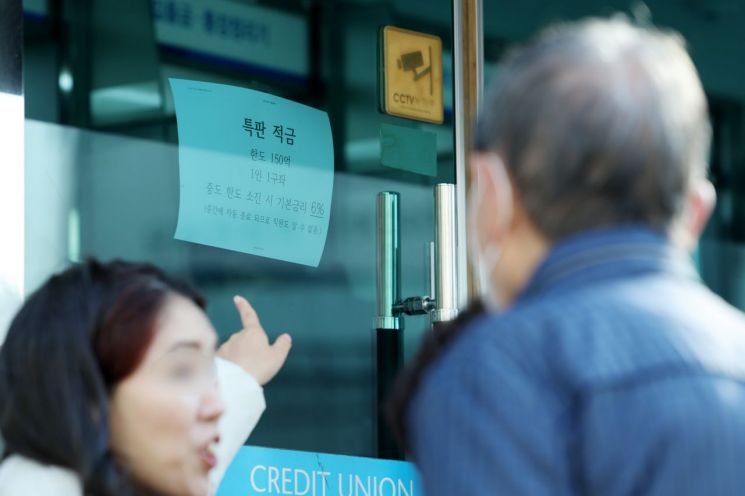
[Asia Economy Reporter Yu Je-hoon] The rapidly rising deposit interest rates of mutual savings banks have entered a "breather" phase. However, concerns remain that competition over deposit interest rates may reignite, as the Bank of Korea has announced additional base rate hikes within the year.
According to the Savings Banks Association's disclosure on the 17th, as of that date, the average interest rate on one-year fixed deposits in the mutual savings bank sector was 5.51%, up 1.02 percentage points (p) from the same period last month. Among savings banks, the six revolving fixed deposit products of Sangsangin and Sangsangin Plus Savings Banks offered the highest rate at 6.1%, while OSB and Must Samil Savings Banks also operated deposit products with interest rates in the 6% range.
The average interest rate on fixed deposits at savings banks rose rapidly, supported by the base rate hikes that began earlier this year. At the beginning of the year, the average fixed deposit rate at savings banks was only around 2.37%. By the end of the first quarter, it was about 2.51%, then increased to 3.07% in the second quarter and 3.86% in the third quarter, showing an accelerating trend.
Especially from the second half of this year, the pace accelerated further due to the bond market tightening triggered by the "Legoland incident" and the resulting deposit rate hikes by commercial banks. As the bond market froze and bank bond issuance declined, commercial banks raised deposit rates, and savings banks, which have no other means of raising funds besides deposits, quickly increased their interest rates. The average rate, which was 3.86% at the end of the third quarter, rose by 154 basis points (bp) to 5.40% by the end of last month, just one month later.
However, recently, this rapid rise appears to have entered a breather phase. The increase in the average rate over about two weeks since the end of last month was only around 11 bp. The upper limit of one-year fixed deposit product rates in the mutual savings bank sector, which once approached the mid-6% range, has also lowered to the low 6% range annually.
The primary reason for this breather is considered to be the financial authorities' request to refrain from excessive interest rate competition. To prevent liquidity tightening in the secondary financial sector, the financial authorities decided to maintain the loan-to-deposit ratio regulations for commercial banks and savings banks at 105% and 110%, respectively, for six months. A savings bank official said, "Looking at the top-tier savings banks, they have secured sufficient deposits through earlier deposit rate hikes and are maintaining loan-to-deposit ratios around 95-100%, so there is little reason for further rate increases." He added, "While circumstances may vary by savings bank, it is true that deposit interest rate competition has somewhat entered a breather phase."
However, with the Bank of Korea's Monetary Policy Committee meeting scheduled for next week, concerns remain that deposit rate competition could flare up again. Amid ongoing debates over a 25-50 bp rate hike, if commercial banks raise deposit rates following a base rate increase, savings banks will have no choice but to take corresponding measures. In this case, the current upper limit of deposit rates in savings banks, formed in the 6% range, could rise to 7%, according to some forecasts.
Banks are also repeatedly raising interest rates to secure funding, influenced by the financial authorities' requests to restrain bond issuance and the disclosure system for loan-deposit interest rate spreads. According to the Korea Financial Investment Association's Bond Information Center, net issuance of bank bonds was 7.46 trillion won in September, 260 billion won in October, but turned negative to -530 billion won this month. With bond issuance declining, banks have no choice but to absorb funds by raising deposit interest rates.
A mutual finance sector official said, "Although there is no specific regulation or basis, savings banks have generally maintained a deposit interest rate gap of around 0.7 to 1.0 percentage points compared to commercial banks to prevent fund outflows." He added, "If commercial banks raise deposit rates due to additional base rate hikes, it is difficult to rule out the possibility that competition will reignite among savings banks to maintain the interest rate gap."
© The Asia Business Daily(www.asiae.co.kr). All rights reserved.
![Clutching a Stolen Dior Bag, Saying "I Hate Being Poor but Real"... The Grotesque Con of a "Human Knockoff" [Slate]](https://cwcontent.asiae.co.kr/asiaresize/183/2026021902243444107_1771435474.jpg)















