211 Screen Quota Defense Materials Released by Video Archive
"Pieces of History... Discovering the Chronology as You Assemble Them"
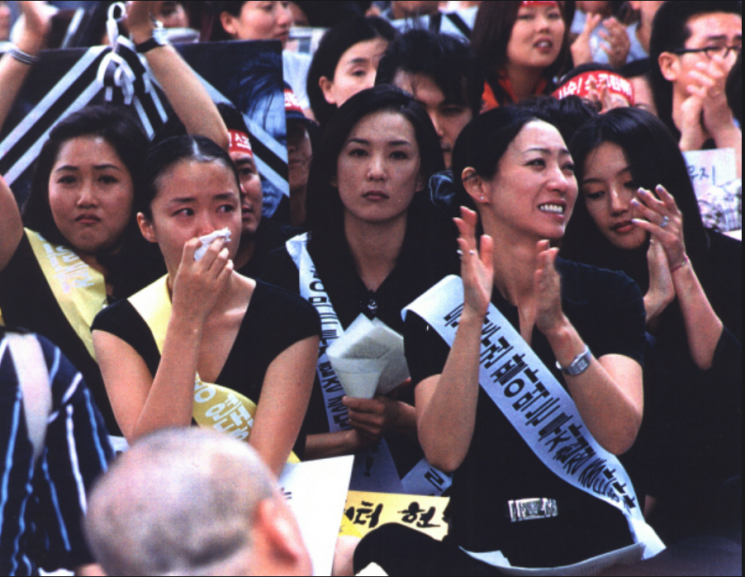 Actors Jeon Do-yeon, Bang Eun-jin, Jung Kyung-soon, Shim Hye-jin, and Kim Hye-soo participating in the nationwide film industry protest rally to prevent the reduction of the screen quota in 1999 (Photo by Jo Hee-moon, former chairman of the Korean Film Council)
Last year, movie theaters suffered from a severe drought. It was due to the prolonged COVID-19 pandemic. Social distancing, bans on eating and drinking inside screening rooms, and restrictions on admission times caused sales to plummet. The screen quota was also cited as a significant obstacle. It is a system that requires theaters to screen domestic films for a certain number of days annually to protect the country's film industry.
South Korea first introduced it in 1966. Initially, theaters in Seoul and Busan were required to screen Korean films for at least 90 and 60 days respectively. The standard was reduced to 30 days in 1970, then expanded to 121 days in 1973. It increased further to 146 days in 1985, then was reduced to 73 days in 2006, which remains the current standard.
Despite the similar mandatory screening days as when it was introduced, theaters expressed significant dissatisfaction. This was because many domestic producers and distributors indefinitely postponed the release of numerous works due to the impact of COVID-19. It became difficult to properly fulfill the screen quota.
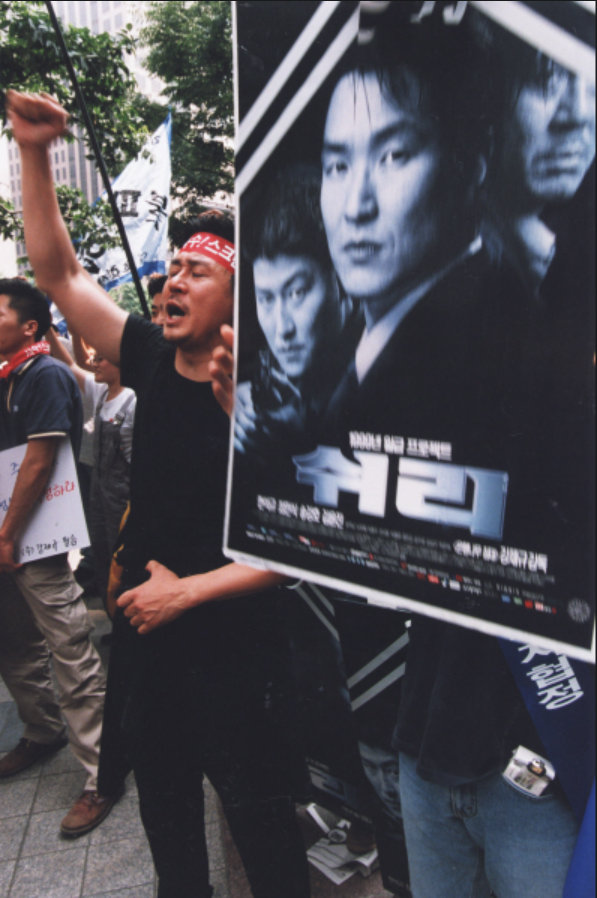 Actor Choi Min-sik, who participated in the nationwide film industry protest rally to prevent the reduction of the screen quota in 1999, is shouting slogans next to a 'Shiri' poster panel wrapped with a black band. (Photo by Jo Hee-moon, former chairman of the Korean Film Council)
Conflicts surrounding the screen quota occurred several times even before the spread of COVID-19. The opposing parties were theaters and producers. It sometimes escalated into resistance from the film industry against government institutional moves to reduce the mandatory screening days. The screen quota is a symbol of protectionism legislated to protect the domestic film market. By nature, it inevitably becomes an obstacle in market liberalization issues. The related discourse exists within the historical context of globalization and neoliberalism.
On the 16th, the Korean Film Archive released 211 related materials on the Korean Movie Database (KMDb) website. These are meaningful records that allow us to observe the flow of the movement to protect Korean films and defend the screen quota after the film market opened. The screen quota defense movement became full-fledged in the 1990s. However, nearly half of the materials point to the 1980s, encompassing the movement to block direct distribution of American films, which was almost the origin. Hence, the collection is named 'Film Market Opening and Screen Quota.'
Among the video materials are five documentaries produced to record the screen quota defense struggle and reveal the essence of film market opening, including 'Shooting the Sun with a Song - Records of the Screen Quota Defense Struggle (1999)', 'Dangerous Liaison, vol 2004 (2004)', and '146-73=Screen Quota + Korea-US FTA (2006)'. They include scenes of filmmakers gathered in front of the Korea Theater in Myeongdong, Seoul, opposing the screening of 'Dangerous Liaison (1987)', the first domestically directly distributed film in 1988, and collective head-shaving events to block screen quota reductions.
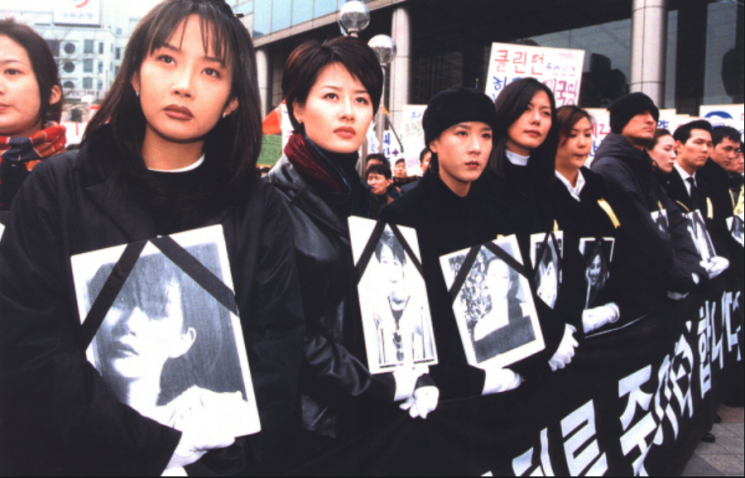 Actors Shim Eun-ha, Choi Jin-sil, Jung Sun-kyung, Kang Soo-yeon, Jin Hee-kyung, Ko So-young, Shin Hyun-joon, Shim Hye-jin, and Lee Jung-jae participated in the 1998 Korean film Killing Conspiracy protest rally. They are wearing black mourning clothes and holding condolence ribbons, as well as placards. (Photo by Jo Hee-moon, former chairman of the Korean Film Council)
The situation at the time can also be confirmed in 144 photographs. They show filmmakers holding placards and banners in front of Seoul Cinematown, which screened 'Ghost (1990)', and directors Kang Je-gyu and Im Soon-rye shaving their heads at the 1999 rally to oppose the conspiracy to reduce the screen quota. 'Ghost' was the first directly distributed film to enter theaters in downtown Seoul.
Documents such as the activity white paper and data book published by the Screen Quota Monitoring Group, and 'From the Peace Democratic Party - A Letter to the Filmmakers of This Land', which contains film-related pledges by Kim Dae-jung, the Peace Democratic Party candidate in the 1987 13th presidential election, are also evaluated as essential materials for reconstructing the overall history of popular culture.
Lee Ji-yoon, a researcher at the Korean Film Archive's Academic Research Team, introduced these as "pieces of history about what filmmakers tried to protect during the film market opening process since the 1980s and why they were so determined to protect it."
She added, "As you piece these fragments together, you will discover how the small voices of individual filmmakers gathered with like-minded comrades to create a greater resonance, and how individuals struggling alone became united, becoming stronger and more solid through solidarity."
© The Asia Business Daily(www.asiae.co.kr). All rights reserved.
![Clutching a Stolen Dior Bag, Saying "I Hate Being Poor but Real"... The Grotesque Con of a "Human Knockoff" [Slate]](https://cwcontent.asiae.co.kr/asiaresize/183/2026021902243444107_1771435474.jpg)

















