Loading 'Ammunition' Amid Strong Performance
Preparing for Surge in Global Demand
Cost Reduction Expected Through Production Facility Optimization
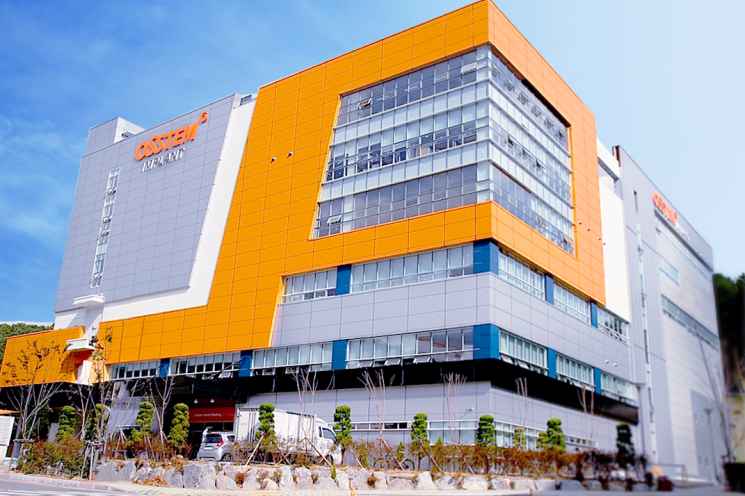 Exterior view of Orange Tower in Haeundae-gu, Busan, where Osstem Implant's Production Headquarters is located. [Photo by Osstem Implant]
[Asia Economy Reporter Lee Gwan-joo] Domestic medical device and bio companies have been expanding their production facilities one after another in the second half of this year. This is interpreted as a move to respond to the surge in global demand and secure future growth engines.
According to the related industry on the 17th, many bio companies are promoting the construction and expansion of production facilities both domestically and internationally. Osstem Implant decided to establish a second factory in Busan and has started expanding the production line of the premium implant ‘HIOSSEN’ in Philadelphia, USA. First, the second factory will be built in the Seokdae Advanced Industrial Complex in Busan, consisting of three buildings with a total floor area of 13,700㎡. The current annual production capacity of the first factory is 17 million sets, and once the second factory is completed, it will be able to produce 13 million sets annually, increasing the total annual implant production to 30 million sets.
The HIOSSEN US production headquarters plans to expand the existing facility of about 1,828㎡ by adding a 2,786㎡ building, creating a total production facility of 4,614㎡. Through this, they aim to increase HIOSSEN production by 58%. An Osstem Implant official explained, “To respond to the rapidly increasing demand and sales volume, we need to increase production by more than 20% annually, but we judged that the existing infrastructure has limitations. Our goal is to start full-scale product mass production at the second factory from the second half of next year.”
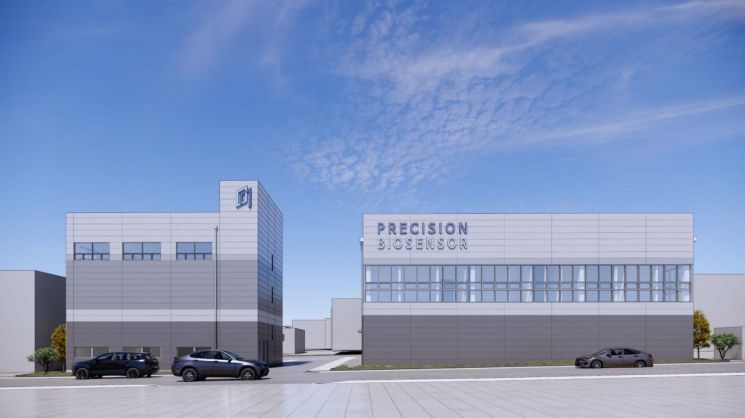 Elevation view of the second factory being developed by Precision Bio in Daejeon Daedeok Technovalley. [Photo by Precision Bio]
Precision Bio, a specialist in in vitro diagnostics, is promoting the establishment of a second factory with a total floor area of 2,975㎡ in Daejeon Daedeok Technovalley. The clinical chemistry cartridge production capacity of the second factory is 2.6 million units annually, which is 45% more than the existing first factory (1.8 million units). Through this expansion, Precision Bio plans to respond to increased demand and optimize production facilities to actively expand its scale. In fact, Precision Bio has been actively entering the North American market this year by signing a supply contract worth 118.2 billion KRW for animal clinical chemistry analyzers and cartridges with the global animal diagnostics company ‘Antech’.
Genome analysis company Macrogen recently held a groundbreaking ceremony for the ‘Macrogen Sejong Campus,’ the largest genome foundry in Korea. The Macrogen Sejong Campus will be built on a 3,570㎡ site within Sejong Tech Valley. A genome foundry refers to a platform that vertically integrates the genome business value chain from research and development to production, sales, marketing, and customers, thereby streamlining and accelerating the entire process. Macrogen plans to increase production capacity in the global market and secure competitiveness through cost reduction by automation with this construction.
Rootronic, a medical device company specializing in skin beauty, is also expanding its production facilities by investing 25 billion KRW to build a new building on the current headquarters site. The new building will have a total floor area of 16,075㎡ and is expected to begin construction within this year at the earliest, or by early next year at the latest, with completion scheduled for 2024.
© The Asia Business Daily(www.asiae.co.kr). All rights reserved.
![Clutching a Stolen Dior Bag, Saying "I Hate Being Poor but Real"... The Grotesque Con of a "Human Knockoff" [Slate]](https://cwcontent.asiae.co.kr/asiaresize/183/2026021902243444107_1771435474.jpg)
















