Current and Former Monetary Policy Committee Members Suggest Slowing Pace
Baby Steps Expected Ahead of Next Week's MPC Meeting
Large Korea-US Interest Rate Gap but Urgent Need for Domestic Financial Stability
Experts Also Express Concerns Over Inflation and Exchange Rates
"Potential Inflationary Pressure High... Possibility of Exchange Rate Rebound"
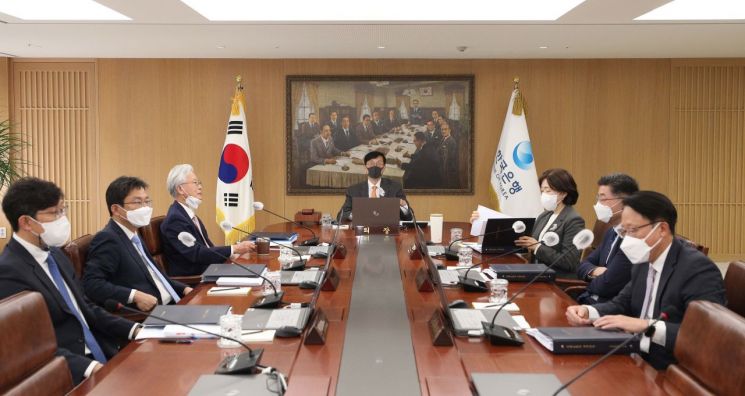
Changes are being detected in the Bank of Korea (BOK), which has maintained a tight monetary policy amid the sharp interest rate hikes and high inflation rates in the United States. As the won-dollar exchange rate falls to the 1,300 won level and concerns about domestic liquidity market tightening grow, voices calling for a 'slowdown in the pace of interest rate hikes' inside and outside the BOK are increasing. However, many experts still point out that there is a high possibility of the won-dollar exchange rate and inflation rebounding, and that the burden could increase due to the widening interest rate gap between Korea and the U.S., so concerns surrounding the BOK's monetary policy are expected to continue.
According to sources inside and outside the BOK on the 16th, unlike last month when a 'big step' (a 0.50 percentage point hike in the base interest rate) was taken, a 0.25 percentage point hike is likely at the Monetary Policy Committee meeting scheduled for the 24th. Monetary Policy Committee member Seo Young-kyung suggested the need to adjust the rate hike magnitude at a policy forum hosted by the National Economic Advisory Council and the Korean Finance Association the day before, saying, "We need to pay more attention to domestic financial stability now."
It is interpreted that while the BOK had previously raised rates sharply to maintain external financial stability such as the exchange rate, it now needs to consider domestic liquidity crisis situations and adjust the pace of hikes accordingly. In particular, Seo mentioned that the current interest rate gap between Korea and the U.S., which is about 1 percentage point, could widen further, confirming that the BOK will maintain a more accommodative stance than the U.S. Federal Reserve (Fed).
Professor Ham Jun-ho of Yonsei University's Graduate School of International Studies, a former Monetary Policy Committee member, also pointed out, "Monetary policy should focus on price stability while considering financial conditions," adding, "In the U.S., the proportion of fixed-rate household debt is high, so even if rates rise quickly, the tightening effect is not severe, but in Korea, the tightening effect is significant, so that situation must also be considered." This also implies the need to slow down the pace of rate hikes rather than sharp increases.
Earlier, Monetary Policy Committee member Park Ki-young also hinted at a slowdown on the 11th, saying, "Now is the time to consider financial stability as well," and as current and former committee members have voiced similar opinions, the analysis that the BOK's monetary policy stance is easing is gaining strength. Although the BOK still maintains the terminal rate at 3.5%, some in the market suggest it could be lowered to around 3.25% considering growth and financial stability.
The variables are the uncertainty of the won-dollar exchange rate and inflation trends. Although the won-dollar exchange rate has returned to the 1,300 won level, it remains high, and the inflation rate is still hovering around 5%. Professor Kang Sam-mo of Dongguk University's Department of Economics emphasized at a forum held the day before that despite the recent return of the won-dollar exchange rate to the 1,300 won level, the equilibrium won exchange rate is around 1,241 to 1,263 won, indicating that the won is undervalued. He said, "Some say it's okay because the exchange rate has dropped significantly in two weeks, but that's not the case," and added, "If a currency swap with the U.S. is difficult, efforts should be made to conclude one with other countries such as Japan."
Professor Jang Yong-sung of Seoul National University's Department of Economics also pointed out that the government's inflation rate does not adequately reflect owner-occupied housing costs and public institution deficits, emphasizing the need for a more proactive response. Professor Jang said, "Although there are signs that inflation is being controlled now, the potential pressure is enormous," and added, "Because uncertainty is high, inflation should be prioritized in operating monetary policy."
© The Asia Business Daily(www.asiae.co.kr). All rights reserved.
![Clutching a Stolen Dior Bag, Saying "I Hate Being Poor but Real"... The Grotesque Con of a "Human Knockoff" [Slate]](https://cwcontent.asiae.co.kr/asiaresize/183/2026021902243444107_1771435474.jpg)
















