On the 15th, the opposition party held and passed a bill review subcommittee meeting alone
Lease business operators excluded from mandatory protection measures
Overlap regulation issues in the Broadcasting Basic Act and the Information and Communications Network Act resolved
Industry welcomes overlap regulation resolution but fears reverse discrimination against overseas operators
 The National Assembly is accelerating the passage of a bill to prevent the recurrence of the 'Kakao outage incident.' The image shows Kakao's Pangyo Ajit in Seongnam-si, Gyeonggi-do, on the morning of the 17th of last month. [Image source=Yonhap News]
[Asia Economy reporters Cha Min-young and Lee Seung-jin] The National Assembly is accelerating the passage of legislative measures to prevent a recurrence of the 'Kakao outage incident.' At the Information and Communications Broadcasting Bill Review Subcommittee (2nd Subcommittee) held on the 15th by opposition party members alone within the National Assembly's Science, Technology, Information and Broadcasting and Communications Committee, five related bills were passed after coordination to resolve overlapping regulations. The IT industry evaluated that concerns about excessive regulation due to overlapping legislation have been partially alleviated.
The Amendment to the Basic Act on Broadcasting and Communications Development, Stalled Two Years Ago, Passes the Threshold
The 'Partial Amendment to the Basic Act on Broadcasting and Communications Development,' proposed by multiple lawmakers across party lines including Cho Seung-rae, Park Seong-jung, and Choi Seung-jae, passed the 2nd Subcommittee. The bill aims to require the Ministry of Science and ICT to include matters related to broadcasting and communication services of data center operators and value-added telecommunications service providers when establishing the basic plan for broadcasting and communication disaster management. Although discussed in 2020, it failed to pass the National Assembly and was pointed out as one of the causes of the Kakao incident. Instead of specifying the exact operators in the law, the bill delegates this authority to a presidential decree.
On the other hand, the 'Partial Amendment to the Act on Promotion of Information and Communications Network Utilization and Information Protection,' proposed by Democratic Party lawmaker Byun Jae-il, which included data center lessee operators like Kakao as subjects obligated to data center protection measures, was significantly revised. While the original bill included lessee operators, they were ultimately excluded. A National Assembly official stated, "There was an opinion that including lessee operators as subjects obligated to protection measures was somewhat excessive." The part where the industry raised concerns about overlapping regulations was also partially resolved. Since both the amendment to the Basic Act on Broadcasting and Communications Development and the amendment to the Information and Communications Network Act include protection measure inspections, if inspections are conducted under the Basic Act, operators are exempted from compliance inspections under the other bill (Information and Communications Network Act amendment).
The 'Partial Amendment to the Telecommunications Business Act,' which requires value-added telecommunications service providers to submit regular service stability implementation data and traffic volume to the Minister of Science and ICT, was passed with only detailed adjustments from the original draft. However, accepting the Ministry of Science and ICT's opinion, the scope of domestic agent duties was revised to include limited service stability implementation measures such as data submission and securing means of contact.
Korea Internet Corporations Association "Concerns of Reverse Discrimination"... American Chamber of Commerce in Korea "Burden Compared to Other Countries"
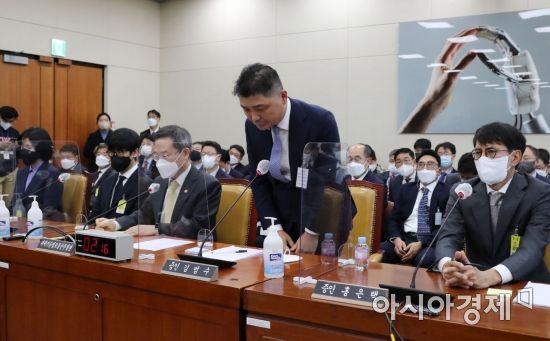 The National Assembly is accelerating the passage of a bill to prevent the recurrence of the 'Kakao blackout incident.' The photo shows Kim Beom-su, Head of the Kakao Future Initiative Center, attending a comprehensive audit of the Ministry of Science and ICT and related agencies held at the National Assembly on the 24th of last month, apologizing for the Kakao outage. Photo by Yoon Dong-ju doso7@
The Korea Internet Corporations Association, where Naver and Kakao serve as senior vice-chair companies, along with the American Chamber of Commerce in Korea (AMCHAM), have continuously voiced sharp criticism regarding the necessity of regulations following the Kakao incident. The Korea Internet Corporations Association has expressed that "imposing obligations on value-added telecommunications service providers that are meant for major broadcasting and telecommunications operators is excessive." They also pointed out issues of reverse discrimination between domestic and overseas data center operators and the ambiguity of the regulatory scope defined by 'presidential decree.' AMCHAM also expressed concerns, stating that "the regulations contained in the amendment to the Information and Communications Network Act are very burdensome compared to other countries."
While the industry expressed concerns about the National Assembly's Science, Technology, Information and Broadcasting and Communications Committee continuing to accelerate legislation, it showed a positive stance regarding the partial resolution of overlapping regulation issues. An IT industry official said, "It is fortunate that the overlapping regulation concerns have been revised," but added, "It is regrettable that the bills seem to be processed too quickly without a deeper hearing of the industry's views, especially amid recent controversies such as data center fires." Another official pointed out, "There are concerns about reverse discrimination with overseas operators," and added, "The development of the domestic data center industry, which is still in its growth phase, could lag significantly behind overseas."
However, since ruling party lawmakers from the People Power Party in the Science, Technology, Information and Broadcasting and Communications Committee did not attend the 2nd Subcommittee, it is uncertain whether the bills will pass the plenary session in the future. It is reported that the ruling party lawmakers boycotted the meeting in protest against the sole decision made by the 2nd Subcommittee chairperson.
© The Asia Business Daily(www.asiae.co.kr). All rights reserved.


















