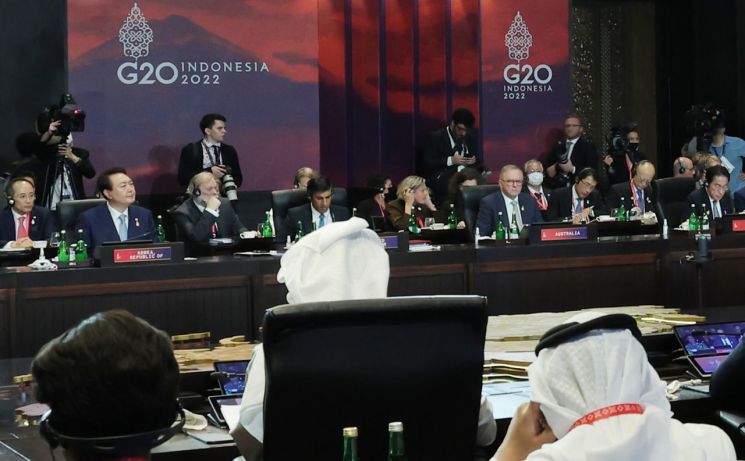
 President Yoon Suk-yeol is attending the first session (Food, Energy, Security) of the G20 Summit held at the Kempinski Hotel in Bali, Indonesia, on the 15th (local time). [Image source=Yonhap News]
[Asia Economy Reporter Kim Daehyun] The United States and the European Union (EU) have reportedly given a written commitment to the United Nations not to block exports of Russian grain and fertilizer.
On the 15th (local time), according to major foreign media, Sergey Lavrov, Russia's Foreign Minister attending the G20 summit held in Bali, Indonesia on behalf of President Vladimir Putin, met with UN Secretary-General Ant?nio Guterres to discuss the extension of the grain export agreement.
He told reporters that day that he explained to Secretary-General Guterres that obstacles remain in exporting Russian grain and fertilizer to the global market. He also said that Guterres had received a written promise from the United States and the European Union (EU) to remove these obstacles, emphasizing that if realized, all barriers to Russian grain and fertilizer exports would be eliminated.
Regarding Lavrov's remarks, there are opinions that Russia has conditionally agreed to extend the Black Sea grain export agreement, which expires on the 19th.
The United Nations is currently persuading Russia to extend the Black Sea grain export agreement. After Russia's invasion of Ukraine in February, Russia blocked Ukrainian grain exports through the Black Sea, but in July, exports through three Black Sea ports controlled by Ukraine resumed through mediation by the UN and T?rkiye (Turkey). At the time of the agreement, it was decided to normalize exports not only of Ukrainian grain but also Russian grain and fertilizer.
However, Russia has been responding passively to negotiations for the extension of the agreement. The reason is that the complex structure of Western countries' sanctions against Russia still restricts the export of its grain and fertilizer, making exports difficult.
© The Asia Business Daily(www.asiae.co.kr). All rights reserved.
![Clutching a Stolen Dior Bag, Saying "I Hate Being Poor but Real"... The Grotesque Con of a "Human Knockoff" [Slate]](https://cwcontent.asiae.co.kr/asiaresize/183/2026021902243444107_1771435474.jpg)















