Gongdae-wi "Education Budget Demand Does Not Decrease Despite Declining School-Age Population"
Emphasizes Need for Budget to Improve Overcrowded Classes and Aging Facilities
Opposition Criticizes Funding Methods as 'Showmanship'
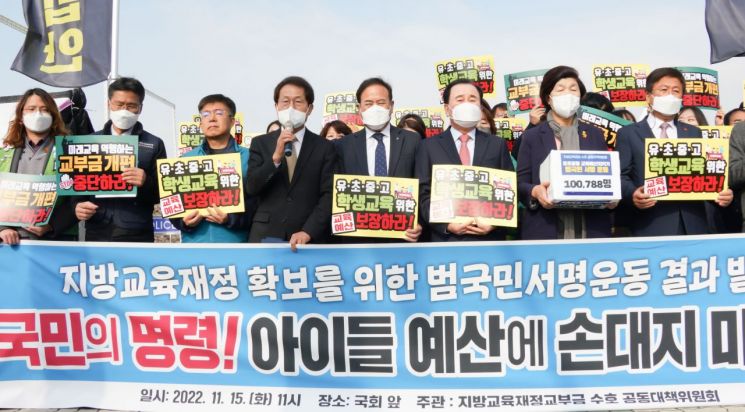 The Joint Countermeasure Committee for the Protection of Local Education Finance Grants held a press conference in front of the National Assembly on the 15th to announce the results of the nationwide signature campaign opposing the reform of the grants. (Photo by Yonhap News)
[Asia Economy Reporter Han Jinju] After the government announced a plan to establish a 'Special Account for Higher and Lifelong Education Support,' which involves investing a portion of the local education finance grants into higher education, the primary and secondary education sectors protested, and opposition parties also raised critical voices.
The Joint Countermeasure Committee to Protect Local Education Grants (JCC), which includes the Council of Superintendents of Education, teacher organizations, and teacher unions, held a press conference in front of the National Assembly on the 15th, pointing out that "population decline is an issue involving not only the Ministry of Education but also several other ministries, yet budgets for other ministries remain unchanged while budgets for students, who have no social voice, are being cut, which is unfair."
The JCC stated, "Despite the decrease in school-age population, the demand for education finance does not decrease. Grants are executed based on the number of classes," adding, "Overcrowded classes with more than 28 students account for 28% of all classes nationwide, and compulsory education is effectively being operated at half capacity, so the quality of education commensurate with the national economic scale must be guaranteed." According to the JCC, the number of students decreased by 370,000 (6.6%) from 5.69 million in 2017 to 5.32 million in 2021, but the number of schools increased from 16,357 to 16,710, and the number of classes rose from 238,958 to 243,521. If this special account is established, the grants will be reduced by 1 trillion won next year, 2.8 trillion won in 2024, 3 trillion won in 2026, and 3.1 trillion won in 2027.
The JCC emphasized, "Diverting part of the budget from early childhood, primary, and secondary education to support higher education is not a fundamental solution," urging, "The government must actively secure separate finances for higher and lifelong education sectors to ensure balanced investment in our education."
From the 24th of last month to the 14th, the JCC conducted a 'National Signature Campaign Against Grant Reduction,' which gathered 100,788 participants. After the press conference, the JCC delivered the signature results to the chairman of the National Assembly's Budget and Accounts Committee.
The Council of Superintendents of Education also opposed the special account bill. The Special Committee on Local Education Finance Grants of the Council urged, "We call for the National Assembly's proactive role in securing stable local education finance," and stated, "The Ministry of Finance and the Ministry of Education should engage in dialogue with parents of early childhood, primary, and secondary education students and the Council of Superintendents," adding, "More proactive budget investment reflecting future education demand is necessary."
Kim Ji-cheol, Superintendent of Chungnam Education Office, said, "Early childhood, primary, and secondary education can be compared to the sprout, root, and trunk of a tree, while higher education, university education, is like the flower," pointing out, "If the flower does not bloom properly and nutrients that should go to the roots are sent directly to the flower, the flower may bloom temporarily, but the tree with weakened roots will eventually become unstable."
On the same day, opposition lawmakers belonging to the Education Committee also issued a statement criticizing the announcement of the establishment of the Special Account for Higher and Lifelong Education Support as a 'push-through.'
Democratic Party and independent lawmakers of the Education Committee said, "The special account announced today can only be organized after three related bills pass the plenary session, but the government is prematurely announcing expenditure details and demanding review," criticizing, "Although we are prepared to go through normal review procedures such as public hearings, they are making unreasonable demands according to their schedule."
They added, "We understand the difficult financial situation of universities and will seek measures to support them during the budget review process," but emphasized, "If the government pushes the special account unilaterally and by unfair means while ignoring the opposition, we will definitely stand against it."
There were also criticisms that the government’s investment in response, excluding the transfer of grants previously allocated to primary and secondary education, is insufficient.
Democratic Party and independent lawmakers of the Education Committee said, "While taking 3 trillion won from the local education finance grants, which are resources for early childhood, primary, and secondary education, the additional national treasury increase was only 200 billion won," criticizing, "The special account was organized by increasing existing financial support projects without national tasks related to higher education. The 'Support for Advanced Teacher Training Programs' is essentially a project for education graduate schools, which Minister Lee Ju-ho has persistently advocated, and it is a serious issue that shakes the teacher training system, yet it was abruptly included."
The Justice Party Policy Committee acknowledged the need to expand higher education finances but pointed out, "The special account transfer from the finance authorities is 200 billion won, and considering higher education competitiveness, additional transfers through expenditure restructuring are recommended. The education tax transfer is 3.0398 trillion won, and we hope the government considers adding a higher education tax to corporate tax."
On the same day, the Ministry of Education and the Ministry of Economy and Finance announced the establishment of a 'Special Account for Higher and Lifelong Education Support' worth 11.2 trillion won. This involves converting 8 trillion won from the Ministry of Education's existing university support project budgets and the Ministry of Employment and Labor's support projects for Polytechnics and Korea University of Technology and Education, 3 trillion won from a portion of the education tax within the local education finance grants, and 200 billion won from general account transfers into the special account. Currently, local education finance grants are used for early childhood, primary, and secondary education budgets and consist of 20.79% of domestic taxes and a portion of the education tax.
© The Asia Business Daily(www.asiae.co.kr). All rights reserved.
![Clutching a Stolen Dior Bag, Saying "I Hate Being Poor but Real"... The Grotesque Con of a "Human Knockoff" [Slate]](https://cwcontent.asiae.co.kr/asiaresize/183/2026021902243444107_1771435474.jpg)















