Related Laws and Systems Lag Behind Industry Growth
Different Regulations Needed for Games to Encourage Creative Activities
Calls for Introducing Self-Regulation and Minimizing Regulations
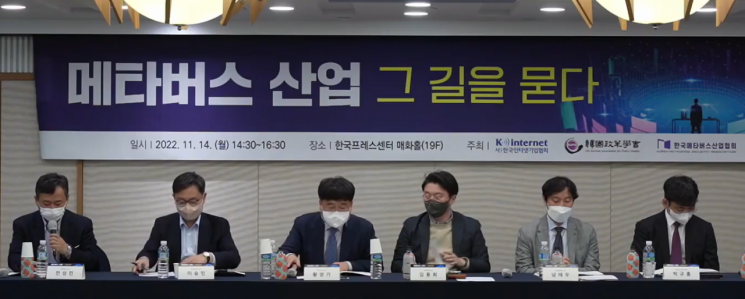 On the 14th, the seminar "Metaverse Industry, Asking the Way" was held at the Korea Press Center in Jung-gu, Seoul, hosted by the Digital Economy Research Institute of the Korea Internet Corporations Association.
[Asia Economy Reporter Seungjin Lee] An analysis has emerged predicting that the domestic metaverse (expanded virtual world) economy will reach approximately 250 trillion KRW by 2030. However, experts diagnose that regulatory reviews related to the metaverse industry are necessary to achieve such growth.
The Korea Internet Corporations Association held a seminar titled "Asking the Path of the Metaverse Industry" on the 14th, where experts from academia and industry engaged in related discussions.
Professor Seongmin Jeon of Gachon University’s College of Business, who presented at the seminar, analyzed Citigroup reports and other sources to forecast the domestic metaverse industry size in 2030 to be between a minimum of 196 trillion KRW and a maximum of 318 trillion KRW. According to the Citigroup report, the global metaverse economy is expected to reach up to 13 trillion USD by 2030, with South Korea accounting for 2% of that total.
He explained, “When connected with existing industries such as computers and scientific communications, the metaverse industry size will expand to 407 trillion KRW,” adding, “It is expected to create about 400,000 jobs, generate exports of approximately 60 trillion KRW, imports of about 50 trillion KRW, resulting in an overall surplus effect close to 10 trillion KRW.”
While the metaverse industry is rapidly growing, there are criticisms that discussions on related laws and systems are slow. Professor Seungmin Lee of Sungkyunkwan University School of Law pointed out the domestic perspective that equates metaverse with games, arguing, “It is not appropriate to treat content and creations produced by creators within the metaverse as games.”
Professor Lee stated that separate regulations should be applied not only to metaverse platforms themselves, such as Zepeto (Naver) and Ifland (SK Telecom), but also to the content freely produced by creators within them. He expressed concerns that the foundational creative activities of the metaverse could be stifled.
He cited the 2018 virtual reality (VR) film "White Rabbit" as an example, saying, “The film, which was screened at the Cannes Film Festival at the time, was classified as a game domestically and thus could not be shown in theaters,” emphasizing, “A minimum safety mechanism is needed to sustain the metaverse business model.”
He added, “It is necessary to consider self-regulation in terms of regulations that align with global standards and effectiveness,” and said, “Establishing rating classification standards that consider the unique characteristics of virtual convergence technology and the metaverse, along with self-regulation by platform operators, could be the solution.”
The Korea Metaverse Industry Association also voiced a unified call for regulatory reform related to the metaverse. Domestically, if ‘game elements’ are included within the metaverse, release is not possible without classification by the Game Rating and Administration Committee. Furthermore, various follow-up regulations such as prohibition of gambling, measures to prevent over-immersion, and bans on game provision businesses within educational environment protection zones are in place.
Kim Gunju, Deputy Director of the Korea Metaverse Industry Association, who participated as a panelist, emphasized, “If the entire content’s main purpose is gaming, it is appropriate to classify it as a game, but a basic principle must be established not to apply game laws to content whose primary purpose is not gaming.”
He continued, “Metaverse is a new industry, so discussing the applicability of existing regulations is inappropriate,” adding, “In the early stages of growth for a new industry, priority should be given to applying ‘self-regulation’ and minimizing regulations.”
Meanwhile, in response to repeated industry criticisms, the government began preparing guidelines in September to distinguish between metaverse and games. The National Data Policy Committee, chaired by Prime Minister Han Duck-soo, plans to establish guidelines within the year and support the enactment of a Metaverse Special Act, including terminology definitions and self-regulation, as well as legislation to promote metaverse content for the development of the metaverse industry.
© The Asia Business Daily(www.asiae.co.kr). All rights reserved.
![Clutching a Stolen Dior Bag, Saying "I Hate Being Poor but Real"... The Grotesque Con of a "Human Knockoff" [Slate]](https://cwcontent.asiae.co.kr/asiaresize/183/2026021902243444107_1771435474.jpg)















