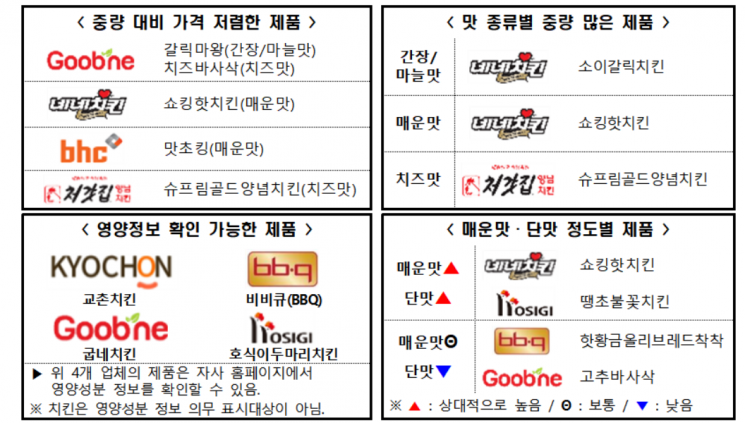
 A table created based on the survey results of 10 franchise chicken brand products by the Korea Consumer Agency. (Photo by Korea Consumer Agency)
[Asia Economy Reporter Jeon Jinyoung] The Korea Consumer Agency announced on the 15th that the nutritional content of one whole chicken from 10 popular franchise chicken brands exceeded the daily intake standards. Significant differences in product weight were also observed.
According to the Consumer Agency, the calorie content of one whole chicken ranged from 1,554 kcal to 3,103 kcal, accounting for 78% to as much as 155% of the estimated daily energy requirement of 2,000 kcal for an adult woman.
The amounts of the three major nutrients were carbohydrates 45g to 282g (14% to 87% of the daily nutrient reference value), protein 128g to 175g (233% to 318%), and fat 71g to 174g (131% to 322%). Saturated fat ranged from 13g to 49g, accounting for 87% to 327% of the daily standard, cholesterol was 541mg to 909mg (180% to 303%), sodium was 1,272mg to 4,828mg (64% to 241%), and sugars ranged from 5g to 201g (5% to 201%).
Calorie-wise, Nene Chicken’s ‘Shocking Hot Chicken’ was the highest at 155% of the daily estimated amount, while Goobne Chicken’s ‘Gochu Basasak’ was the lowest at 78% of the daily estimate.
For saturated fat, Nene Chicken’s ‘Cheese Snowing’ was the highest at 327% of the daily standard, while Hosigi Dumari Chicken’s ‘Soy Sauce Chicken’ and Kyochon Chicken’s ‘Kyochon Red Original’ were the lowest at 87% of the daily standard.
Cholesterol was highest in Goobne Chicken’s ‘Cheese Basasak’ at 303% of the daily standard. Even the lowest content product, BBQ’s ‘Soy Garlic X,’ reached 180% of the daily standard.
There were also large differences in weight by product. Nene Chicken’s Shocking Hot Chicken weighed 1,234g, and Cheogajip Yangnyeom Chicken’s ‘Supreme Gold Yangnyeom Chicken’ weighed 1,101g, which were on the heavier side, while Kyochon Chicken’s ‘Kyochon Original’ weighed 625g and Hosigi Dumari Chicken’s ‘Soy Sauce Chicken’ weighed 679g.
The Consumer Agency stated, “If companies display nutritional information on their websites, consumers should refer to that information to check the nutritional content of the products and adjust their intake accordingly.”
© The Asia Business Daily(www.asiae.co.kr). All rights reserved.
![Clutching a Stolen Dior Bag, Saying "I Hate Being Poor but Real"... The Grotesque Con of a "Human Knockoff" [Slate]](https://cwcontent.asiae.co.kr/asiaresize/183/2026021902243444107_1771435474.jpg)















