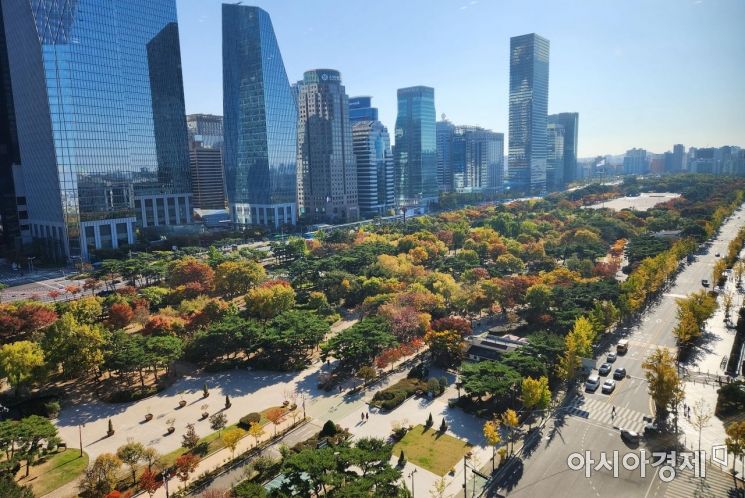
 On the 24th, when the weather was fully autumnal, the foliage in Yeouido Park, Seoul, turned red./Photo by Hyunmin Kim kimhyun81@
[Asia Economy Reporter Kwon Jae-hee] This year, major securities firms are expanding the scale of their own short-term promissory notes based on their own credit. As liquidity securing becomes urgent due to the tightening of the short-term money market, it is interpreted that they are making every effort to raise funds by mobilizing even the promissory note funding sources.
On the 13th, an analysis of the promissory note balances of major securities firms capable of issuing promissory notes?Mirae Asset Securities, Korea Investment & Securities, NH Investment & Securities, and KB Securities?showed that the recent balances of all four companies have increased significantly compared to the end of last year.
The largest increase was seen at Mirae Asset Securities. As of the end of last year, it was 436.5 billion KRW, but by the end of September, it surged more than tenfold to 4.4232 trillion KRW.
During the same period, NH Investment & Securities also increased by 58.8%, from about 3.4 trillion KRW to 5.4 trillion KRW, and KB Securities expanded by 51.6%, from 4.4745 trillion KRW to 6.7844 trillion KRW.
Currently, Korea Investment & Securities holds the largest amount of promissory note balance. As of the end of last month, it was 12.199 trillion KRW, up 45.7% from 8.3719 trillion KRW at the end of last year.
Promissory notes are short-term financial products within one year issued by large securities firms with a capital of over 4 trillion KRW, based on their own credit.
Only four large firms?Mirae Asset Securities, Korea Investment & Securities, NH Investment & Securities, and KB Securities?have been authorized to issue promissory notes. They can issue promissory notes up to 200% of their own capital.
The interest rates of promissory note products from these four companies vary slightly depending on the type but mostly record rates in the 5% range. However, recently KB Securities launched a special promissory note with a fixed annual interest rate of 6%, and it is known that one securities firm is selling special promissory notes with interest rates in the 8% range to high-net-worth individuals through some branches.
The recent rapid increase in the scale of promissory notes is closely related to the liquidity drought plaguing the securities industry.
Starting with the Legoland Asset-Backed Commercial Paper (ABCP) incident, as investment sentiment in the short-term money market sharply cooled and refinancing of PF ABCP became difficult, liquidity tightening risks have also emerged for securities firms actively engaged in related businesses.
Hwang Se-woon, Senior Research Fellow at the Korea Capital Market Institute, analyzed, "Currently, securities firms are desperate for funding sources, and for large firms, the attractiveness and utilization of promissory notes inevitably increase."
There is also an aspect of trying to use the current interest rate hike period as an opportunity to attract customers or invest.
From the securities firms’ perspective, if they secure as many customers as possible by promoting the high interest rates of promissory notes, they can attract other transactions, and if they have funding capacity through promissory notes, they can invest in high-interest products to generate profits for the securities firms themselves.
However, some voices express concern about the rapid increase in promissory notes.
An industry insider explained, "For a securities firm to make a profit from promissory notes, it must invest in products with higher yields than the interest rates offered to customers to leave a margin. If a firm issues promissory notes with excessively high interest rates, it may not be to make a profit but rather a signal that they urgently need money."
© The Asia Business Daily(www.asiae.co.kr). All rights reserved.
![Clutching a Stolen Dior Bag, Saying "I Hate Being Poor but Real"... The Grotesque Con of a "Human Knockoff" [Slate]](https://cwcontent.asiae.co.kr/asiaresize/183/2026021902243444107_1771435474.jpg)















