Our Military's Solo Command Post Exercise Ends Today
North Korea Criticizes Daily and Launches Missiles
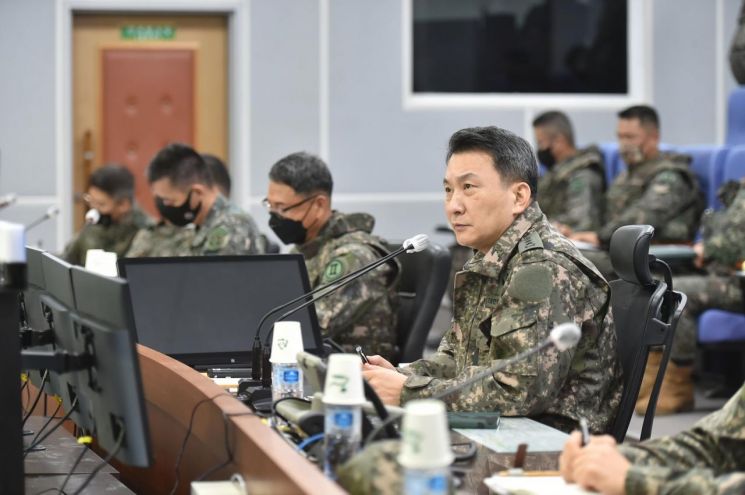
[Asia Economy Reporter Jang Hee-jun] South Korea's independent command post exercise (CPX), the Taeguk Exercise, designed to prepare for various threats including North Korea's nuclear and missile threats, will conclude on the fourth day of training, the 10th. The military is closely monitoring North Korea's movements, which resumed provocations by launching ballistic missiles on the third day of the exercise, and is maintaining a readiness posture against possible additional provocations.
The Joint Chiefs of Staff announced that the Taeguk Exercise, which began on the 7th of this month, will end today.
The military practiced realistic mission execution capabilities by assuming various threats such as North Korea's nuclear and missile threats and recent provocation patterns during this Taeguk Exercise. The Joint Chiefs of Staff and the Army, Navy, and Air Force operational commands formed combat staff groups for the exercise, and other necessary units participated by organizing response teams.
The Taeguk Exercise was conducted as a 'wargame' using computer simulation (CPX) without mobilizing troops or equipment.
Nevertheless, North Korea condemned the Taeguk Exercise daily through external propaganda media and carried out missile provocations on the third day of the training. Four days after launching a short-range ballistic missile (SRBM) on the 5th, North Korea again fired an SRBM into the East Sea from the Sukchon area in South Pyongan Province the day before.
Prior to that, North Korea fired more than 33 missiles from the 2nd to the 5th of this month in response to the South Korea-U.S. joint air exercise 'Vigilant Storm.' Among these, one missile fell south of the Northern Limit Line (NLL) in the East Sea for the first time since the division of Korea, causing an unprecedented air raid alert across Ulleungdo Island.
The Taeguk Exercise traditionally took place in May to June but was postponed to October in 2018 considering inter-Korean and North Korea-U.S. dialogues. In 2019, it was integrated with the government exercise Eulji Exercise and conducted as the Eulji-Taeguk Exercise in May. In 2020, it was not held due to the spread of COVID-19 and flood damage, and last year it was conducted as the Eulji-Taeguk Exercise at the end of October.
This year, with the Eulji Exercise running concurrently during the South Korea-U.S. joint UFS (Ulchi Freedom Shield) in August, the Taeguk Exercise was conducted independently again for the first time in four years.
Meanwhile, starting with UFS in August, the military has continued large-scale monthly exercises for four consecutive months, including joint maritime exercises and anti-submarine warfare training in September with the participation of the U.S. nuclear-powered aircraft carrier Ronald Reagan (CVN-76), the Defense Training and West Sea Joint Maritime Exercise in October, and Vigilant Storm in November.
North Korea has also responded with missile launches by tactical nuclear units, artillery fire from naval buffer zone artillery units, and large-scale air power demonstrations during South Korea's independent or South Korea-U.S. and South Korea-U.S.-Japan joint exercises since August.
© The Asia Business Daily(www.asiae.co.kr). All rights reserved.

















