Volkswagen Files New Hydrogen Fuel Cell Patent... BMW Also Plans Mass Production Soon
Hyundai's Nexo Holds 58.7% Market Share Globally, Toyota's Mirai Records 18.2%
[Asia Economy Reporter Kim Junran] As Volkswagen and BMW are reportedly entering the hydrogen vehicle market, there are forecasts that the global hydrogen vehicle market will grow.
According to the automotive industry on the 9th, Volkswagen recently developed a hydrogen fuel cell in collaboration with the German energy company Kraftwerk and filed a patent in Germany. Until now, Volkswagen had maintained a skeptical stance on hydrogen vehicle production. Herbert Diess, Volkswagen's CEO who resigned in July, repeatedly stated, "There will be no situation where Volkswagen hydrogen electric vehicles are seen in the market," and "Hydrogen vehicles cannot be a solution to climate change."
Volkswagen's recent patent involves making the membrane (polymer electrolyte membrane, PEM), a core material of fuel cells for hydrogen vehicles, out of ceramic instead of polymer. Ceramic fuel cells have the advantage of being produced more cheaply as they do not contain platinum. The maximum driving range per charge is 2,000 km, and the hydrogen vehicle equipped with this fuel cell is scheduled to be released in 2026. If Volkswagen produces hydrogen vehicles using this fuel cell, it will be the group's first mass-produced hydrogen vehicle.
BMW is also preparing for mass production of hydrogen vehicles. Last year, it unveiled the hydrogen vehicle concept car 'iX5' and announced a mass production target for 2025. BMW has been developing hydrogen vehicles under the stance that the answer to zero carbon emissions is better to have two (electric vehicles and hydrogen vehicles) rather than just one (electric vehicles). Recently, Oliver Zipse, BMW's CEO, predicted in an interview with Bloomberg that "the next trend after electric vehicles is hydrogen vehicles."
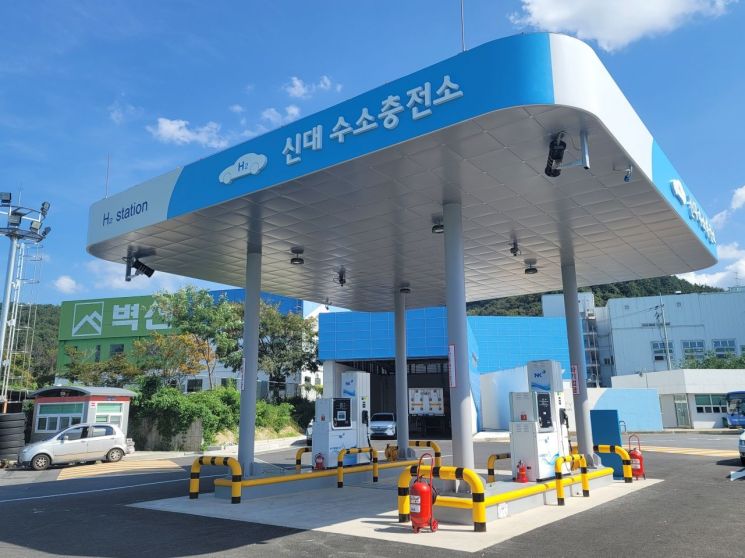
In fact, hydrogen vehicles have faster refueling times compared to electric vehicles. Electric vehicles require 30 minutes to 1 hour for fast charging, whereas hydrogen vehicles only need 5 minutes. The maximum driving range per charge is also longer than that of electric vehicles. This is why hydrogen vehicles have the potential to grow sufficiently in the market. On the other hand, hydrogen refueling stations lack infrastructure, and hydrogen vehicles are more expensive than electric vehicles based on the same performance.
Currently, the companies selling hydrogen vehicles in the global market are limited to Hyundai Motor and Toyota. According to SNE Research, global hydrogen vehicle sales from January to September this year totaled 14,400 units. Hyundai's 'Nexo' recorded sales of 8,499 units, accounting for a 58.7% market share, while Toyota's 'Mirai' recorded 2,619 units, accounting for an 18.2% market share.
Compared to electric vehicles, the global hydrogen vehicle market is stagnant, but countries are accelerating the hydrogen economy and speeding up the use of alternative energy. The EU passed a bill mandating the installation of hydrogen refueling stations every 100 km on major European highways by 2028. Accordingly, the current approximately 150 hydrogen refueling stations are expected to increase to more than 1,500 by 2030. China also announced plans earlier this year to supply 100,000 hydrogen vehicles by 2025 and 1 million hydrogen vehicles by 2030.
In South Korea, infrastructure related to hydrogen vehicles is falling short of government targets. The hydrogen vehicle market is evaluated as sluggish. According to the 'Hydrogen Economy Activation Roadmap' announced by the government in 2019, the target for hydrogen vehicle supply is a total of 81,000 units. However, as of August, hydrogen vehicle supply was only 25,570 units.
Hydrogen refueling stations are also insufficient. According to the Ministry of Environment's 'Zero Emission Vehicle Integrated Website,' as of the 8th of this month, there are only 126 hydrogen refueling stations nationwide. By region, Jeollanam-do has 4 stations, and Gyeongsangbuk-do has only 3 stations. South Korea's budget for hydrogen refueling station installation next year has also been set at 189.5 billion KRW, a 3.8% decrease from this year.
© The Asia Business Daily(www.asiae.co.kr). All rights reserved.
![Clutching a Stolen Dior Bag, Saying "I Hate Being Poor but Real"... The Grotesque Con of a "Human Knockoff" [Slate]](https://cwcontent.asiae.co.kr/asiaresize/183/2026021902243444107_1771435474.jpg)















