Prime Minister Han Deok-su Chairs the '2nd Regulatory Innovation Strategy Meeting'
Announces 12 Tasks for Digital Industry Regulatory Innovation
Supply of Frequency for Wireless Charging of Electric Vehicles
Expecting 1,000 Uses for 'Ieum 5G'
[Asia Economy Reporter Cha Min-young] Next year, a wireless charging method for electric vehicles that does not require plug connection or card tagging will be commercialized. The frequency supply procedure for 'Ieum 5G (5G specialized network)' will be simplified, and the wireless equipment permit procedure for robots, intelligent CCTVs, and others will also be abolished. The government plans to induce more than 3 trillion KRW in private investment by 2030 through such digital industry regulatory relaxation.
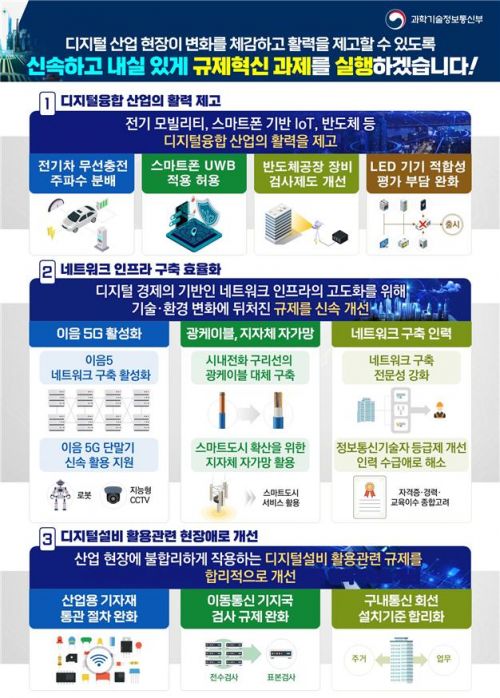
On the 9th, the Ministry of Science and ICT announced 12 regulatory innovation tasks to revitalize the digital industry at the 2nd Regulatory Innovation Strategy Meeting held at the Incheon Seongwang New Container Terminal, chaired by Prime Minister Han Duck-soo.
These tasks were selected based on recommendations from industries and local governments such as the Korea Chamber of Commerce and Industry, the Korea Federation of SMEs, and the Korea Information and Communication Contractors Association, to prevent falling behind in the fierce global digital technology competition due to outdated regulations.
Allowing Frequency-Based Wireless Charging for Electric Vehicles
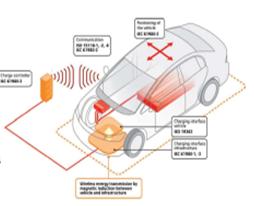 Establish a foundation for device commercialization by allocating frequencies for wireless charging of electric vehicles.
First, wireless charging technology, which is considered a key to the spread of electric vehicles because it does not require plug connection or card tagging during charging, will be commercialized. Since wireless charging requires activated frequencies, the government plans to supply a dedicated frequency (85kHz) by the end of the year. Originally, electric vehicle wireless charging technology was temporarily permitted in September 2021 under a regulatory sandbox such as a demonstration exception. Through this revision of the notification, a foundation for device commercialization has been established.
The government also decided to permit the use of low-power, ultra-precise ultra-wideband (UWB) wireless technology portable devices that, when embedded in smartphones, enable more convenient use of Internet of Things services such as smart door lock operation and lost item search. Globally, UWB devices are expected to surge from 317 million units last year to 1.8 billion units by 2030, with smartphone-linked devices exceeding 65%. However, in Korea, the use of portable devices with bandwidth exceeding 500 MHz has been restricted due to concerns about frequency interference with aircraft, ships, and others. Going forward, portable devices equipped with a function that automatically disables operation when entering areas with frequency interference concerns will be allowed to have this feature.
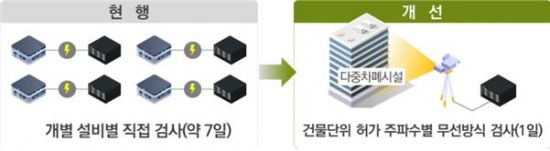 The inspection of radio equipment in semiconductor factories will be improved to a building-level inspection method.
The government will also simplify the inspection procedure for radio equipment used in semiconductor manufacturing facilities by shifting from inspecting each device separately to inspecting by building unit outside the building. This is expected to reduce inspection time from the current 7 days to 1 day and reduce the inconvenience of halting each process during inspection.
Simplification of Frequency Supply Procedures for 'Ieum 5G'
In particular, the government aims to activate the 'Ieum 5G service,' which allows entities other than mobile carriers to directly install and use 5G networks on land or building units, by simplifying the frequency supply procedures compared to now and abolishing the wireless station permit procedure for terminals connected to Ieum 5G such as robots and intelligent CCTVs, similar to smartphones. The Ministry of Science and ICT expects that through this, 1,000 5G specialized networks will be established by 2030, and investments of 3 trillion KRW will be promoted.
Additionally, the government will allow internet phone services via optical cables when newly installing wired telephones, which were previously only permitted based on copper wire. The Ministry of Science and ICT expects this to promote broadband communication network investments worth approximately 250 billion KRW.
For low-power wireless charging devices with low electromagnetic wave hazards, a product-specific certification system will be introduced step-by-step, allowing the same type of device to receive electromagnetic compatibility certification only once. For LED lighting devices and others that had to undergo electromagnetic compatibility testing and registration for each product despite low electromagnetic wave risks, a voluntary regulation called the 'Electromagnetic Self-Declaration System' will be introduced.
The government will enhance the expertise of network construction personnel and resolve supply and demand difficulties. First, information and communication experts will be allowed to perform design and supervision of information and communication facilities within buildings. The recognition criteria for the 'special grade' of information and communication engineers will be improved to alleviate difficulties in securing technical personnel due to workforce aging.
Improvement of Regulations Related to Digital Equipment Utilization
Electromagnetic compatibility evaluation will be exempted for imported radio parts and other industrial equipment. Previously, small quantities of industrial equipment used for special purposes in industrial sites had minimal impact on daily life such as electromagnetic waves, but there were issues such as customs clearance delays due to conformity evaluation requirements. The method of wireless station change inspection will also be improved from full inspection to sample inspection. Furthermore, the installation standards for in-building communication lines in residential officetels will be improved from business use to residential use.
The government plans to complete all related legal amendments for these regulatory improvements by next year at the latest. The Ministry of Science and ICT will promptly complete regulatory improvements that can be done at the ministry level through government notifications and enforcement decrees, and also plans to complete all necessary related law amendments in the National Assembly within next year.
The government expects that by 2030, implementing Ieum 5G activation, promoting optical cable construction, and improving semiconductor production facility operation rates will result in more than 3.25 trillion KRW in private investment. Minister Lee Jong-ho of the Ministry of Science and ICT said, "We will boldly and swiftly reform digital industry regulations to revitalize industrial sites and lay the foundation to become a model digital nation."
Meanwhile, the Korea Information and Communication Contractors Association issued a statement on the day expressing expectations, saying, "The regulatory innovation measures announced by the Ministry of Science and ICT appropriately reflect the continuous requests of the information and communication construction industry."
© The Asia Business Daily(www.asiae.co.kr). All rights reserved.
![Clutching a Stolen Dior Bag, Saying "I Hate Being Poor but Real"... The Grotesque Con of a "Human Knockoff" [Slate]](https://cwcontent.asiae.co.kr/asiaresize/183/2026021902243444107_1771435474.jpg)

















