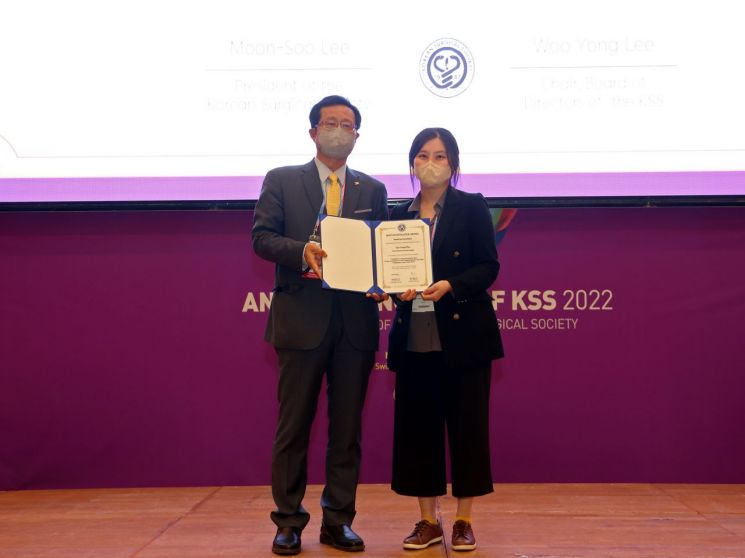
 Woo Hye-young, a clinical instructor in the Vascular Surgery Department at Seoul National University Hospital, received the Outstanding Researcher Award at the Annual Congress of KSS 2022 & 74th Congress of the Korean Surgical Society held from the 3rd to the 5th.
[Asia Economy Reporter Kim Young-won] Seoul National University Hospital announced on the 9th that Woo Hye-young, a clinical instructor in the Department of Transplantation Vascular Surgery, received the Best Investigator Award for Excellence at the Annual Congress of KSS 2022 & 74th Congress of the Korean Surgical Society.
The Korean Surgical Society is the most prestigious academic society in the field of surgery in Korea. It holds an annual academic conference and awards the Best Investigator Award for Excellence to researchers who present the most outstanding research.
At the 74th Annual Congress held from the 3rd to the 5th, a total of 55 research papers were submitted. Among them, clinical instructor Woo Hye-young was honored for her research titled "Visualization of Ischemia-Reperfusion Injury after Kidney Transplantation Using a Cysteine Probe and Early Prediction of Allograft Dysfunction (Corresponding author: Professor Min Sang-il, Department of Transplantation Vascular Surgery)."
Seoul National University Hospital explained that this study was selected as the final outstanding paper because it suggested the possibility of predicting ischemia-reperfusion injury occurring during organ transplantation. Ischemia-reperfusion injury is an inevitable phenomenon during organ transplantation, and if the damage is severe, it can cause delayed graft function after transplantation, leading to poor outcomes such as rejection and death. However, there were no clear tools or markers to predict the extent of the damage, making this research important.
Clinical instructor Woo confirmed through animal studies that cysteine, a type of amino acid, increases when ischemia-reperfusion injury occurs during the organ transplantation process. She visualized the extent of the injury using a cysteine probe and verified the effectiveness of this tool for predicting ischemia-reperfusion injury.
Woo said, "These results are expected to contribute to minimizing the risks faced by organ transplant patients, especially brain-dead donors, after transplantation, and to providing more appropriate management and treatment for patients." She added, "I hope this research will help increase the success rate of transplant surgeries and improve the quality of life of patients after surgery."
© The Asia Business Daily(www.asiae.co.kr). All rights reserved.
![Clutching a Stolen Dior Bag, Saying "I Hate Being Poor but Real"... The Grotesque Con of a "Human Knockoff" [Slate]](https://cwcontent.asiae.co.kr/asiaresize/183/2026021902243444107_1771435474.jpg)















