Artist Kang Ik-jung's Solo Exhibition in Korea After 12 Years 'The Moon Rises'
Held at Gallery Hyundai New Building, Dugahheon
Over 200 Major Series Works Revealed, New 'Moon Jar' and 'The Moon Rises' Featuring Moon Rainbow
Installation 'Hansikgu' Stacking 500 Bowls, etc.
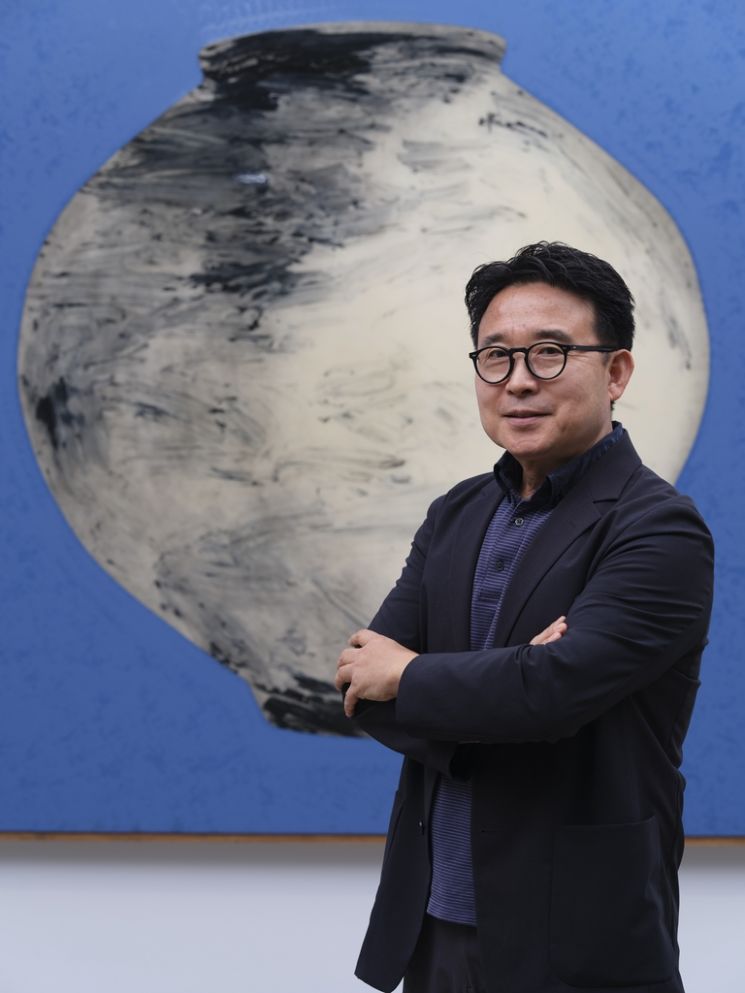
[Asia Economy Reporter Kim Heeyoon] “It seems my role is to connect what has been broken.”
Returning with a solo exhibition after 12 years, Korean-American artist Kang Ikjung introduced his belief and role regarding ‘connection.’ His current exhibition, held at Gallery Hyundai’s new building in Samcheong-dong, Seoul, and at Dugahen, showcases over 200 diverse works, including the new series "The Moon Rises," which depicts a lunar rainbow, more than 30 drawings, and the series "What I Know."
The artist first incorporated the moon jar into his work in 2004. While installing a large circular structure at Ilsan Lake Park, he recalled the moon jars he saw in his childhood upon seeing the tilted shape of the piece. He explained that the process of joining the lower and upper parts by hand and completing it as one body in the kiln embodies themes of fusion, harmony, and abundance.
When asked if small things around us come together to form a bigger story, the artist said, “This becomes our life itself,” emphasizing, “Connection with other beings is an essential element of our lives, and art must fulfill this role.” Gazing at the moon series as if looking at the moon in the sky, he added, “In the world we live in now, my role as an artist is like an antenna that looks up at the sky, down at the earth, and connects the space in between.”
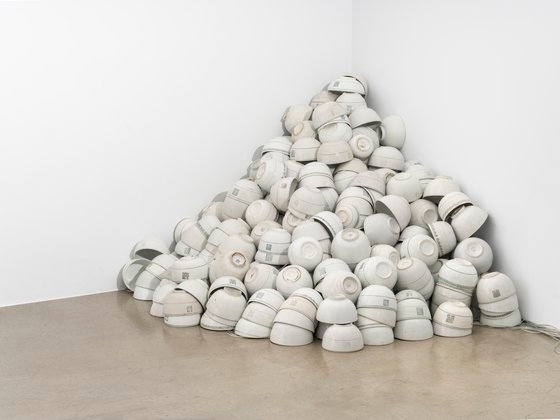 Installation work 'We Are One Family'. Behind the rice bowls piled up like a mountain, the sound of birds recorded in the DMZ flows out. Photo by Gallery Hyundai
On one corner of the second floor of the exhibition hall, hundreds of old rice bowls are piled up like a mountain. Through them, the sounds of birds recorded in the DMZ (Demilitarized Zone) can be heard. The artist said the rice bowls represent a situation waiting for warm rice to be served and for a family to eat together. Shortly after arriving in Korea for the exhibition, the Itaewon tragedy occurred. After visiting the Seoul City Hall memorial altar, he posted a poem titled “We Are One Family” on his SNS.
“Eating together makes us one family / Crying together makes us one family / Laughing together makes us one family / Suffering together makes us one family / Embracing together makes us one family / Sharing together makes us one family / Dreaming together makes us one family”
He shared that he wiped tears together with mourners who came to the altar to share their grief. He explained, “‘We Are One Family’ means we share joy and sorrow; it signifies the South and North, family and nation.” He added, “Right now, we are patiently letting the rice cook, but I believe the day will come when we warmly share steaming rice together.” Through his work, he conveyed a message of comfort through connection, even for the wounds the world is experiencing at this moment.
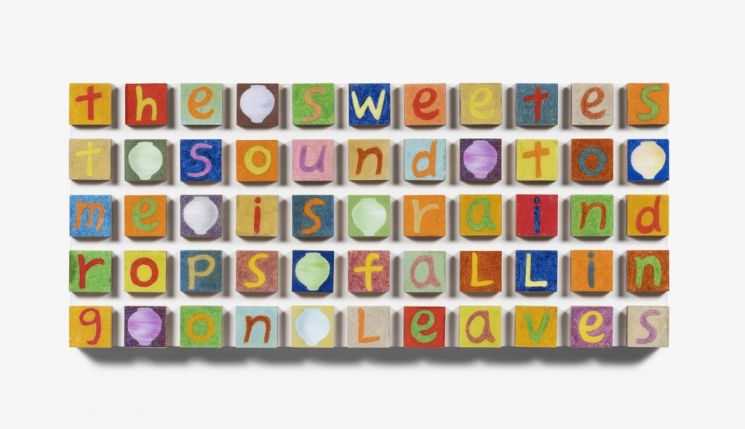
Born in Cheongju, Chungbuk, the artist graduated from Hongik University’s Department of Western Painting in 1984 and then moved to New York, where he graduated from Pratt Institute. During his studies abroad, his ‘3-inch’ works, created on small canvases while commuting by subway for part-time jobs, later expanded into large-scale public art projects.
He recalled his connection with artist Nam June Paik, whose 90th birth anniversary events have been ongoing recently. In 1994, he held the ‘Multiple/Dialogues’ exhibition with the late artist at the Whitney Museum. He said, “The master challenged me with the idea that a true artist should not only focus on selling paintings but embrace the world, imagine the future, and move forward.” He reminisced, “When I first met him in New York, he immediately asked, ‘What do you think the 30th century will be like?’ While people worry about today and tomorrow, he was a ‘digital shaman who sees stars in the daytime,’ looking a thousand years ahead.”
The artist introduced that writing poetry has become a habit for him. For this exhibition, he wrote 30 poems on the plane from New York to Seoul. Recently, he published a poetry collection titled “The Water in My Heart Must Be Calm for Me to Be Seen.” He said, “I have exactly three goals in life: first, simple thoughts; second, a diligent body; and third, a heart without greed.” All felt like his resolute commitment to long-term artistic activity. The exhibition runs until December 11 at Gallery Hyundai in Sagan-dong, Jongno-gu, Seoul.
© The Asia Business Daily(www.asiae.co.kr). All rights reserved.
![Clutching a Stolen Dior Bag, Saying "I Hate Being Poor but Real"... The Grotesque Con of a "Human Knockoff" [Slate]](https://cwcontent.asiae.co.kr/asiaresize/183/2026021902243444107_1771435474.jpg)

















