[Asia Economy Reporter Changhwan Lee] Domestic insurance companies have significantly increased the issuance of capital securities in recent years to raise capital, resulting in a sharp rise in interest burdens. It is pointed out that they are facing headwinds as they sought easy capital expansion in a prolonged low-interest-rate environment, but interest rates have risen sharply.
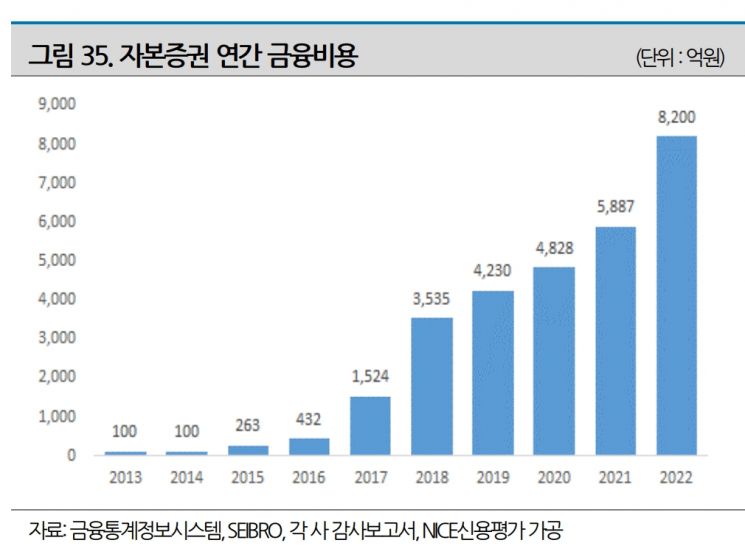
According to NICE Credit Rating on the 9th, the annual financial cost of capital securities issued by domestic insurance companies amounts to 820 billion KRW as of this year.
Capital securities refer to subordinated bonds and hybrid capital securities. Financial costs are the total amount of interest and dividends that insurance companies must pay to investors.
The financial costs of capital securities for insurance companies have been rapidly increasing every year. It was only 43.2 billion KRW in 2016 but increased 19-fold in six years until this year. This is because the issuance of capital securities by insurance companies has significantly increased since 2017, and interest expenses have ballooned as interest rates have recently risen.
Insurance companies needed capital expansion to defend against the decline in the RBC (Risk-Based Capital) ratio and to prepare for the new accounting standard (IFRS17) to be introduced from next year.
However, due to intensified market competition in the insurance industry and continued low growth, internal capital accumulation was difficult. The favorable issuance conditions under low interest rates were also the background for the significant increase in the issuance of hybrid capital securities and subordinated bonds, which are easier ways to raise capital.
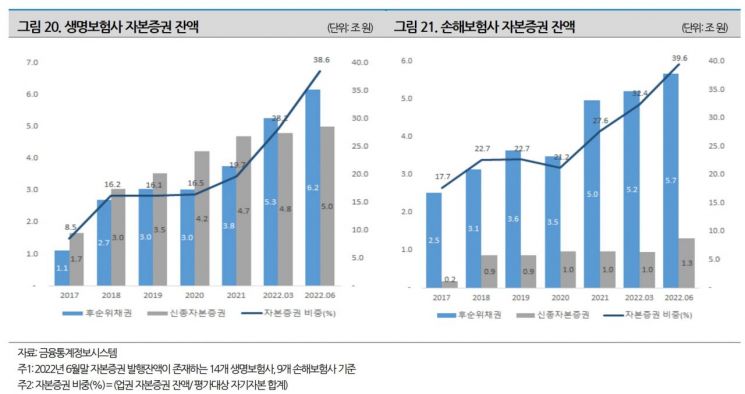
The proportion of capital securities relative to the equity capital of insurance companies has also increased significantly. In the case of life insurance companies, the proportion of capital securities in equity capital reached 38.6% as of June this year, up from 8.5% in 2017. During the same period, non-life insurance companies rose from 17.7% to 39.6%.
Under low-interest-rate conditions, the burden from issuing capital securities was not large, but as market interest rates have risen sharply recently, the financial cost burden has increased, and problems are actually occurring in the market.
Heungkuk Life Insurance's reluctance to exercise the early redemption right (call option) of hybrid capital securities issued five years ago earlier this month was because issuing new capital securities to repay them would result in excessive interest burdens. Eventually, financial authorities intervened and connected support from banks and other insurance companies, calming the situation.
With the central bank's interest rate hike trend expected to continue until next year, the financial cost burden on insurance companies is expected to increase further next year. In particular, insurance companies that have already exhausted their capital securities issuance limits and find it difficult to raise additional capital without external help may face significant difficulties due to excessive financial costs.
According to NICE Credit Rating, MG Non-Life Insurance, Hanwha Non-Life Insurance, Heungkuk Fire & Marine Insurance, KDB Life Insurance, and DGB Life Insurance are among the companies whose outstanding capital securities issuance exceeds the recognized capital limit.
Hanul Kim, Senior Researcher at NICE Credit Rating, emphasized, "The high dependence on capital securities by insurance companies negatively affects profitability and can lower the level of capital adequacy in the long term. Insurance companies managing regulatory capital ratios through capital securities issuance without qualitatively sound capital expansion may fall into a vicious cycle where profitability and capital adequacy decline due to bearing high financing costs."
© The Asia Business Daily(www.asiae.co.kr). All rights reserved.
![Clutching a Stolen Dior Bag, Saying "I Hate Being Poor but Real"... The Grotesque Con of a "Human Knockoff" [Slate]](https://cwcontent.asiae.co.kr/asiaresize/183/2026021902243444107_1771435474.jpg)
















