"Endemic Polarization" Department Stores Smile in Q3
Despite Consumption Slowdown Concerns and Last Year's Strong Performance Base
Three Companies' Operating Profit Grows Over 50% Year-on-Year
Continued Recovery in High-Profit Categories Like Fashion
Department Stores Expected to Benefit from Year-End Effects and Profitability Improvement
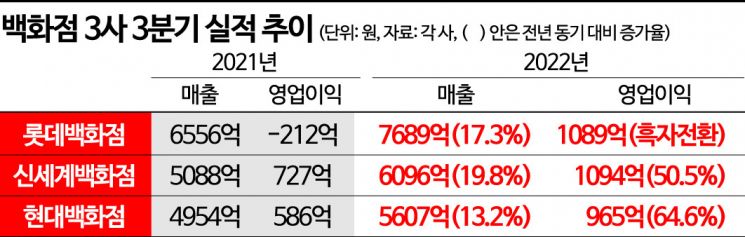
[Asia Economy Reporter Kim Yuri] This year in the third quarter, all three department stores?Lotte, Shinsegae, and Hyundai Department Store?recorded strong performances. Despite concerns over consumption slowdown and the base effect from last year's 'revenge consumption,' they generally exceeded market expectations. Industry insiders expect department stores, which are seeing concentrated demand due to consumption polarization, to experience a clear year-end effect in the fourth quarter. Luxury goods demand remains strong amid high exchange rates, and the entry of emerging 'designer brands' has boosted the high-margin fashion category, leading to continued foot traffic from consumers visiting department stores for the time being.
◆ Three Department Stores Each Post Operating Profit Around 100 Billion KRW: "High-Margin Fashion Led the Growth"
Lotte Department Store recorded an operating profit of 108.9 billion KRW and sales of 768.9 billion KRW in the third quarter of this year. Operating profit turned positive with an increase of over 130 billion KRW compared to the same period last year, and sales also rose by 17.3%. The leading contributor to the strong performance of domestic department stores was the fashion category. Strong sales in the fashion product group led to a 16.5% increase in same-store sales. Overseas department stores in Indonesia and Vietnam also saw sales increase by 62.9%, reflecting the base effect of temporary closures due to COVID-19 last year. The strong sales momentum improved operating profit by 130.1 billion KRW year-on-year, turning it into a profit.
Shinsegae Department Store's third-quarter operating profit rose 50.5% year-on-year to 109.4 billion KRW. Sales increased by 19.8% to 609.6 billion KRW (including separate corporations in Gwangju, Daegu, and Daejeon). The increase in outdoor activities also boosted fashion demand, contributing to the strong performance. Not only luxury goods but also mass-market genres such as women's fashion (31.7%), men's fashion (29.1%), and golf wear (33.7%) grew significantly compared to the same period last year, satisfying both growth and profitability. Sales during the Chuseok holiday also increased by 21.1% year-on-year, contributing to top-line growth. Shinsegae Department Store evaluated that "the differentiated content such as the Young Contemporary specialty hall targeting millennials at Shinsegae Gangnam Store contributed to sales in the third quarter."
Hyundai Department Store also saw strong sales in high-margin product groups such as fashion, sports, and cosmetics due to eased consumer sentiment amid the endemic (periodic epidemic) in the third quarter. Hyundai Department Store's separate operating profit in the third quarter was 96.5 billion KRW, up 64.6% from the same period last year. Sales during this period increased by 13.2% to 560.7 billion KRW.
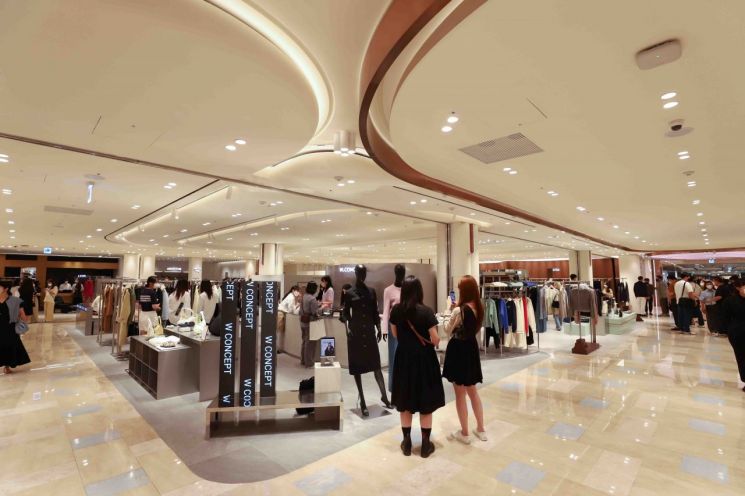 Customers are browsing clothing at the W Concept store on the 5th floor of Shinsegae Gangnam. Shinsegae Department Store renovated the young fashion specialty hall on the 5th floor of the Gangnam branch last August, showcasing a total of 14 designer brands (Photo by Shinsegae Department Store).
◆ Department Store Consumers Less Affected by Economy... "Year-End Consumption Expectations Remain"
The industry expects this strong performance trend of department stores to continue for the time being. Until early this year, there were concerns that department stores, which had concentrated 'revenge consumption' on luxury goods due to COVID-19, would peak and then decline in the endemic era. However, the global high inflation, high exchange rates, and residual COVID-19 effects have combined to sustain the growth of luxury goods in department stores.
Additionally, since social distancing was lifted this spring, even those who had been relying on 'one-mile wear' (clothes worn within a 1-mile radius from home) for the past few years have started purchasing new clothes seasonally, leading to continued high growth in the high-margin fashion category. This trend is expected to continue for the time being. Particularly, while overseas fashion continues to grow, domestic fashion led by emerging designers is also rising among the MZ generation (Millennials + Generation Z), increasing related sales, which is seen as positive. The increase in demand for outdoor activities and sports such as golf, tennis, and hiking also supports the outlook for sustained strong performance.
Especially, VIP customers, who account for a large portion of department store performance, are less affected by economic conditions, leading to expectations of continued strong results next year. Jo Sang-hoon, a researcher at Shinhan Investment Corp., said, "Despite recent economic downturns and concerns about consumption slowdown, department store performance remains favorable," adding, "Although clothing consumption has increased significantly this year, compared to 2019, there is still room for further performance growth."
© The Asia Business Daily(www.asiae.co.kr). All rights reserved.
![Clutching a Stolen Dior Bag, Saying "I Hate Being Poor but Real"... The Grotesque Con of a "Human Knockoff" [Slate]](https://cwcontent.asiae.co.kr/asiaresize/183/2026021902243444107_1771435474.jpg)

















