'2022 1st Pharmaceutical and Biohealth Statistics Forum'
Half of FDA-Approved Drugs Last Year Were Orphan Drugs
Guidelines Needed to Actively Encourage Decentralized Clinical Trials
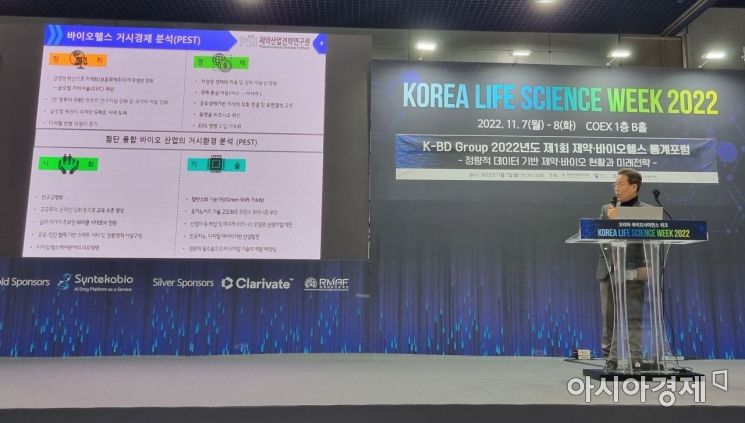 Jung Yuntaek, CEO of the Pharmaceutical Industry Strategy Institute, is presenting at the '2022 1st Pharmaceutical and Biohealth Statistics Forum' held on the 7th at COEX, Seoul, organized by the Pharmaceutical and Bio Business Development Research Group (K-BD Group). Photo by Kim Youngwon
[Asia Economy Reporter Kim Young-won] Experts advised that future growth in the pharmaceutical and bio industries should focus on rare drugs and decentralized clinical trials.
At the '2022 1st Pharmaceutical and Bio Health Statistics Forum' held on the 7th at COEX, Seoul, hosted by the Pharmaceutical and Bio Business Development Research Group (K-BD Group), experts made these remarks.
Jung Yoon-taek, CEO of the Pharmaceutical Industry Strategy Institute, stated in his presentation, "Among the drugs approved by the U.S. Food and Drug Administration (FDA), rare drugs are rapidly increasing their share," adding, "From the perspective of U.S. regulatory authorities and government, priorities must be placed on these areas in terms of social safety nets, and drugs with alternatives may face difficulties in approval."
According to FDA data, last year, the proportion of rare drugs among FDA-approved drugs reached 52%. Although this is a slight decrease compared to the highest shares in 2018 and 2020 (58%), it remains at a high level. Jung evaluated, "Preparing for the future should focus on these (rare drugs) areas to overcome the stringent U.S. approval process."
Kim Sun-sik, head of Intralinks Korea, also emphasized the importance of rare disease pipelines based on recent pharmaceutical and bio mergers and acquisitions (M&A) and technology transfer deals. He said, "Between 2018 and 2020, there were four major deals ranked within the top 15 in pharmaceutical and bio history," adding, "These M&As can be seen as investments by big pharma to strengthen rare disease pipelines."
Kim further noted, "During the global COVID-19 pandemic from 2020 to 2021, prescription drug sales stagnated or declined, but rare drugs consistently grew by double digits, exceeding 10%."
Regarding clinical trials, opinions were expressed that digitalization and the capability and utilization of decentralized clinical trials (DCT) must be enhanced for the future of the pharmaceutical and bio industries. Ji Tae-yong, team leader at the National Clinical Trial Support Foundation, identified 'digitalization' as a key factor in the clinical field going forward. He stated, "In early 2020, virtual, remote, and decentralized clinical trials surged to overcome COVID-19, and this year, more than 1,300 trials are expected to be conducted, a 28% increase compared to the previous year."
Both researchers and patients responded positively to decentralized clinical trials, which can be conducted without visiting hospitals through non-face-to-face methods. According to Ji’s presentation materials, 94% of researchers showed interest in hybrid and decentralized clinical trials, and 71% believed decentralized trials reduce patient burden. Additionally, 68% of patients expressed expectations for non-face-to-face environments such as home treatment. He explained, "Digitalization of clinical trials could resolve patient recruitment issues by enabling participation without hospital visits."
Although the global proportion of decentralized clinical trials has increased significantly, South Korea’s utilization rate remains relatively low. From 2019 to this year, South Korea’s use of decentralized clinical trials was 1.1% in multinational trials and 7.5% in single-country trials. In contrast, the UK conducts decentralized trials at rates of 14.6% in multinational trials and 12.0% in single-country trials.
Ji emphasized the need to establish clear guidelines domestically regarding decentralized clinical trials and digitalization. He said, "Major countries have established specific guidelines related to digitalization of clinical trials," adding, "South Korea must understand these trends and maintain competitiveness through prompt policy and institutional support so that the industry can actively attempt new clinical trials."
© The Asia Business Daily(www.asiae.co.kr). All rights reserved.
![Clutching a Stolen Dior Bag, Saying "I Hate Being Poor but Real"... The Grotesque Con of a "Human Knockoff" [Slate]](https://cwcontent.asiae.co.kr/asiaresize/183/2026021902243444107_1771435474.jpg)
















