National Gwacheon Science Museum Holds Special Observation Event
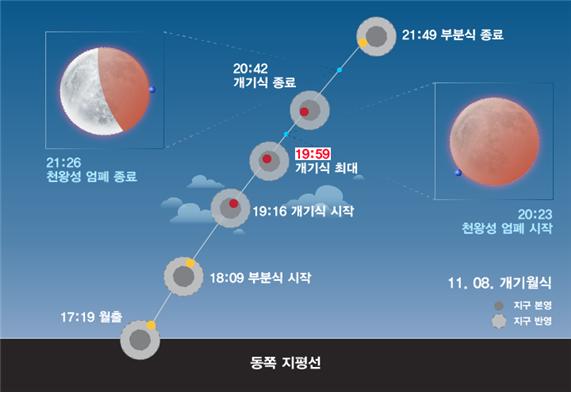
[Asia Economy Reporter Kim Bong-su] On the evening of the 8th, a rare astronomical event that occurs once or twice in a century, namely a total lunar eclipse and an occultation of Uranus, will happen simultaneously.
The Gwacheon National Science Museum announced on the 7th that it will hold a special observation event both offline and online from 7 PM on the day, where the total lunar eclipse and the occultation of Uranus can be observed simultaneously.
The total lunar eclipse, where the Earth's shadow covers the Moon, is occurring about 1 year and 6 months after May 26, 2022, and the occultation of Uranus, where the Moon covers Uranus, is happening for the first time in about 7 and a half years since January 25, 2015.
In particular, this total lunar eclipse will be observed as a very rare scene where the Moon, hidden by the Earth's shadow, again covers Uranus. The simultaneous occurrence of a lunar eclipse and a planetary occultation happens about once or twice every hundred years. In the past 200 years, there have been only four instances worldwide where a lunar eclipse and a planetary occultation occurred simultaneously. The most recent simultaneous occurrence of a lunar eclipse and Uranus occultation was on October 8, 2014, but it was not visible in Korea. Another simultaneous event will occur on October 10, 2098, 76 years later, but it will also not be observable in Korea.
The simultaneous total lunar eclipse and Uranus occultation on November 8 can be observed throughout Korea in the evening. The next total lunar eclipse will be observable on September 8, 2025, and the next Uranus occultation on February 27, 2068. There will be no opportunity to observe these two astronomical phenomena simultaneously in Korea within the next 200 years.
A lunar eclipse occurs when the Moon passes through the Earth's shadow, happening on average about once every six months. When the Moon completely enters the Earth's shadow, it is a total lunar eclipse; if it only grazes the shadow, it appears as a partial lunar eclipse. During a total lunar eclipse, the Moon appears red because sunlight passing through the Earth's atmosphere scatters blue light and only red light illuminates the Moon.
Occultation in astronomy refers to the phenomenon where a distant celestial body is obscured by a closer celestial body. Specifically, a Uranus occultation means the Moon covers Uranus. Occultations caused by the Moon occur about once every two years per planet, but the observable area is limited and sometimes occurs during daytime, making it rare to observe from specific locations.
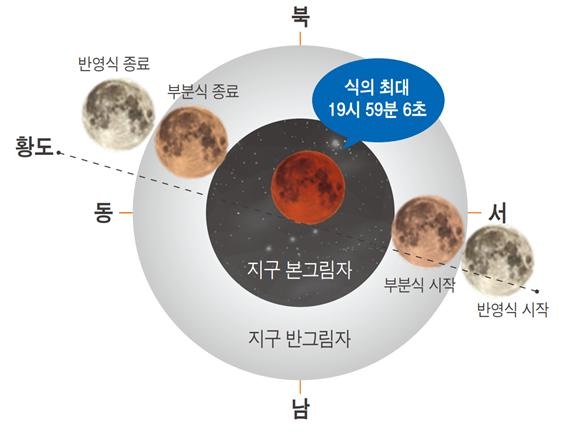
This special observation event will be held at the Gwacheon National Science Museum Observatory from 7 PM to 9:40 PM on the day and will be live-streamed on YouTube. Participation has no age or number restrictions and is free of charge. In addition to the total lunar eclipse and Uranus occultation, Mars, Jupiter, Saturn, and the Pleiades star cluster will also be observed. The online live broadcast will be hosted by Park Dae-young, head of the Astronomy and Space Team at the Gwacheon National Science Museum, and Dr. Kang Sung-joo, featuring lectures and real-time commentary on the eclipse and occultation phenomena on the museum’s YouTube channel. Furthermore, the event will connect simultaneously with several locations including the Miryang Arirang Space Observatory, Taipei Astronomical Museum in Taiwan, and Sapporo Youth Science Museum in Japan to share local observation conditions. If the weather near the museum is unfavorable, footage from these locations will be broadcast instead.
During the observation, the planetarium education room inside the museum will be open to reduce fatigue and cold from long-term observation, and videos of the observation scenes will be shown along with dome films related to solar and lunar eclipses to help deepen understanding of the lunar eclipse. This total lunar eclipse can be observed with the naked eye, but since it begins just after moonrise, it is necessary to find a location with an open eastern horizon. Uranus is difficult to see with the naked eye, so a telescope must be used. Telescopes without celestial coordinates input can find Uranus near the Moon once the Moon is located, allowing observation of the occultation phenomenon.
Dr. Jo Jae-il, head of the Astronomy and Space Team at the Gwacheon National Science Museum, said, "The simultaneous occurrence of a total lunar eclipse and Uranus occultation is a very rare astronomical event, and we hope you experience this century’s cosmic show at the Gwacheon Science Museum." Detailed information can be found on the Gwacheon Science Museum website.
© The Asia Business Daily(www.asiae.co.kr). All rights reserved.
![Clutching a Stolen Dior Bag, Saying "I Hate Being Poor but Real"... The Grotesque Con of a "Human Knockoff" [Slate]](https://cwcontent.asiae.co.kr/asiaresize/183/2026021902243444107_1771435474.jpg)
















