Hundreds of Protesters Demonstrate at Amsterdam Schiphol Airport Private Jet Zone
Private Jets Emit 5 to 14 Times More Pollutants Than Commercial Aircraft
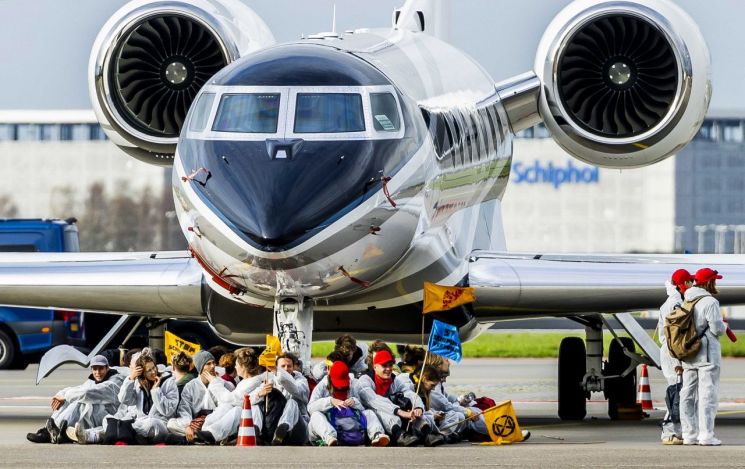 On the 5th (local time), environmental group members blocked a private jet preparing for takeoff at Schiphol Airport in the Netherlands, urging restraint in the use of private jets. Photo by EPA Yonhap News
[Asia Economy Reporter Kim Hyunjung] Hundreds of members of two international environmental organizations, including Greenpeace, occupied an airport in the Netherlands and held a protest against unnecessary private jet use and short-haul flights.
According to major foreign media on the 5th (local time), hundreds of protesters from Greenpeace and Extinction Rebellion (XR) occupied the private jet area of Amsterdam Schiphol Airport in the Netherlands. Schiphol Airport is the Netherlands' representative hub airport, a large-scale airport with three terminals. Dressed in white work uniforms, the protesters sat in front of the aircraft wheels to obstruct the takeoff of private jets, causing delays in the departure of several private jets.
Greenpeace stated that Schiphol Airport is the largest source of carbon dioxide emissions in the Netherlands, emitting 12 billion kilograms annually. Debbie Zuloch, campaign leader of Greenpeace Netherlands, said, "We want to reduce air travel and use trains more," and argued, "Unnecessary short-haul flights and private jet use should also be banned."
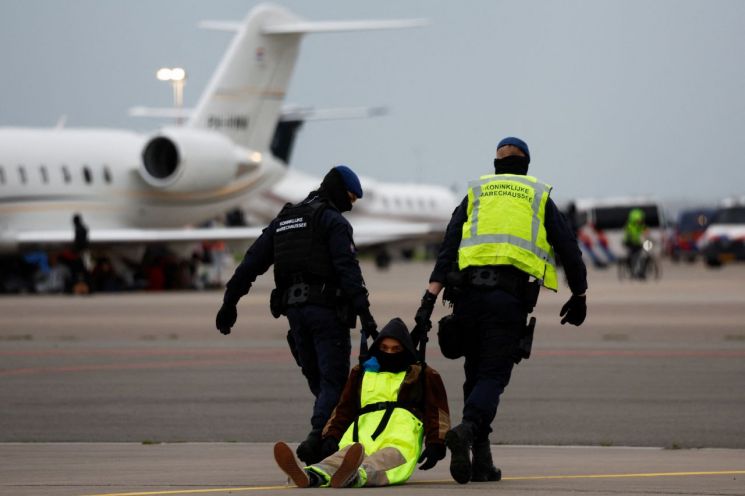
Some protesters held placards around the airport's main hall with slogans such as "Limit Aviation" and "Increase Train Use." Dutch police began arresting activists about three hours after the protest started, and around 100 were taken away by waiting buses. In response to the environmental groups' protests, Schiphol Airport stated that it aims to become a carbon-neutral airport by 2030 and supports the aviation industry's goal of reaching zero carbon emissions by 2050. Mark Harbers, the Dutch Minister of Transport, said in parliament last month that the Ministry of Transport cannot control the increasing use of private jets and is considering whether to include this issue in government climate policy.
There are also research findings that private jets emit more pollutants than commercial aircraft. The BBC reported last year that private jets emit 5 to 14 times more pollutants than commercial planes. Debbie Hopkins, an associate professor at Oxford University researching decarbonized transportation, urged restraint in private jet use in an interview with the BBC, saying, "Regardless of the number of passengers, airplanes use an enormous amount of fuel during takeoff and landing."
Private jets are mainly used by a very small number of wealthy individuals and celebrities. Recently, Kylie Jenner, Drake, and Taylor Swift have faced public criticism for excessive private jet use. Kylie Jenner (24) drew backlash after posting a photo on her Instagram on July 16 with her famous rapper husband Travis Scott (31) in front of two private jets, captioned "Which one do you want to ride, mine or yours?"
According to flight information posted on the Twitter account "Celebrity Jets," which shares celebrities' private jet routes, Jenner flew by private jet from Camarillo to Van Nuys, California?a 45-minute drive?in just 17 minutes. Additionally, singer Taylor Swift, who expressed concerns about climate change in a 2020 interview with the U.S. media outlet Variety, used private jets 170 times in the first half of this year alone, emitting a total of 8,293 tons of carbon dioxide, earning the dishonor of being the celebrity with the highest carbon emissions this year and criticism for inconsistency.
The bigger problem is that private jet users themselves have no intention of reducing their usage. A survey by Private Jet Card, a private aviation company, found that 52% of respondents plan to use private jets more in the future. Private jet use has increased even more since the COVID-19 pandemic.
© The Asia Business Daily(www.asiae.co.kr). All rights reserved.


















