Household Loans Decline Monthly This Year
Personal Business Loans Decrease for the First Time Since 2017
Only Corporate Loans Show Growth... Impact of Corporate Bond Market Tightening
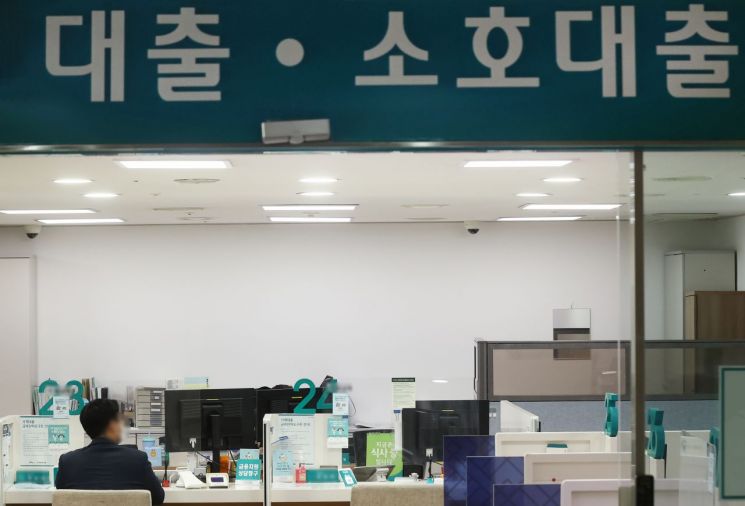
[Asia Economy Reporter Minwoo Lee] Households continue to repay loans while companies seek funds from banks.
According to the financial sector on the 5th, the outstanding household loans at the five major commercial banks?KB Kookmin, Shinhan, Hana, Woori, and NH Nonghyup?stood at 693.6475 trillion KRW in October this year. This is a decrease of 1.4355 trillion KRW compared to the previous month. The figure has been declining every month this year. In particular, household credit loans decreased by 1.9321 trillion KRW in just one month. Jeonse loans, which had driven loan growth in the banking sector, also fell by 135.1 billion KRW compared to the previous month. On the other hand, corporate loans increased significantly. Large corporate loans rose by 9.9088 trillion KRW, and small and medium-sized enterprise loans increased by 6.6651 trillion KRW. However, loans to individual business owners decreased by 460.2 billion KRW from the previous month to 314.8077 trillion KRW, marking the first monthly decline since 2017.
As interest rates rise sharply, households are rapidly repaying loans. Individual mortgage loans, which had increased by 800 billion KRW annually from 2018 to 2021, showed a decline of about 800 billion KRW this year, indicating sluggish performance. Jeonse loans increased by 4.3656 trillion KRW through October this year, which contrasts with the 14 to 21 trillion KRW net increase seen from 2018 to 2021. Credit loans decreased by a staggering 15.9273 trillion KRW over the past 10 months this year. Lee Byung-geon, a researcher at DB Financial Investment, explained, "It is estimated that borrowers with financial flexibility are rapidly repaying loans due to the burden of rising interest rates," adding, "This is the first time since December 2010 that the outstanding balance of individual business owner loans in the banking sector has decreased on a monthly basis."
Meanwhile, companies are rushing to banks. Excluding the COVID-19 period, it is considered unusual for large and small-to-medium enterprise loans at the five major banks to have increased by more than 10 trillion KRW net. Including IBK Industrial Bank of Korea and regional banks, which saw corporate loans increase by 1.7637 trillion KRW during the same period, the growth is expected to be even larger. In the current environment where the corporate bond and short-term funding markets are tightening, many companies appear to be raising funds through banks.
However, loan growth rates are expected to be higher than anticipated this year and somewhat sluggish next year. Considering that household loans at the three internet-only banks are increasing by 1 to 1.5 trillion KRW monthly, the overall household loan volume in the banking sector is still maintaining its level. However, individuals are reducing their debt size, and companies are flocking to banks rather than the corporate bond market. The researcher predicted, "Considering this, it is highly likely that bank loans will increase by 1 to 2 percentage points more than expected due to corporate credit transactions until the end of the year," adding, "If the base interest rate hike stops next year and the funding market normalizes, the growth rate of corporate loans will decrease, and the overall bank loan growth rate will fall to around 3%."
© The Asia Business Daily(www.asiae.co.kr). All rights reserved.
![Clutching a Stolen Dior Bag, Saying "I Hate Being Poor but Real"... The Grotesque Con of a "Human Knockoff" [Slate]](https://cwcontent.asiae.co.kr/asiaresize/183/2026021902243444107_1771435474.jpg)
















