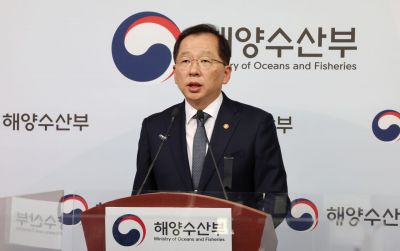
[Asia Economy Sejong=Reporter Dongwoo Lee] The Ministry of Oceans and Fisheries will invest 3 trillion won to support domestic shipping companies. This plan aims to prevent a recurrence of shipping industry crises like the Hanjin Shipping incident in advance.
On the 4th, at the Emergency Economic Ministers' Meeting, the Ministry announced the "Measures to Strengthen the Competitiveness of the Shipping Industry in Response to Market Fluctuations." The shipping industry, which enjoyed a freight rate boom due to the COVID-19 logistics crisis, is now facing significant market fluctuations such as recent index declines, prompting proactive support measures.
Minister Cho Seung-hwan of the Ministry of Oceans and Fisheries stated, "Considering accumulated cash assets, the possibility of an immediate crisis for Korean shipping companies is low," but added, "Given the very rapid recent decline in freight rates, we judged that it is necessary to prepare proactive countermeasures."
The Ministry identified four key initiatives: ▲ Establishing a 3 trillion won management safety net ▲ Enhancing shipping market analysis and response ▲ Expanding the growth foundation of the shipping industry ▲ Leading eco-friendly and digital transformation.
First, a crisis response fund of up to 1 trillion won will be created. For small and medium-sized shipping companies, investment and guarantee rates will be significantly reduced to provide 250 billion won in support. Additionally, a 50 billion won emergency management stabilization fund will be prepared for rapid support in case of liquidity crises. The Korea Ocean Business Corporation will invest about 1.7 trillion won by 2026 to secure up to 50 vessels and lease them to domestic shipping companies through a public shipowner project.
To improve efficiency, overlapping routes among small and medium-sized shipping companies operating intra-Asia routes will be adjusted through a voluntary cooperation body (K-Alliance). To strengthen response capabilities according to shipping market conditions, shipping companies will be categorized by vessel type, route, and scale to establish a group-based crisis response system.
Judging that the widely used Shanghai Containerized Freight Index (SCFI) does not accurately reflect Korea's shipping reality, the Ministry developed the Korea Containerized Cargo Index (KCCI), which will be announced weekly starting this month.
To establish a stable export base for small-scale shippers, the Ministry plans to support long-term transportation contracts between domestic shipping companies and industry-specific shipper associations. The Ministry expects that small and medium shippers will achieve up to a 30% reduction in logistics costs through this initiative.
To ensure the supply stability of key strategic materials such as liquefied natural gas (LNG), the Ministry decided to increase the transportation share of domestic shipping companies. Investment in terminals and joint logistics centers at major overseas hub ports will also be expanded. A total of 528 public and private vessels will be gradually converted to eco-friendly ships, and core technologies for low-carbon and zero-carbon vessels will be developed.
Minister Cho said, "We plan to accelerate the transition to eco-friendly and digital shipping to respond to rapidly changing global logistics environments such as strengthening environmental regulations and the digital revolution," adding, "Through proactive policy establishment, we will prepare for upcoming crises and support the shipping industry to reliably back Korea's import and export logistics."
© The Asia Business Daily(www.asiae.co.kr). All rights reserved.
![Clutching a Stolen Dior Bag, Saying "I Hate Being Poor but Real"... The Grotesque Con of a "Human Knockoff" [Slate]](https://cwcontent.asiae.co.kr/asiaresize/183/2026021902243444107_1771435474.jpg)















