Store Owner and Part-Time Worker Disputes 'Worry'
Ministry of Environment Grants One-Year Fine Suspension
Convenience Store Headquarters Takes Preemptive Measures Like Order Restrictions
Partial Limitations on Providing Wooden Chopsticks Also Implemented
[Asia Economy Reporter Lim Chun-han] “Even now, it's tough dealing with drunk or rude customers, and I'm scared they might pick a fight over plastic bags.”
On the afternoon of the 2nd at a GS25 in Gwanak-gu, Seoul, part-timer Kim said, “Honestly, who brings a shopping basket just to buy a few items?” and added, “They should be told to buy the more expensive bags, but it's obvious what will happen. Many customers will complain.”
Although restrictions on the use of plastic bags and wooden chopsticks at convenience stores are imminent, voices expressing concern about confusion on the ground are growing due to insufficient policy promotion. Seemingly aware of such criticism, the Ministry of Environment has set a one-year grace period and decided not to impose fines.
Starting from the 24th of this month, the 'Enforcement Rules of the Act on the Promotion of Saving and Recycling of Resources' will be implemented to restrict the use of plastic bags and wooden chopsticks at convenience stores. This expands the ban on plastic bag use that has been applied to large supermarkets since 2019, allowing convenience stores to sell only paper bags, volume-based bags, and reusable bags. Failure to comply with disposable item restrictions will result in fines of up to 3 million KRW.
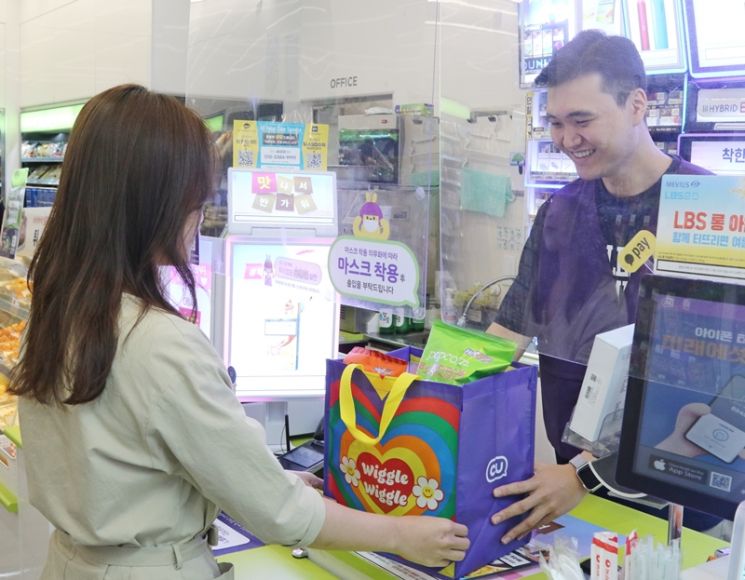
Convenience store headquarters have taken preemptive measures such as limiting plastic bag orders and posting notices. CU has been gradually adjusting plastic bag orders since August and stopped ordering last month. GS25 and 7-Eleven have limited orders since September, and Emart24 has done so since last month. As a result, it is expected that plastic bags will soon be hard to find in most convenience stores.
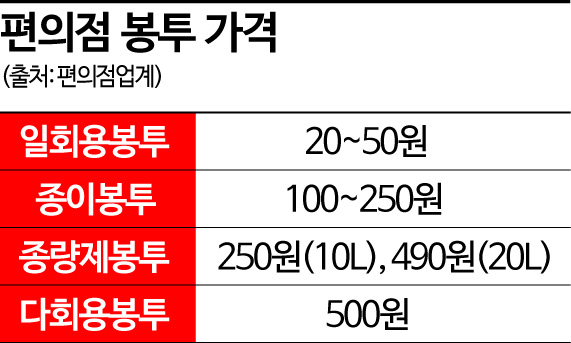
Plastic bags will be replaced by paper, volume-based, and reusable bags. Paper bags cost 100 to 250 KRW, volume-based bags (Seoul standard) are 250 KRW for 10L and 490 KRW for 20L, and reusable bags are 500 KRW. This is up to 25 times more expensive than the existing plastic bag price of 20 to 50 KRW and is excessively high compared to the average spending per customer at convenience stores, which is 6,808 KRW (as of September this year). From the store owner's perspective, it is difficult to predict demand and decide how many of each type of bag to order.
The provision of wooden chopsticks will also be partially restricted. Previously, they could be used when eating ready-to-eat foods such as chicken, roasted sweet potatoes, and frozen dumplings, but now they are only allowed for eating lunch boxes and cup noodles. Many consumers are unaware of the regulation itself, causing store owners and part-timers to worry about disputes that may arise in convenience stores. In fact, in March this year, a man who threatened part-timers with a box cutter for asking for 20 KRW for a bag at a convenience store in Gangseo-gu, Seoul, was prosecuted.
A convenience store industry official said, “We agree that actively implementing eco-friendly activities and adapting to change is the right direction,” but pointed out, “Customers accustomed to using plastic bags and wooden chopsticks are not properly aware of the policy. Confusion on the ground is inevitable.”
© The Asia Business Daily(www.asiae.co.kr). All rights reserved.
![Clutching a Stolen Dior Bag, Saying "I Hate Being Poor but Real"... The Grotesque Con of a "Human Knockoff" [Slate]](https://cwcontent.asiae.co.kr/asiaresize/183/2026021902243444107_1771435474.jpg)
















