Bank of Korea Announces Foreign Exchange Reserves at End of October
Decrease of $2.76 Billion for Exchange Rate Defense
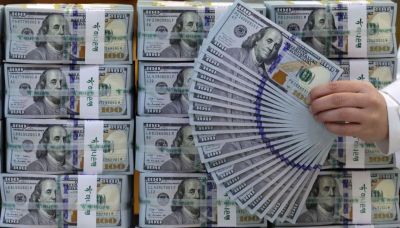
South Korea's foreign exchange reserves have decreased by more than 2.7 billion dollars in one month. Although this marks the third consecutive month of decline since July, the reduction has significantly lessened compared to the previous month as the volatility of the won-dollar exchange rate has somewhat eased recently.
According to the 'End of October Foreign Exchange Reserves' statistics released by the Bank of Korea on the 3rd, South Korea's foreign exchange reserves stood at 414.01 billion dollars, down 2.76 billion dollars from the end of the previous month.
The foreign exchange reserves showed a slight increase to about 438.6 billion dollars in July but have been declining for three consecutive months since then. In particular, in September, the reserves dropped by 19.7 billion dollars in one month, marking the largest decrease in 13 years and 11 months since October 2008.
The Bank of Korea explained that in October, the US dollar depreciated by about 1.3%, leading to an increase in the dollar-converted amount of foreign currency deposits and other currency foreign assets held by financial institutions. However, due to measures to ease volatility in the foreign exchange market, the overall foreign exchange reserves decreased.
The foreign exchange authorities sell dollars they hold to defend the value of the won when exchange rate volatility increases. On the 25th of last month, the won-dollar exchange rate rose to 1,444.2 won, reaching a yearly high and showing signs of instability, which is interpreted as prompting continued market intervention by the foreign exchange authorities.
However, the Bank of Korea stated, "In October, compared to September, the concentration phenomenon in the foreign exchange market eased, leading to a significant reduction in the scale of volatility mitigation measures," and explained that "foreign exchange swaps between the National Pension Service and the foreign exchange authorities, as well as dollar sales by export companies such as shipbuilders, contributed to improving domestic supply and demand conditions."
The foreign exchange reserves consisted of securities worth 362.35 billion dollars (87.5%), deposits of 28.29 billion dollars (6.8%), SDRs of 14.31 billion dollars (3.5%), gold of 4.79 billion dollars (1.2%), and IMF positions of 4.26 billion dollars (1.0%).
Although foreign exchange reserves have been decreasing monthly, the Bank of Korea plans to continue active responses if the concentration phenomenon persists.
The Bank of Korea said, "If the won-dollar exchange rate excessively diverges from our economy's fundamentals and the movements of major currencies, intensifying the concentration phenomenon, we plan to implement active market stabilization measures."
As of the end of September, South Korea ranked 9th globally in terms of foreign exchange reserves, dropping one rank from the previous month.
China had the largest reserves at 3.029 trillion dollars, followed by Japan with 1.2381 trillion dollars, and Switzerland with 892.1 billion dollars. Japan and Switzerland saw sharp declines in their foreign exchange reserves in September, dropping by 54 billion dollars and 57 billion dollars respectively. Hong Kong's reserves decreased by 12.6 billion dollars but its ranking rose to 8th.
© The Asia Business Daily(www.asiae.co.kr). All rights reserved.
![Clutching a Stolen Dior Bag, Saying "I Hate Being Poor but Real"... The Grotesque Con of a "Human Knockoff" [Slate]](https://cwcontent.asiae.co.kr/asiaresize/183/2026021902243444107_1771435474.jpg)















