Korea Railroad Research Institute
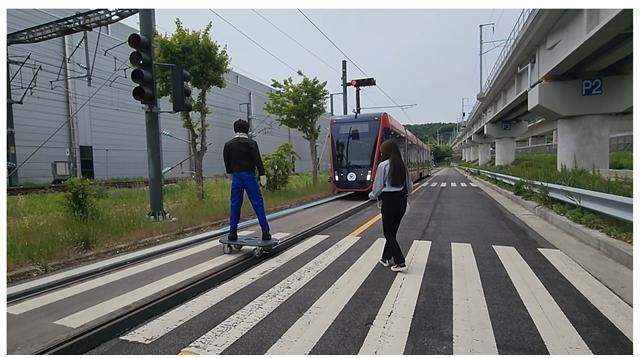
[Asia Economy Reporter Kim Bong-su] Autonomous tram driving technology that independently obeys traffic signals and stops when people or vehicles are on the tracks to prevent accidents and damage has been developed.
The Korea Railroad Research Institute announced on the 1st that it has developed 'catenary-free tram autonomous driving technology' to prevent accidents and damage occurring during tram operation. This technology enables compliance with intersection signals linked to traffic signal controllers, recognition of objects such as pedestrians, cars, and bicycles within 100 meters ahead, and control based on collision risk assessment.
It is now possible to secure road driving safety of trams by reducing collisions with cars, bicycles, and pedestrians violating signals on tram tracks by more than 50% and reducing damage scale by more than 30%. The technology enhances tram safety through precise positioning for rapid charging of large-capacity batteries installed in vehicles and boarding/alighting detection control functions that assist passengers' safe boarding and alighting.
The developed catenary-free tram autonomous driving technology integrates automobile autonomous driving technology with tram signaling technology. By applying cameras capable of detecting objects up to 100 meters ahead and AI-based video analysis algorithms, it solves the problem of braking distances that are 2 to 3 times longer than those of cars and boarding/alighting congestion caused by multiple doors at open stations. The collision risk assessment function based on a linear map digitizing the tram route prevents collisions with cars, bicycles, pedestrians, and others. Through Vehicle-to-Everything (V2X) communication, the tram vehicle directly receives information such as remaining signal time from tram signals, autonomously decides whether to pass or stop at intersections, sets appropriate target speeds, and drives accordingly. If stopping is necessary, it stops precisely at the intersection stop line if no external hazards are present.
The Railroad Research Institute verified the developed autonomous driving technology by conducting a cumulative 600 km autonomous driving test on the catenary-free tram test line in Osong, Chungbuk. Tests were conducted on a 1.3 km track consisting of 3 stations and 4 intersections, including scenarios such as end-to-end operation, section speed limits, and emergency situations.
Hwang Hyun-cheol, head of the Smart Tram Research Lab at the Railroad Research Institute, said, "The commercialization of autonomous driving technology that monitors surrounding conditions in real time and actively responds to dangerous situations has come one step closer," adding, "We will continue to conduct autonomous driving tests in various environments and scenarios to enhance the completeness of the technology."
© The Asia Business Daily(www.asiae.co.kr). All rights reserved.
![Clutching a Stolen Dior Bag, Saying "I Hate Being Poor but Real"... The Grotesque Con of a "Human Knockoff" [Slate]](https://cwcontent.asiae.co.kr/asiaresize/183/2026021902243444107_1771435474.jpg)
















