29 Wildfires Occurred in September-October This Year... 1.5 Times Increase Compared to the Last 10-Year Average
Proportion of Wildfires in January, June, and August, Known as Off-Season, Also Increased
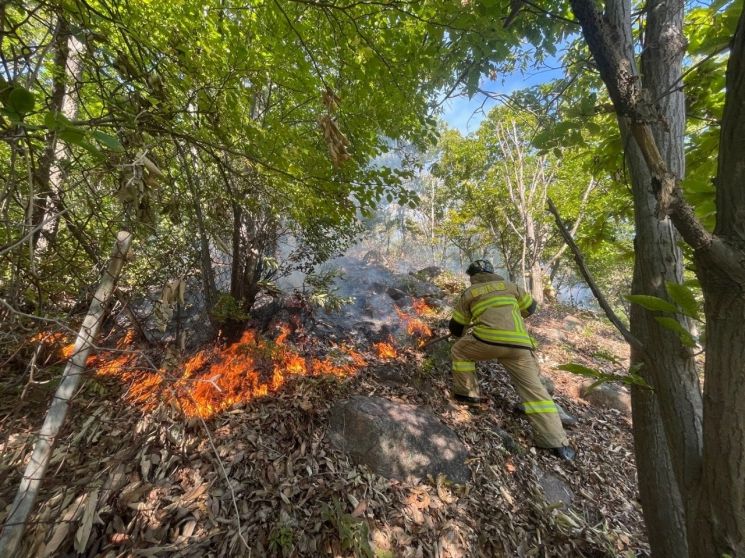 Around 2:38 PM on the 12th, a fire broke out in the hills of Okgok-myeon, Gwangyang-si, Jeollanam-do, and firefighters are seen conducting extinguishing operations. Photo by Yonhap News
[Asia Economy Culture Young Intern Reporter] Local governments are establishing wildfire suppression strategies to respond to increasingly large and year-round wildfires. Late autumn, in particular, is prone to fires due to dry air and low humidity compared to other seasons.
According to the Korea Forest Service, 632 wildfires occurred up to September this year. This is a 30% increase compared to the recent 10-year average of 481 cases. Large wildfires over 100 hectares surged from 2 cases last year to 11 cases this year. Wildfires occurring in September and October also increased 1.5 times to 29 cases this year, compared to the recent 10-year average of 20 cases.
On October 12, a fire broke out on a hill in Gwangyang-si, Jeollanam-do. According to the Jeonnam Fire Headquarters, it is estimated that the fire spread due to carelessness while burning trash. Seven pieces of equipment including helicopters and 24 personnel were mobilized to extinguish the fire about two hours after it started. Around 1:38 p.m. on October 30, a fire broke out near a hill cultivation area in Daedeok-myeon, Damyang-gun, Jeollanam-do. Authorities are investigating the exact cause, suspecting that the fire spread while burning bamboo leaves. Fortunately, no casualties were reported in either wildfire.
There are quite a few cases where burning trash leads to large fires. Especially in the dry late autumn weather, small sparks can easily spread into large fires. Around 10 p.m. on November 14 last year, a fire caused by trash burning in Yangyang-gun, Gangwon-do, spread into a wildfire. The flames spread along the mountain ridge, and the rugged terrain made wildfire suppression difficult. In Chungbuk, seven wildfires occurred during the autumn wildfire caution period over the past 10 years until last year, all of which were found to be 'human-caused.' Among these, three cases were due to trash burning.
According to Korea Forest Service data, the main causes of wildfires are fires caused by visitors' mistakes and burning-related wildfires, with an average of 440 wildfires occurring annually over the past 10 years. The resulting forest damage covers 857 hectares, equivalent to 1,174 times the size of a soccer field.
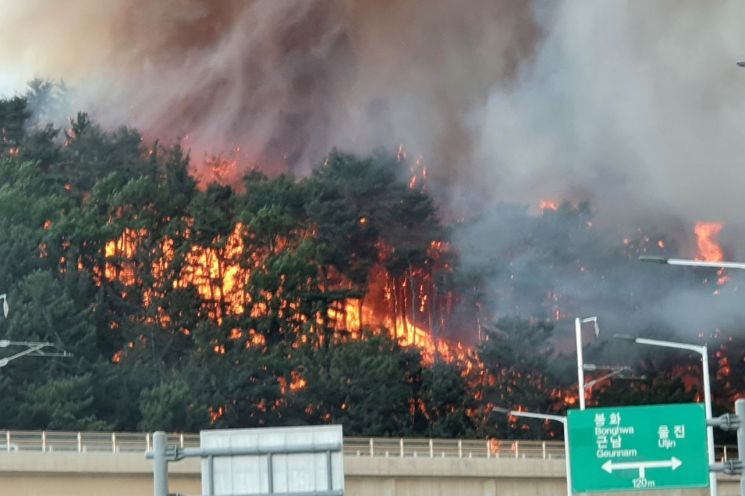 On May 28th, a fire is spreading around a hill in Geunnam-myeon, Uljin-gun, Gyeongbuk. Photo by Yonhap News
Spring wildfires, which were concentrated in March and April, are becoming year-round due to climate change, and the scale of wildfires is also increasing. There are opinions that the traditional wildfire season is disappearing. Currently, the Korea Forest Service's wildfire caution period is five months in total, covering spring (February 1 to May 15) and autumn (November 1 to December 15).
However, in 1990, there were 112 days in a year with at least one wildfire, but in the past three years, this has increased by 57 days to 169 days. This is analyzed to be influenced by abnormal high temperatures and drought in winter, and heatwaves in summer. In particular, wildfires are increasing in January, June, and August, which were previously considered off-season for wildfires.
It is also noteworthy that large wildfires over 100 hectares or lasting more than 24 hours have occurred in February and May. In February 2021, a large wildfire occurred in Andong, Gyeongbuk; in May 2020, in Goseong, Gangwon-do; and in February 2018, in Samcheok, Gangwon-do. The period of concentrated large wildfires is gradually expanding. The Uljin-Samcheok wildfire, recorded as the longest wildfire since statistics began in 1986, also occurred in March this year. The wildfire that started on March 4 lasted for more than ten days.
Meanwhile, the Korea Forest Service has established strengthened countermeasures through analysis and evaluation of changes in wildfire occurrence types and past wildfire suppression efforts. The wildfire suppression strategy is shifting to focus on ultra-large helicopters, and wildfire suppression infrastructure centered on forest roads is being greatly expanded. The plan is to expand wildfire suppression helicopters to 58 units and special suppression teams to 2,223 personnel by 2027. Forest roads for wildfire suppression will also be expanded, and wildfire response capabilities will be strengthened by creating firebreak forests (fire-resistant forest belts).
© The Asia Business Daily(www.asiae.co.kr). All rights reserved.
![Clutching a Stolen Dior Bag, Saying "I Hate Being Poor but Real"... The Grotesque Con of a "Human Knockoff" [Slate]](https://cwcontent.asiae.co.kr/asiaresize/183/2026021902243444107_1771435474.jpg)
















