49% Decrease Compared to Last Year... Increase in Unsold Units
Decline in Groundbreaking... Monthly Rent Accounts for Half of Lease Transactions
Concerns Over Hard Landing Persist Despite Last Week's Deregulation
Additional Deregulation of Restricted Areas in November, Focus on 수도권
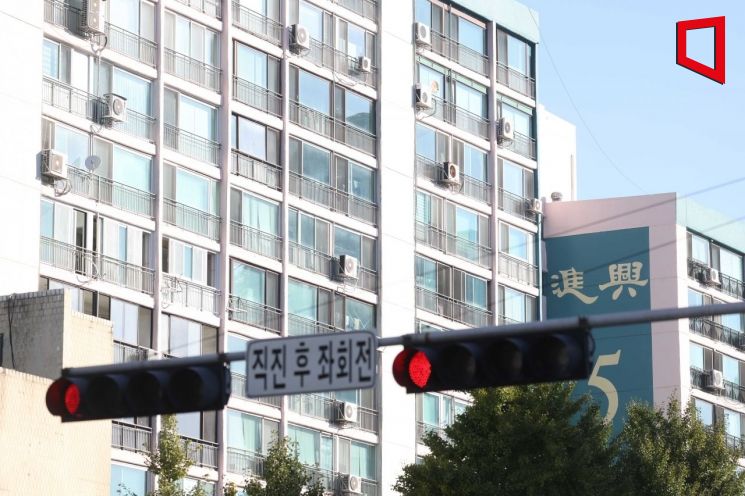
Amid the deepening real estate transaction freeze caused by interest rate hikes and economic recession, the number of unsold houses continues to rise. Although the government announced deregulation measures last week, concerns about a hard landing in the real estate market remain unresolved.
◆Housing sales volume from January to September down 49% year-on-year... Unsold houses also on the rise
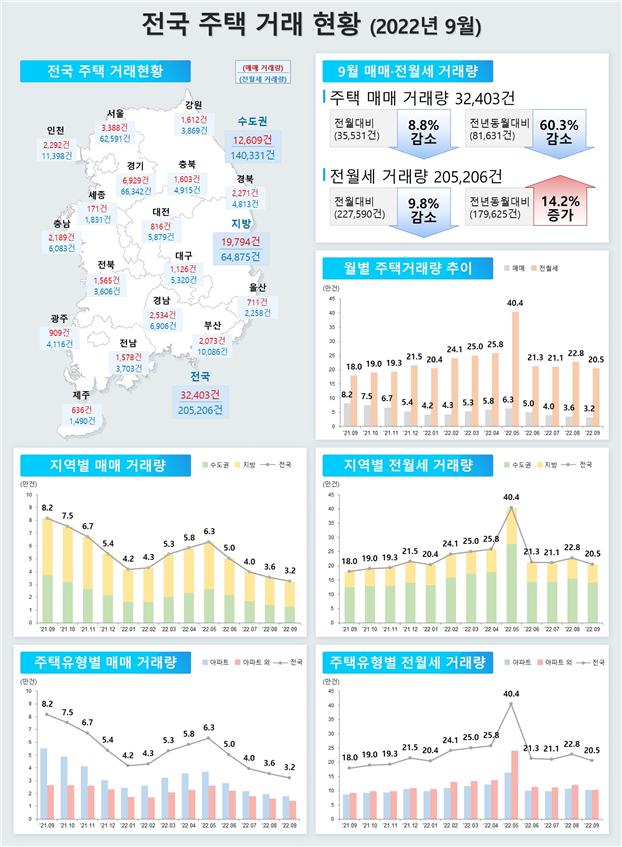
According to the Ministry of Land, Infrastructure and Transport on the 30th, the total number of housing sales nationwide from January to September this year was 417,794, a 49.0% decrease compared to the same period last year (818,948).
By region, the Seoul metropolitan area (167,057 cases) decreased by 59.2%, and other regions (250,737 cases) decreased by 40.2%.
By type, apartments (243,513 cases) decreased by 55.6%, and non-apartment houses (177,280 cases) decreased by 35.5%.
Looking at September alone, the transaction volume was 32,403 cases, down 8.8% from the previous month (35,531 cases) and down 60.3% compared to the same month last year (81,631 cases).
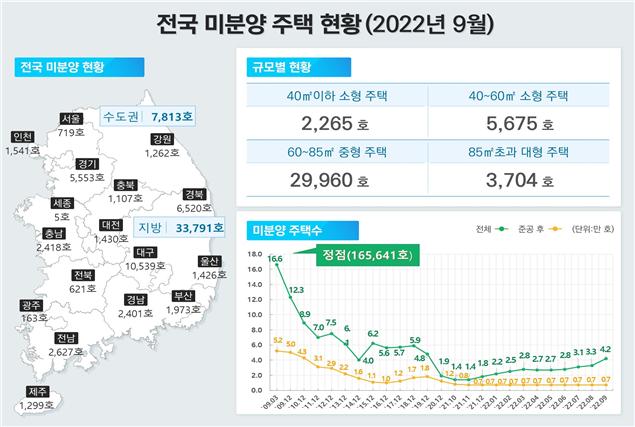
Unsold houses have steadily increased amid the unprecedented transaction freeze.
The number of unsold houses bottomed out at around 14,000 units in October-November last year and has been increasing every month this year.
As of the end of September, the total number of unsold houses nationwide was 41,604 units, up 27.1% from the previous month (32,722 units). By region, the Seoul metropolitan area saw a sharp increase of 55.9% from 5,012 units to 7,813 units. Other regions increased by 21.9% from 27,710 units to 33,791 units. The number of unsold houses bottomed out at around 14,000 units in October-November last year and has been increasing every month this year.
◆Decrease in housing starts amid recession concerns... Monthly rent accounts for half of lease transactions
The total number of lease transactions (based on reporting date) in September, combining lease reporting system data and fixed-date reporting data, was 205,206 cases, an increase of 14.2% compared to the same period last year (179,625 cases).
Looking at the cumulative total from January to September, this year recorded 2,214,166 cases, up 26.3% from the same period last year (1,753,227 cases). The proportion of monthly rent in lease transactions was 51.8%, up 8.8 percentage points from 43.0% in the same month last year.
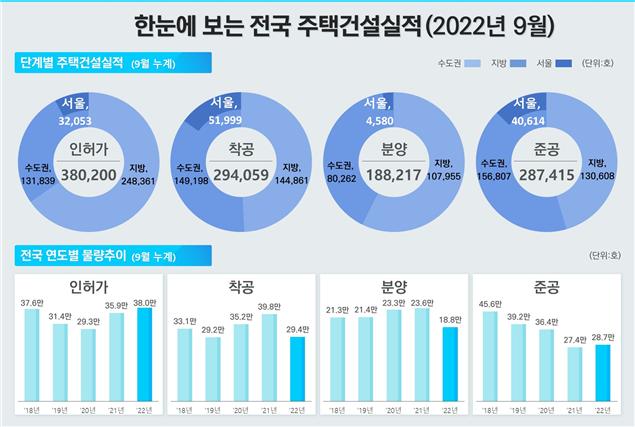
The number of housing permits from January to September nationwide was 380,200 units, an increase of 5.9% compared to the same period last year (358,990 units).
By region, the Seoul metropolitan area recorded 131,839 units, down 28.3% year-on-year, while other regions recorded 248,361 units, up 41.8%.
By type, apartments increased by 16.2% to 312,229 units, while non-apartment houses decreased by 24.8% to 67,971 units.
Amid rising raw material costs and recession concerns affecting the construction industry, the cumulative housing starts as of September nationwide were 294,059 units, down 26.1% compared to the same period last year (397,657 units).
By region, the Seoul metropolitan area recorded 149,198 units, down 24.8% year-on-year, and other regions recorded 144,861 units, down 27.3%.
Apartments decreased by 24.1% to 227,477 units, and non-apartment houses decreased by 32.0% to 66,582 units.
The supply volume of multi-family housing nationwide up to September was 188,217 units, down 20.1% compared to the same period last year.
Among these, the Seoul metropolitan area decreased by 26.5% to 80,262 units, and other regions decreased by 14.6% to 107,955 units.
By type, general sales were 148,010 units, down 15% from the same period last year, rental housing was 15,552 units, down 53.5%, and cooperative members' units decreased by 11.9% to 24,655 units.
The number of housing completions nationwide totaled 287,415 units, an increase of 4.8% compared to January-September last year.
The Seoul metropolitan area recorded 156,807 units, down 5.0%, while other regions recorded 130,608 units, up 19.8%.
By type, apartments increased by 8.7% to 219,418 units, while non-apartment houses decreased by 5.8% to 77,997 units.
◆Concerns over hard landing persist despite deregulation... Attention on additional deregulation in the Seoul metropolitan area
As concerns over a hard landing in the real estate market due to falling apartment prices and transaction freezes grow, the government announced a series of deregulation measures last week.
The loan-to-value ratio (LTV) for mortgage loans was eased to 50% for the homeless and one-homeowners planning to dispose of their existing homes, and mortgage loans were allowed for apartments exceeding 1.5 billion won in speculative and overheated speculation districts. The threshold for restricting interim payment group loans was raised from 900 million won to 1.2 billion won in sale prices.
While the market responded positively, some view these measures as insufficient to prevent a hard landing.
In particular, the cumulative decline rate of apartments in the Seoul metropolitan area up to September this year has surpassed the annual decline rate of 2013. The decline is steep in areas such as Gyeonggi, Incheon, and northern Seoul, which is why there are expectations that some parts of the Seoul metropolitan area may be removed from regulated areas in the upcoming month.
If removed from the adjustment target areas, financial regulations such as subscription restrictions, LTV, and debt-to-income ratio (DTI) will be eased, along with reductions in various taxes such as capital gains tax and comprehensive real estate tax. Therefore, local governments in the Seoul metropolitan area are demanding deregulation.
The Ministry of Land, Infrastructure and Transport is reportedly planning to hold the Housing Policy Deliberation Committee (Jujeongshim) as soon as Minister Won Hee-ryong returns from his business trip to Saudi Arabia early next month.
Kwon Hyuk-jin, Director of the Housing and Land Office at the Ministry of Land, Infrastructure and Transport, said, "We plan to hold the Jujeongshim early in November," adding, "We will lift regulation areas considering housing price decline areas and transaction volumes."
© The Asia Business Daily(www.asiae.co.kr). All rights reserved.
![Clutching a Stolen Dior Bag, Saying "I Hate Being Poor but Real"... The Grotesque Con of a "Human Knockoff" [Slate]](https://cwcontent.asiae.co.kr/asiaresize/183/2026021902243444107_1771435474.jpg)


















