Weekly Average Daily Confirmed Cases Reach 30,000 Range
Increase in Detection Rate of BQ.1 and BQ.1.1 Variant Viruses
Influenza Suspected Cases Hit Highest Level Since February 2020
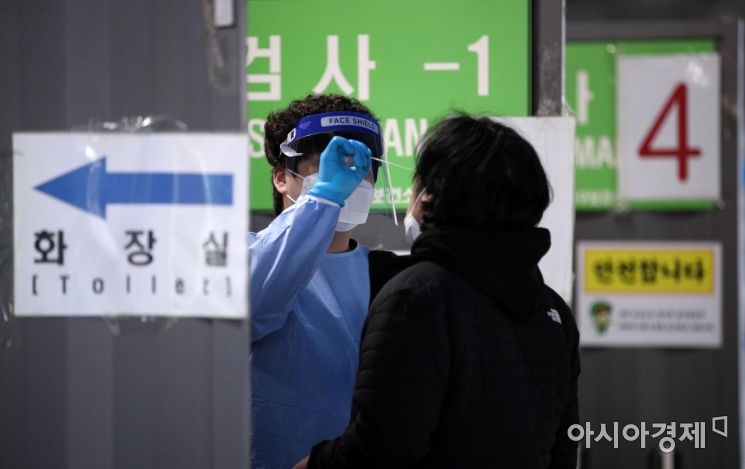 On the 25th, when the number of new COVID-19 cases was recorded at 43,759, entering the 40,000 range for the first time in 34 days, citizens were undergoing PCR tests at the screening clinic of Yongsan-gu Public Health Center in Seoul. Photo by Hyunmin Kim kimhyun81@
[Asia Economy reporters Byeon Seon-jin and Kim Young-won] Early signs of the 7th wave of COVID-19, initially expected in early December, are appearing in various epidemic indicators. The number of confirmed COVID-19 cases is not decreasing but showing an increasing trend, and the severity and mortality rates among the elderly are rapidly rising. The high domestic detection rate of variant viruses with strong transmissibility and immune evasion is a factor raising concerns about the acceleration of the spread. Additionally, with the recovery of daily life and the concurrent influenza (flu) epidemic, the quarantine authorities view this winter as a critical period for a 'twindemic' (simultaneous epidemic of two infectious diseases).
Weekly average daily confirmed cases in the 30,000 range... the scale is gradually increasing
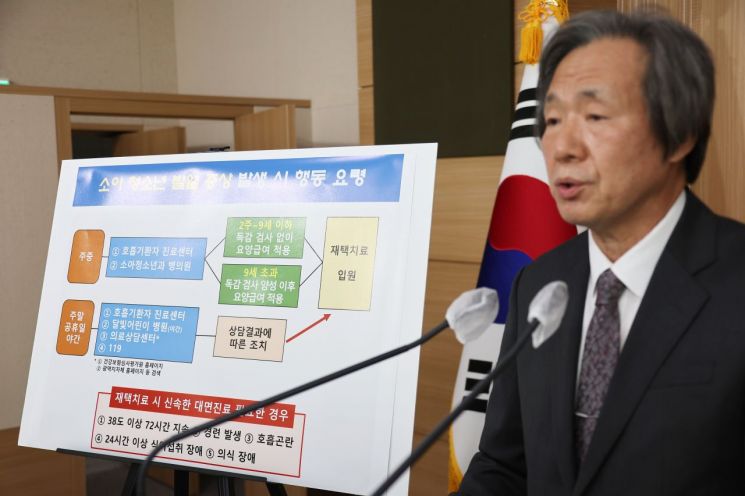
Jung Ki-seok, head of the COVID-19 Special Response Team and advisor to the National Infectious Disease Crisis Response Committee, stated at the regular briefing on October 31 that regarding the early stage of the 7th wave, "If the number of COVID patients suddenly increases one day and this phenomenon continues, it can be definitively called the 7th wave," adding, "Since the immunity formed by the March Omicron pandemic (5th wave) will be completely gone by November, an increase in mid-November or early December is inevitable."
The reason for concerns that the current time marks the beginning of the 7th wave is that the weekly average daily confirmed cases, which had been maintained in the 20,000 range since late September, surpassed 30,000 for the first time in 31 days on September 27 with 30,258 cases, following 32,237 cases on September 26. On the 31st, which marked the fifth consecutive day in the 30,000 range, the weekly average daily confirmed cases reached 35,122, indicating an increasing scale. The infection reproduction number (Rt) for the fourth week of October (23?27) was 1.09, exceeding 1 for two consecutive weeks following the previous week (1.09). An Rt above 1 indicates epidemic expansion.
The number of severe and critical patients hospitalized due to COVID-19 is increasing, and deaths are on the rise. Over the past five weeks, the severity rate rose from 0.12% to 0.19%, and the fatality rate increased from 0.06% to 0.09%. Regarding this, Mr. Jung said, "Although the numbers seem small, the relative increase rate is significant, with severity and fatality rates each rising by 50%, so it is a time when the quarantine authorities need to be vigilant," adding, "The proportion of confirmed cases among high-risk groups aged 60 and above is increasing." The bed occupancy rate, which had been maintained at around 18?19% since early October, recently fluctuated between 23?24%.
Another concern is that variant viruses with stronger immune evasion and transmissibility than the dominant BA.5 have begun to be detected domestically. Subcategories of BA.5, BQ.1 and BQ.1.1, have risen to double-digit shares within a month in the US and Europe, and due to rapid spread, it is forecasted that their share will reach 90% by January next year. According to the Korea Disease Control and Prevention Agency, BQ.1, first detected domestically on the 8th of last month, had a detection rate of 1.2% in the third week of October, and BQ.1.1, first confirmed on the 13th, had a detection rate of 2.5%, representing increases of 2.4 times and 6.25 times respectively compared to the previous week.
Influenza epidemic intensifies... highest number of suspected cases since February 2020
The influenza epidemic is also intensifying. According to the Korea Disease Control and Prevention Agency's 'Infectious Disease Sentinel Surveillance Weekly Report,' the proportion of patients showing suspected influenza symptoms per 1,000 outpatients was 7.6 during October 16?22 (week 43), the highest since February 2020. This level far exceeds the epidemic threshold of 4.9 for this season. During the same period in 2020?2021, strengthened quarantine and hygiene measures such as mask-wearing and social distancing kept the figure at around 1. The number of suspected influenza cases among infants and adolescents (ages 1?18) increased by 25.1%, from 23.9 (week 42) to 29.9 (week 43). Since influenza typically spreads in the order of infants → young adults → middle-aged → elderly, there is speculation that the influenza epidemic may worsen for some time.
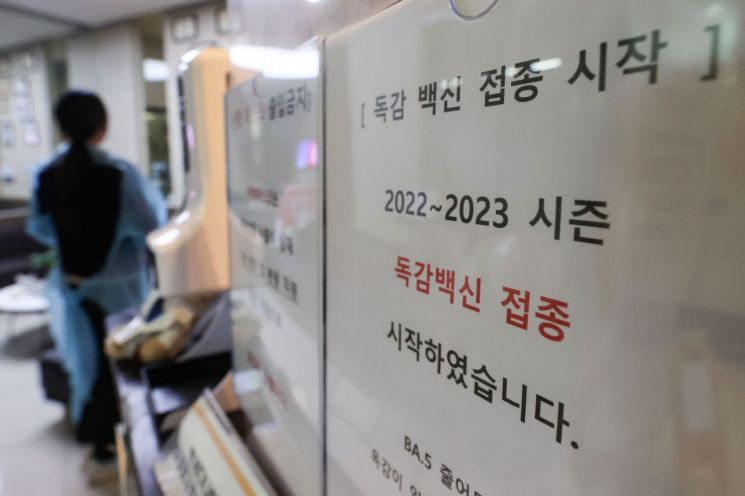
"Get vaccinated"... yet vaccination rates remain low
Experts say that to get through this winter well, it is important to hurry with vaccinations. Mr. Jung warned, "The only way is to build artificial immunity by getting vaccinated," adding, "If immunity is not high, severity and fatality rates will inevitably increase." Regarding COVID vaccines, since October 27, pre-booking for the bivalent vaccines developed to respond to Omicron BA.1, BA.4, and BA.5 has been expanded to all adults, and from the 14th, same-day vaccination for all types of vaccines will be possible. Influenza vaccines are available free of charge for children aged 6 months to 13 years, pregnant women, and seniors aged 65 and above, but others must pay 30,000 to 40,000 KRW per dose.
However, the COVID vaccine uptake rate during the winter season remains at around 1.5%, and many avoid influenza vaccination due to cost, which is a challenge for the quarantine authorities to address. Kim, a 31-year-old office worker who refuses winter vaccination, said, "I caught COVID-19 just one month after my second vaccine dose, so I doubt the vaccine's effectiveness." Regarding the influenza vaccine, Yang, a 25-year-old newcomer to society, said, "I am used to free vaccinations due to COVID, so I think the 30,000 KRW influenza vaccine is expensive."
Baek Soon-young, emeritus professor at the Catholic University School of Medicine, advised, "If too many people show respiratory symptoms, the number of people getting COVID-19 tests will increase, and if multiple viruses spread simultaneously, there could be a shortage of hospital beds," adding, "Diagnostic testing should be conducted quickly to enable timely identification, and special hospital beds must be reliably secured."
© The Asia Business Daily(www.asiae.co.kr). All rights reserved.
![Clutching a Stolen Dior Bag, Saying "I Hate Being Poor but Real"... The Grotesque Con of a "Human Knockoff" [Slate]](https://cwcontent.asiae.co.kr/asiaresize/183/2026021902243444107_1771435474.jpg)


















