Announced at the National Science and Technology Advisory Council on the 28th, 50 Detailed Technologies Also Confirmed
Next-Generation Nuclear Power and Advanced Mobility Added to Existing 10 Essential Strategic Technologies
[Asia Economy Reporter Kim Bong-su] The government has added two new national strategic technologies to be intensively nurtured and protected for technological hegemony competition and economic security: next-generation nuclear power and advanced mobility. The national research and development (R&D) budget allocated to these fields will also be slightly increased.
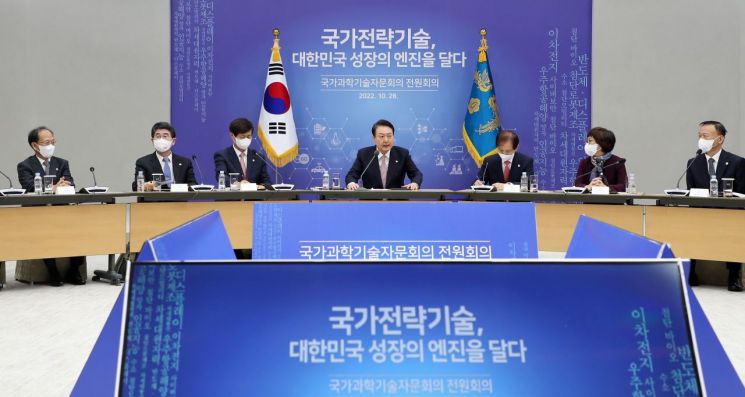
On the morning of the 28th, the Ministry of Science and ICT announced the "National Strategic Technology Development Plan" at the plenary meeting of the National Science and Technology Advisory Council held at the Yongsan Presidential Office, presided over by President Yoon Suk-yeol. Previously, the Moon Jae-in administration had designated 10 essential national strategic technologies for the same purpose in December last year. Two new fields were added: next-generation nuclear technologies such as Small Modular Reactors (SMR) and advanced mobility such as Urban Air Mobility (UAM). Additionally, the aerospace sector was expanded to aerospace and marine fields by including marine technology. The existing 10 essential strategic technologies included artificial intelligence, 5G/6G, advanced bio, semiconductors and displays, secondary batteries, hydrogen, advanced robotics and manufacturing, quantum technology, aerospace, and cybersecurity. Alongside this, 50 detailed key technologies were also identified for each field. Joo Young-chang, Director of the Science and Technology Innovation Bureau at the Ministry of Science and ICT, explained in a pre-briefing on the 27th, "The rapidly changing domestic and international situation has brought next-generation nuclear technology to the forefront as an alternative in carbon neutrality, and advanced mobility has emerged as a major next-generation transportation means. The marine sector was added from the perspective of resource acquisition."
The government plans to focus on nurturing and protecting these 12 strategic technology fields going forward. First, strategic roadmaps for each technology will be established to strengthen strategic investments. The national R&D investment in the 12 fields will increase by 10.1%, from 3.74 trillion KRW this year to 4.12 trillion KRW next year. Approximately 265.1 billion KRW will be newly invested in urgently needed technology development such as 5G Open RAN, quantum computing and sensors, and innovative SMRs. The Ministry of Science and ICT stated, "While the overall R&D investment budget growth rate is 3.0%, the 12 strategic technology fields will see a much higher increase of 10.1%. Rather than a simple quantitative expansion, we will establish a cross-ministerial strategic roadmap that clearly defines the missions and technology development goals at the national level for each detailed key technology unit to enable strategic investment."
To respond to the rapidly changing technological environment, the government will also support mission-oriented performance creation by flexibly applying preliminary feasibility studies for R&D. Efforts will be made to secure core talent, strengthen international cooperation, and designate and nurture research hubs in industry-academia-research sectors. In particular, a "National Strategic Technology Special Committee" will be established within the Science and Technology Advisory Council, chaired by the president, to oversee and coordinate the designation and management of strategic technologies and the establishment of basic plans.
A public-private joint Strategic Technology Promotion Group will also be created under the Science and Technology Innovation Bureau. The enactment of a National Strategic Technology Special Act is also planned. Through this, the goal is to expand the number of strategic technology fields with technology levels exceeding 90% of the leading countries from three in 2020 to eight or more by 2027. The plan envisions becoming a technology sovereign nation by 2027 by securing super-gap technologies and future economic security, leading future innovative technologies through fostering new industries, and cultivating a strong advanced science and technology force, ultimately ranking among the global top five technology powers.
Minister of Science and ICT Lee Jong-ho said, "In the geopolitical structure where science and technology are at the center of the international order, we must concentrate the capabilities of both government and private sectors to nurture the 12 strategic technologies, which are the core links of the national economy and security."
Meanwhile, the meeting was held for the first time under the theme "Equipping National Strategic Technologies as the Engine of Korea's Growth," with newly appointed Vice Chairman Lee Woo-il and 19 private members attending since the start of the Yoon Suk-yeol administration.
© The Asia Business Daily(www.asiae.co.kr). All rights reserved.
![Clutching a Stolen Dior Bag, Saying "I Hate Being Poor but Real"... The Grotesque Con of a "Human Knockoff" [Slate]](https://cwcontent.asiae.co.kr/asiaresize/183/2026021902243444107_1771435474.jpg)
















