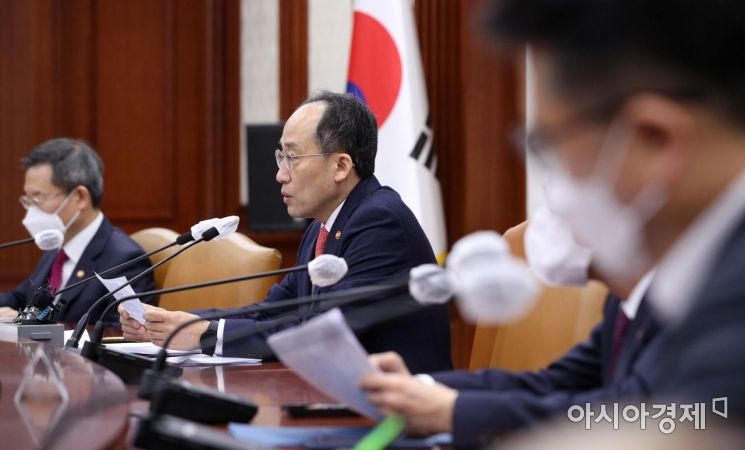
 Deputy Prime Minister and Minister of Economy and Finance Choo Kyung-ho is presiding over the Emergency Economic Ministers' Meeting held at the Government Seoul Office in Jongno-gu, Seoul, on the 28th. Photo by Hyunmin Kim kimhyun81@
[Asia Economy Sejong=Reporter Kim Hyewon] The government will release a total of 10,500 tons of stockpiled garlic, chili peppers, onions, salt, and other ingredients into the market to manage the supply and prices of kimchi-making materials.
The Ministry of Agriculture, Food and Rural Affairs, the Ministry of Oceans and Fisheries, and the Ministry of SMEs and Startups announced the "2022 Kimchi Ingredient Supply Stabilization Measures" at an emergency economic ministers' meeting chaired by Deputy Prime Minister and Minister of Economy and Finance Choo Kyung-ho on the 28th.
For garlic, 5,000 tons of stockpiled peeled garlic will be processed and supplied to large supermarkets on the condition of a 30% discount to consumers. Dried chili peppers will be released at about 500 tons weekly, totaling 1,400 tons, and onions will be released at 240 to 500 tons weekly, totaling 3,600 tons into the market.
The government expects a decrease in solar salt production and plans to supply 500 tons from stockpiles to the market, selling it to consumers at up to 30% lower prices. Due to early monsoon rains reducing sunlight and lower average temperatures, solar salt production this year is projected to be 260,000 tons, a 7.1% decrease from last year.
Production of the main kimchi ingredients, napa cabbage and radish, is expected to be at last year's levels, with plans to strengthen growth management. Red pepper powder and mustard greens will be supplied at last year's levels, while the supply of green onions, salted shrimp, and anchovy fish sauce is expected to increase compared to last year.
The government will support price discount events for kimchi ingredients to reduce the burden on consumers. The Ministry of Agriculture, Food and Rural Affairs will conduct discounted sales of agricultural products at 820 locations, including marts, traditional markets, local agricultural product direct stores (local food), eco-friendly stores, and online malls from December 3 to December 7, linked with agricultural and livestock product discount support projects.
Kimchi vegetables will be sold at a 20% discount, and traditional markets will offer discounts up to 30%. The maximum discount limit is 30,000 won. Nonghyup will also sell kimchi vegetables at 5 to 40% discounts by item at Hanaro Mart and online malls.
The Ministry of Oceans and Fisheries will sell solar salt, salted shrimp, and anchovy fish sauce at discounted prices at the "Korea Seafood Festa" held from the 31st to the 16th of next month. From December 11 to 20, 15 traditional seafood markets will hold an event where customers purchasing kimchi ingredients can receive up to 30% (with a 20,000 won per person limit) back in Onnuri gift certificates.
The Ministry of SMEs and Startups will raise the purchase limits for Onnuri gift certificates in November and December. The purchase limits by type are 1 million won for card type, 700,000 won for paper type, and 1 million won for mobile type.
The government will operate a "Kimchi Ingredient Supply Stabilization Task Force" starting next month to ensure smooth supply and discounts of kimchi ingredients. The task force will include staff from the Ministry of Agriculture, Food and Rural Affairs, the Ministry of Oceans and Fisheries, the Ministry of SMEs and Startups, and Nonghyup.
Deputy Prime Minister Choo said, "As the kimchi-making season begins in November, price volatility centered on kimchi ingredients may increase. We will thoroughly manage supply and prices for all kimchi ingredients to ensure that kimchi prices remain lower than last year."
According to a survey conducted by the Korea Rural Economic Institute from the 17th to 19th targeting 622 people, the average kimchi-making scale was 21.8 heads of cabbage (based on a four-person household), down from 22.1 heads last year. 55.6% of respondents said their kimchi-making scale would be "similar to last year." 30.2% said they would reduce it compared to last year, with 34.6% of those citing "cost burden" as the reason.
© The Asia Business Daily(www.asiae.co.kr). All rights reserved.
![Clutching a Stolen Dior Bag, Saying "I Hate Being Poor but Real"... The Grotesque Con of a "Human Knockoff" [Slate]](https://cwcontent.asiae.co.kr/asiaresize/183/2026021902243444107_1771435474.jpg)















