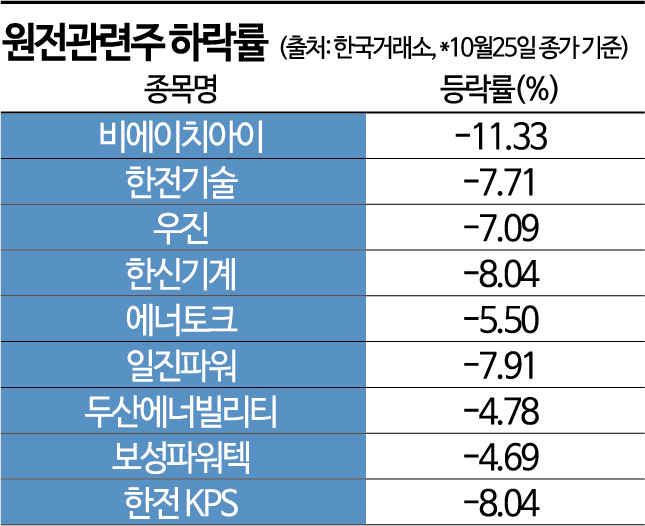
[Asia Economy Reporter Kwon Jae-hee] Nuclear power stocks, which had been on the rise riding the 'Tae·Jo·I·Bang·Won (Solar Power·Shipbuilding·Secondary Battery·Defense·Nuclear Power)' theme, have encountered a setback due to a lawsuit filed by a U.S. company. The core of the lawsuit is a request to prohibit Korean nuclear power companies from exporting to other countries without U.S. approval. As a result, domestic nuclear power-related stocks, including Doosan Enerbility, are showing a series of declines.
According to the Korea Exchange as of 9:22 a.m. on the 26th, Doosan Enerbility was trading at 13,050 KRW, up 0.77% from the previous trading day. The previous day, Doosan Enerbility closed down 4.78%. Based on the closing prices on the 25th, Woojin fell 7.09%, and Hanshin Machinery closed down 8.04%.
The reason nuclear power-related stocks are showing a series of declines is that the U.S. nuclear company Westinghouse has filed a lawsuit against Korea Hydro & Nuclear Power (KHNP). The key issue in the lawsuit is Westinghouse's claim that KHNP used the APR1400 and APR1000 designs under a license agreement with Westinghouse, and the court is requested to rule that the APR1400 and APR1000 nuclear power plant designs are technologies subject to export control under Section 810. Since Westinghouse’s intellectual property rights are included in the APR1400 reactor design, prior approval from the U.S. is required under Section 123 of the U.S. Atomic Energy Act. In other words, Westinghouse is requesting to block Korean nuclear exports if cooperation with Westinghouse does not occur.
As a result, orders worth up to 70 trillion KRW are expected to be disrupted. KHNP and Poland are scheduled to sign a letter of intent related to nuclear power plant construction in two weeks. Accordingly, domestic nuclear power stocks showed a significant rise last week on expectations of orders. Due to Westinghouse’s lawsuit, disruptions are expected not only in Poland but also in the Czech Republic and Saudi Arabia, where new nuclear export projects are underway. The combined project scale of Poland, the Czech Republic, and Saudi Arabia is approximately 70 trillion KRW.
This is not the first time that U.S. Westinghouse has filed a lawsuit against KHNP. Since 2017, there has been conflict over intellectual property rights related to the APR1400. When exporting four nuclear reactors to the United Arab Emirates (UAE) in 2009, intellectual property issues were also raised. At that time, KHNP paid Westinghouse technical consulting fees and obtained approval from the U.S. side.
Analysts say this lawsuit also has a strong character of a check. Westinghouse is competing with KHNP and ?lectricit? de France (EDF) for the new nuclear power project in Poland. The Polish government plans to build six pressurized water reactors with a capacity of 6?9 GW and is expected to select a project operator as early as the end of this year. The Czech Republic’s new nuclear project is also being competed for by these three companies. The Czech government plans to introduce one nuclear reactor by 2036, with a high possibility of adding three more depending on contract conditions.
Kim Yoon-jung, a researcher at Ebest Investment & Securities, said, "Korean nuclear power has advantages over competing countries in terms of price, financing capability, and reliability," adding, "If the Westinghouse intellectual property claim causes disruptions in orders, it is expected to affect the Yoon Suk-yeol administration’s policy direction of exporting 10 nuclear reactors by 2030."
© The Asia Business Daily(www.asiae.co.kr). All rights reserved.
![Clutching a Stolen Dior Bag, Saying "I Hate Being Poor but Real"... The Grotesque Con of a "Human Knockoff" [Slate]](https://cwcontent.asiae.co.kr/asiaresize/183/2026021902243444107_1771435474.jpg)
















