Canada Ottawa University Dr. Stephan Arisbroso Research Team
"Regions with Large Inflows of Melted Glacier Water Have Higher Risk of Virus Leakage"
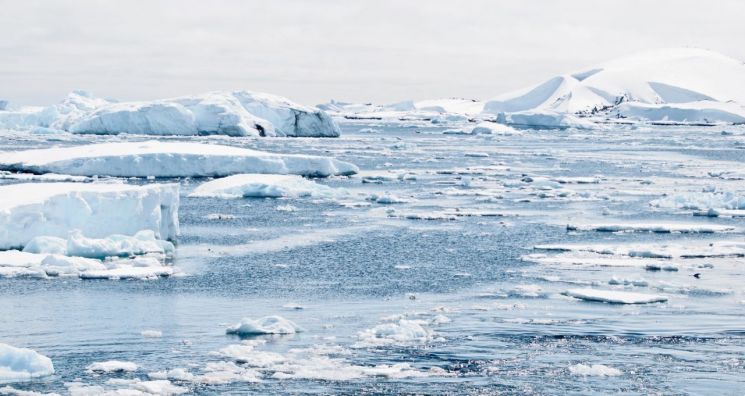
[Asia Economy Reporter Kim Jung-wan] As global warming causes glaciers worldwide to melt rapidly, a study has found that ancient viruses never before encountered may emerge and infect wildlife.
On the 24th (local time), according to the British daily The Guardian, a research team led by Dr. Stephan Arisbrose from the University of Ottawa in Canada reported that areas where large amounts of meltwater from glaciers flow into the Arctic freshwater lake 'Hazen Lake' in Ellesmere, Nunavut, Canada, have a higher risk of virus leakage.
The research team collected soil and sediment samples from Hazen Lake, where glacier meltwater flows in, and analyzed the RNA and DNA sequences to identify characteristics of known viruses and bacteria. They also conducted experiments to assess the likelihood of these viruses infecting organisms. As a result, they concluded that viruses and bacteria dormant in glaciers and permafrost have awakened and the possibility of infecting new hosts such as local wildlife has increased.
However, the research team stated that it has not yet been clearly proven whether the viruses discovered in this study are the first of their kind to humanity, or whether these viruses can actually cause infection and transmission. The team plans to specify information about the viruses within a few months. The Guardian emphasized that this study is the latest research proving that viruses never before experienced by humanity could emerge due to glacier loss.
In fact, similar cases leading to death have occurred repeatedly. In July last year, viruses dating back 15,000 years were found in ice samples from the Tibetan Plateau at an altitude of 6,500 meters. Thirty-three viruses were identified in the ice at that time, of which 28 were viruses humanity encountered for the first time. Half of the discovered viruses were presumed to have survived even in the freezing environment where the ice formed.
Also, in 2016, an anthrax outbreak in northern Siberia caused the death of a child and infected at least seven people. Due to a heatwave, the permafrost melted, exposing reindeer carcasses, and anthrax bacteria spread, resulting in multiple infections. In 2014, a 30,000-year-old virus named 'Mollivirus sibericum' was discovered in Siberian permafrost.
© The Asia Business Daily(www.asiae.co.kr). All rights reserved.
![Clutching a Stolen Dior Bag, Saying "I Hate Being Poor but Real"... The Grotesque Con of a "Human Knockoff" [Slate]](https://cwcontent.asiae.co.kr/asiaresize/183/2026021902243444107_1771435474.jpg)















