Neighbor Conflicts and Assaults Occur
Even in No-Smoking Apartments, Blind Spots Like Hallways and Stairs Are Common
Interfloor Smoking Ban Bill Pending for 2 Years
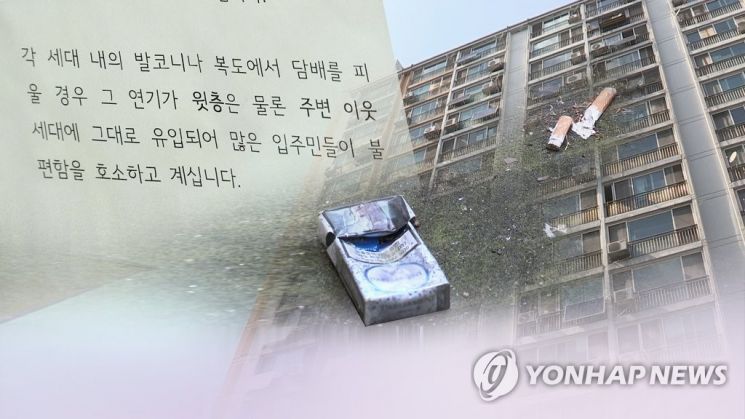
[Asia Economy Reporter Han Seung-gon] Complaints about secondhand smoke in apartments and other multi-family housing are increasing. In some cases, severe disputes and conflicts with neighbors escalate into violent incidents.
Complaints about secondhand smoke, including noise between floors, have been steadily rising recently. According to data submitted by the Ministry of Land, Infrastructure and Transport on the 23rd to Min Hong-chul, a member of the National Assembly's Land, Infrastructure and Transport Committee from the Democratic Party of Korea, over the five years from 2017 to 2021, there were 135,232 cases where residents of multi-family housing reported damage caused by noise between floors or secondhand smoke, prompting the management entity to conduct investigations to verify the facts. By year, the numbers were ▲15,091 cases in 2017 ▲18,503 in 2018 ▲23,654 in 2019 ▲34,605 in 2020 ▲43,379 in 2021, showing an annual increase.
Secondhand smoke is known to be more harmful to health than direct smoking. The smoke inhaled by non-smokers is the smoke exhaled by smokers after inhalation, and the smoke directly emitted from the burning cigarette tip contains a much higher concentration of carcinogens and is harmful to the human body.
Secondary and Tertiary Secondhand Smoke, Invisible Violence
Not only secondary smoke but tertiary smoke can also cause serious harm. Tertiary smoke refers to situations where people are affected without direct exposure to smoke. For example, it refers to the transfer of cigarette smoke residues on a smoker's body, clothes, or hair to others.
According to research by the Lawrence Berkeley National Laboratory under the U.S. Department of Energy, over 50 types of volatile organic compounds remain for up to 18 hours after tertiary smoke exposure. The study found that nicotine reacts with ozone to create ultrafine harmful particles, which are absorbed into the body through skin contact or inhalation of dust. Tertiary smoke exposure is also believed to cause genetic damage to cells.
Another study showed that even if a smoking father smokes outdoors, the nicotine concentration in the hair of his wife and children under 12 was about twice as high compared to non-smoking households.
Ultimately, secondhand smoke is not just a source of neighborly conflict but a behavior that causes fatal health damage, leading to disputes and even violent incidents.
On the 3rd, in an apartment complex in Yeongtong-gu, Suwon-si, Gyeonggi-do, residents involved in a conflict over secondhand smoke physically assaulted each other, prompting police intervention. Also, in an apartment in Nam-gu, Busan, a resident protested secondhand smoke damage by throwing protest notes and eggs at neighbors.
Realistic Difficulties in Mediation by Management Offices
In response, local governments are implementing a "No Smoking Apartment" system that designates no-smoking zones in apartment complexes. If more than half of the households in a multi-family housing complex agree, the local government can designate the complex as a no-smoking zone, and smoking in these zones can result in a fine of up to 100,000 KRW.
However, the entire complex is not designated as a no-smoking zone. Smoking is prohibited only in four areas: hallways, stairs, elevators, and underground parking lots. As a result, some residents smoke in blind spots of the no-smoking areas or inside their homes even in no-smoking apartments.
Another issue is the authority to manage smokers. According to the current Multi-Family Housing Management Act, if damage occurs due to secondhand smoke, the affected resident can notify the management entity and request that the management entity advise the resident causing the secondhand smoke to stop smoking. However, it is practically difficult for management offices to directly advise smokers to stop due to relationships with residents and other reasons.
In this context, a so-called "Anti-Secondhand Smoke" bill was proposed in the National Assembly. In November 2020, Lee Jong-bae, a member of the National Assembly's Land, Infrastructure and Transport Committee from the People Power Party, proposed an amendment to the Multi-Family Housing Management Act. The bill aims to allow victims of secondhand smoke to apply for mediation through the "Multi-Family Housing Management Dispute Mediation Committee."
The bill also stipulates defining the scope and standards of secondhand smoke. The Dispute Mediation Committee mediates and arbitrates various conflicts arising in multi-family housing, such as noise between floors, remodeling, management fees, and maintenance. Furthermore, if damage continues despite the management entity's recommendation to stop smoking, the affected resident can apply for mediation to the committee. The management entity is also required to actively inform residents about secondhand smoke prevention and dispute mediation through bulletin boards in each building.
Lee explained the reason for proposing the bill, saying, "The current law has limitations in preventing smoking damage within households and resolving disputes." However, the amendment has been pending for two years since it was submitted to the National Assembly's Land, Infrastructure and Transport Committee in February last year.
© The Asia Business Daily(www.asiae.co.kr). All rights reserved.


















