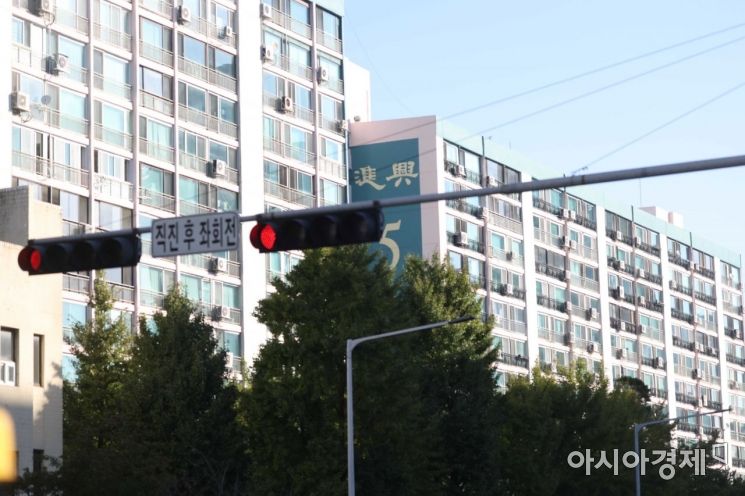
 The Bank of Korea raised the base interest rate by 0.5 percentage points, and the real estate transaction market is expected to experience a prolonged winter. On the 13th, a red light was on at a traffic signal near an apartment in downtown Seoul.
[Asia Economy Reporter Hwang Yoon-joo] Recently, as the decline in house prices has accelerated, the risk of 'empty-can jeonse' has increased.
According to the 'Lease Market Siren' information released on the 23rd by the Korea Real Estate Board through Real Estate Tech, the nationwide apartment jeonse price ratio in September was 75.2%, up 0.5 percentage points (p) from 74.7% in August.
The jeonse price ratio is the ratio of the jeonse price to the sale price. When this ratio is high and the jeonse price approaches or surpasses the sale price, tenants face a greater risk of losing their deposit from landlords.
Recently, as both sale and jeonse prices in the housing market have weakened, the sale prices have fallen more than the jeonse prices, causing the jeonse price ratio to rise relatively.
Since last month, the Korea Real Estate Board has been providing information on jeonse price ratios, deposit accident status, and auction bid statistics through the Real Estate Tech website to prevent non-return of jeonse deposits and jeonse fraud damage. Among these, the jeonse price ratio is surveyed based on actual transaction data over the past three months as of the relevant month.
In the September survey, regions such as Buk-gu, Pohang, Gyeongbuk (91.7%), Gumi-si, Gyeongbuk (90.8%), Iksan-si, Jeonbuk and Nam-gu, Pohang, Gyeongbuk (each 90.6%), and Gwangyang-si (90.2%) exceeded a jeonse price ratio of 90%, increasing the risk of empty-can jeonse compared to the previous month.
The average jeonse price ratio for apartments in the metropolitan area rose from 69.4% in August to 70.4% in September, reaching the 70% range. Seoul's average jeonse price ratio was 63.2%, lower than other regions, but it rose by 1.2 percentage points from 62% in the previous month, showing a relatively noticeable upward trend.
Among the 25 districts of Seoul, Jung-gu recorded the highest jeonse price ratio last month at 78.6%, soaring by a remarkable 16 percentage points from 62.6% in the previous month. Geumcheon-gu followed with 76.6%, then Gwanak-gu at 73.3%, and Gangseo-gu at 73.2%.
Generally, multi-family and row houses, commonly referred to as 'villa,' have higher jeonse price ratios than apartments, increasing the risk of empty-can jeonse damage, so tenants should be cautious.
The nationwide jeonse price ratio for multi-family and row houses rose by 0.3 percentage points from 83.1% in August to 83.4% in September. The average jeonse price ratio for multi-family and row houses is 80.5% in provincial areas, but Seoul's 82% is higher, indicating a significant risk of empty-can jeonse damage in Seoul as well.
In particular, some areas in Seoul have seen jeonse price ratios exceeding 90%. In September, Gwanak-gu's multi-family and row house jeonse price ratio rose by 6.6 percentage points from 85.3% in the previous month to 91.9%, the highest in Seoul, and Gangbuk-gu also entered the 90% range, rising by 6.6 percentage points from 84.6% to 91.2%.
In provincial areas, there are also places where jeonse prices have surpassed sale prices. Yeonje-gu, Busan (127.4%), Gumi-si, Gyeongbuk (102.6%), Icheon-si, Gyeonggi (102.1%), Hwaseong-si, Gyeonggi (102%), Buk-gu, Pohang, Gyeongbuk (101.8%), and Sangnok-gu, Ansan, Gyeonggi (100.7%) all exceeded a jeonse price ratio of 100%.
However, since the jeonse price ratios disclosed through the Lease Market Siren are based on actual transaction prices, there is a numerical difference compared to jeonse price ratios surveyed monthly based on market prices.
The Korea Real Estate Board's market price-based average jeonse price ratio for September is 68.9% nationwide and 57.4% in Seoul for apartments, and 67.7% nationwide and 70.5% in Seoul for multi-family and row houses.
© The Asia Business Daily(www.asiae.co.kr). All rights reserved.
![Clutching a Stolen Dior Bag, Saying "I Hate Being Poor but Real"... The Grotesque Con of a "Human Knockoff" [Slate]](https://cwcontent.asiae.co.kr/asiaresize/183/2026021902243444107_1771435474.jpg)















