Key Points to Watch: 'Mangiyongdaega, In-App Payments, Kakao Outage'
Big Tech Companies like Google, Apple, Netflix
Korean Executives Scheduled to Appear as Witnesses and Witnesses
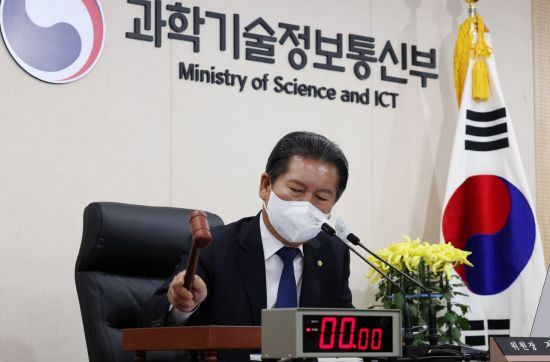 On the 4th, during the National Assembly Science, Technology, Information and Broadcasting and Communications Committee's audit of the Ministry of Science and ICT and the Korea Post, Jeong Cheong-rae, a member of the Democratic Party of Korea, is striking the gavel.
 [Image source=Yonhap News]
[Asia Economy Reporter Cha Min-young] The final inspection by the National Assembly’s Science, Technology, Information and Broadcasting and Communications Committee targeting the Korea Communications Commission, starting at 10 a.m. on the 21st, is expected to mainly address issues such as Big Tech companies’ network usage fees, the controversy over forced in-app payments, and the Kakao outage incident. Executives from Big Tech companies in Korea, including Google, Apple, and Netflix, will also appear as witnesses and reference persons at the KCC’s final inspection.
First, the issue of Big Tech’s free-riding on domestic telecom operators’ (ISP) networks has been highlighted as a key agenda item in this audit. Telecom companies claim that Big Tech firms, including Google (YouTube), use massive traffic without paying domestic network usage fees, while Google encourages participation in petitions opposing legislation on network usage fees, arguing that such laws would disadvantage creators.
Twitch also retaliated by lowering video quality, citing increased operating costs for its Korean service. On the 29th of last month, Twitch announced it would reduce the original video quality from a maximum of 1080p to 720p due to increased costs such as network fees, and began implementing this from the 30th. This caused consumer harm and led to a surge in complaints directed at telecom companies.
Regarding this, Han Sang-hyuk, Chairman of the Korea Communications Commission, stated at the KCC audit on the 6th, “We are reviewing whether user harm has occurred and whether this constitutes a prohibited act” concerning Twitch’s video quality reduction, adding, “YouTube will be reviewed later.”
The alleged violations by app market operators such as Google and Apple of the domestic In-App Payment Forced Prohibition Act (an amendment to the Telecommunications Business Act) are also expected to be addressed. The market views the conflict between Google and KakaoTalk over outlinking in early July as the decisive factor that shifted the issue from a reality check to a fact-finding investigation.
The KCC has been conducting a fact-finding investigation since August targeting the three app market operators (Google, Apple, and One Store). This is because it is judged that the act of allowing only a specific payment method (internal payment) controlled under limited conditions by the three companies, while refusing app registration or renewal for app developers using other payment methods (external payment), may constitute forcing a specific payment method.
Han Sang-hyuk, Chairman of the Korea Communications Commission, also revealed plans to send official letters to Google and Apple, who have been passive in submitting materials for the in-app payment forced prohibition law fact-finding investigation, stating that corrective orders and enforcement fines could be imposed.
To this end, executives from Big Tech companies such as Google, Apple, and Netflix will appear as witnesses at the KCC final inspection on this day. Kim Kyung-hoon, President of Google Korea; Ahn Cheol-hyun, Vice President of Apple Korea; and Jung Gyo-hwa, Executive Director of Netflix Services Korea, will attend as general witnesses and reference persons.
Originally, the Science, Technology, Information and Broadcasting and Communications Committee requested the attendance of Nancy Mable Walker, CEO of Google Korea; Peter Aldenwood, CEO of Apple Korea; and Reginald Schomtonson, CEO of Netflix Services Korea, but they conveyed their intention not to attend due to residing overseas and other reasons.
Questions regarding responsibility for user protection related to the Kakao incident are also expected to be raised. The KCC has established a ‘Kakao Reporting Channel’ for prompt damage reporting and decided to utilize the existing ‘Online Damage 365 Center’ for damage reception. It has also requested Kakao to open a support window for user damage reception and consultation. The KCC plans to check whether prompt compensation is made based on the reports received.
Some have expressed concerns that the Kakao outage incident has become an ‘issue black hole,’ potentially leading to insufficient questioning on current issues during the audit. An IT industry official said, “Even just considering urgent ICT issues such as the network usage fee law, there are many pressing matters, but since the Kakao incident has attracted a lot of attention from the political sphere, interest seems to be focused there,” adding, “Since this is the final inspection stage, I hope sufficient questioning will take place.”
© The Asia Business Daily(www.asiae.co.kr). All rights reserved.

















