Risk Disclosure in Hanjin Investment Prospectus
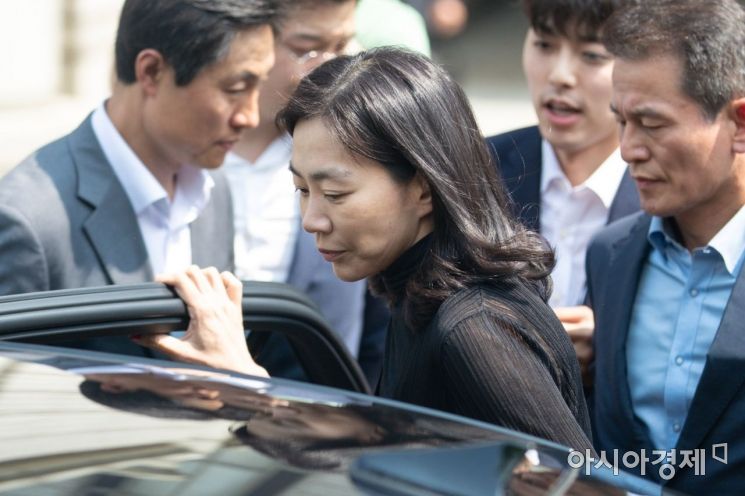 Former Korean Air Vice President Cho Hyun-ah, who was prosecuted for illegally employing a Filipino domestic worker, is leaving the courtroom after being sentenced to one year in prison with a two-year probation at the first trial held on the 2nd at the Seoul Central District Court in Seocho-gu, Seoul. Photo by Kang Jin-hyung aymsdream@
[Asia Economy Reporter Hwang Junho] "Our related party, former Ilwoo Foundation director Lee Myung-hee, was non-detained indicted by the prosecution on charges of special injury, obstruction of business, and insult, and was sentenced to 2 years in prison with a 3-year probation in the appellate trial on November 19, 2020. On February 1, 2019, she was also non-detained indicted along with former Vice President Cho Hyun-ah for violating customs law by failing to pay customs duties after purchasing overseas goods, and the case proceeded to the appellate trial, where they were sentenced to imprisonment, probation, and community service."
On the 13th, the courier company 'Hanjin' issued 30 billion KRW worth of corporate bonds (the 103rd unsecured) and listed 'reputation-related risks of related parties' as one of the key investment risks. Unlike other companies' investment prospectuses, it considers incidents involving the owner family as 'investment risks' and discloses the details thoroughly. However, Korean Air, where incidents raising reputation risks occurred, has removed such reputation risks, causing controversy.
Reputation Risk of Hanjin's Owner Family
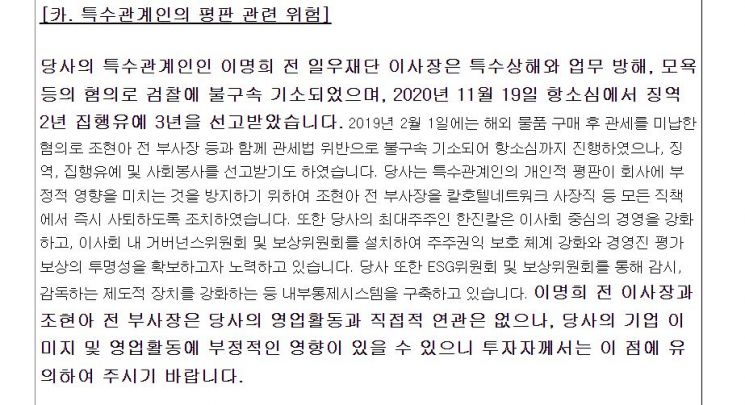 On the 13th, Hanjin issued corporate bonds worth 30 billion KRW, explicitly mentioning reputational risks related to Mrs. Lee Myung-hee and former Korean Air Vice President Cho Hyun-ah.
Hanjin's third generation of the Hanjin family?former Korean Air Vice President Cho Hyun-ah, Korean Air Chairman Cho Won-tae, and Hanjin President Cho Hyun-min?each hold only about 0.03% of shares. Mrs. Lee Myung-hee holds no shares in Hanjin at all.
Even from the perspective of the third generation's management activities, Mrs. Lee Myung-hee and former Vice President Cho Hyun-ah did not hold any positions in Hanjin and currently do not hold any. The youngest of the third generation, President Cho, holds an important position but was acquitted in court and has never been pointed out as a 'reputation-related risk of related parties' within the Hanjin Group.
From this perspective, it feels somewhat distant that Hanjin declares reputation risks related to Mrs. Lee and former Vice President Cho as related parties. Viewed this way, it gives the impression that Hanjin wants to shake off the mistakes of the Hanjin Group and establish new ownership.
If not, it could be interpreted that although Mrs. Lee Myung-hee and former Vice President Cho Hyun-ah are not designated as reputation risk figures, since President Cho Hyun-min, who was acquitted, is active in management, investors should keep this in mind. However, considering Korean corporate culture, such 'overreach' is unlikely to be a realistic analysis.
The Disappeared Owner Family Reputation Risk of Korean Air
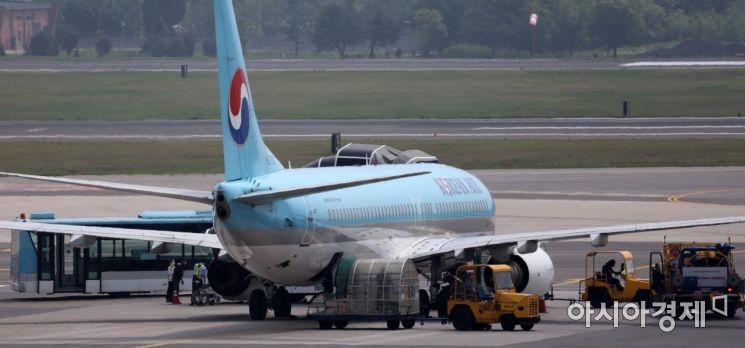 Due to the rise in international oil prices, the fuel surcharge imposed on international flight tickets has once again reached an all-time high. According to the airline industry, Korean Air's international fuel surcharge for July has increased by three levels from June to level 22, resulting in charges ranging from 42,900 KRW to as much as 339,300 KRW depending on the distance. The domestic fuel surcharge will also increase from 17,600 KRW to 19,800 KRW starting this month. Consequently, the airfare paid by consumers is expected to rise further. The photo shows the runway and apron at Gimpo Airport on the 17th. Photo by Kim Hyun-min kimhyun81@
Unlike Hanjin's progressive(?) disclosure of reputation risks, it is even more peculiar that such reputation risks cannot be found in Korean Air.
On September 6, when Korean Air issued 200 billion KRW worth of corporate bonds (the 100-1, 100-2), the disclosed risk factors detailed the management dispute between Chairman Cho Won-tae and the alliance of former Vice President Cho Hyun-ah (KCGI, Bando Construction, etc.), but there was no mention of owner family reputation risks.
To be precise, the expression 'disappeared' fits better. Until October last year, Korean Air also specified reputation risks like Hanjin, but this part was removed this year. Unlike Hanjin, where the owner family holds similar share ratios, Korean Air judged that it was unnecessary to include owner family reputation risks. The three siblings of the owner family hold about 0.53% of Korean Air shares (preferred stock), and Mrs. Lee Myung-hee holds about 0.80%, which can be understood.
However, the fact that the social reputation of Hanjin family members has become a risk factor for bond issuance can be traced back to the 'nut rage' incident and other power abuse cases that occurred at Korean Air, the group's flagship company. These incidents triggered social turmoil, including a boycott of Korean Air. There are persuasive criticisms that the owner family deleted this content for protection or that Korean Air, rather than Hanjin, should have disclosed this information.
'Same Bed, Different Dreams' Owner Family Reputation Risk
More interesting are the opinions of the two companies regarding this matter. Both sides agree that the incidents are 'old cases.' However, despite being affiliates within the Hanjin Group, the two companies differ in their judgments on 'owner family reputation risks.'
Hanjin judged that Mrs. Lee Myung-hee and former Vice President Cho Hyun-ah pose risks threatening the company's management situation, as previously announced. Hanjin stated, "Although it is a matter from a long time ago, since it is an affiliate of the Hanjin Group, we listed it as a risk factor for external issues."
On the other hand, Korean Air explained, "The trial has ended, and Mrs. Lee and former Vice President Cho are not involved in management, so we did not include this as an investment risk starting this year." They added, "In the case of disclosures, the Financial Supervisory Service's examiner makes the final judgment. The company removed the content, and the examiner approved it."
The Financial Supervisory Service, unexpectedly caught in the crossfire, did not seem to have detailed knowledge of the matter. An official from the FSS drew a line by saying, "In principle, the responsibility for disclosure lies with the listed company." They also explained, "If a listed company omits information about classified risks through casebooks, the authorities request corrections. If the owner family is involved in management, it is appropriate to disclose it, and if it is considered that the affiliate relationship may have an influence, disclosure is necessary for investors."
© The Asia Business Daily(www.asiae.co.kr). All rights reserved.