Tesla Indefinitely Suspends Production at German Battery Plant
Global Automakers Pursuing In-House Production Face Yield Issues
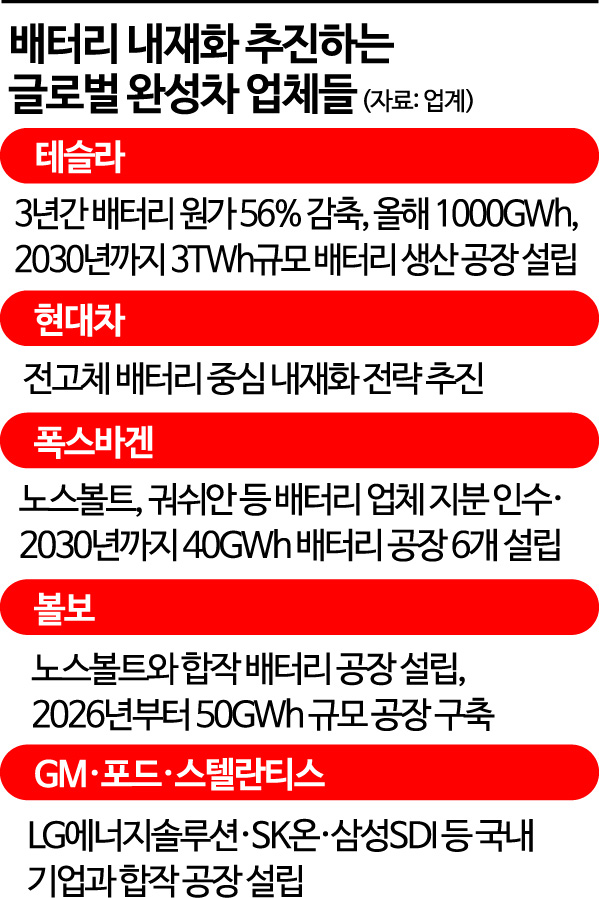
Global electric vehicle company Tesla, which had planned to produce electric vehicle batteries in-house, appears to be indefinitely postponing the production plan at its European base factory. Automakers attempting to produce batteries, which account for 30-40% of electric vehicle production costs, inevitably face issues with production process completeness and the resulting 'yield rate' (rate of good products).
According to local foreign media and industry sources on the 18th, Tesla's plan to mass-produce the 2024 '4680 (46mm diameter, 80mm height)' cylindrical battery cells at the Gruenheide battery factory near Berlin is expected to be indefinitely postponed. Most of the equipment needed for production is reportedly being moved to Austin, Texas, USA, where Tesla's headquarters are located.
The reason for the production plan postponement is said to be due to technical problems found in the process. An industry insider stated, "It is presumed that there are issues with the mass production using the dry electrode process that Tesla is pursuing," adding, "The dry process omits drying and calendaring (rolling and pressing) steps compared to the existing wet process, saving production time and processing costs, but it is technically challenging and is expected to take considerable time to establish a process suitable for mass production."
It seems Tesla, which had actively pursued in-house battery production, is stepping back. In September 2020, at 'Battery Day,' Tesla announced strategies including ▲a 56% reduction in battery manufacturing costs within 18 months to 3 years ▲production of a 'half-price electric vehicle' priced around $25,000 (approximately 35.7 million KRW) ▲and increasing battery production capacity to 3 terawatt-hours (TWh) by 2030.
In fact, the industry reports that the production yield of Tesla's cylindrical batteries currently undergoing trial production at the Fremont factory in the US is only around 40-50%. This means that out of 100 battery cells produced, only 40-50 are actually usable. The battery industry considers a yield rate of over 90% necessary for stable mass production.
This yield issue is likely to be faced by global automakers other than Tesla as well. Automakers are internalizing battery production to reduce the high cost proportion of batteries in electric vehicles, but it is pointed out that such attempts are unlikely to achieve short-term results. Therefore, American automakers such as GM, Ford, and Stellantis are pursuing 'partial internalization' through joint ventures with domestic battery companies instead of in-house production.
Streamlining and standardizing production processes is a long-standing challenge in the battery industry. With factories operating worldwide, establishing processes that maximize yield according to the types of batteries to be supplied to each region, local regulations, and the skill levels of production personnel is as important a task as developing next-generation batteries. For this reason, domestic battery companies are building 'model factories' in Korea, where research personnel and equipment infrastructure are most concentrated, to maximize yield.
A representative example is LG Energy Solution's first 'cylindrical medium-to-large battery' production base, the Ochang factory. The strategy is to secure an initial stable production volume of the '4680 battery,' which will determine future partnerships with Tesla, and to share the most efficient process model with additional factories to be established worldwide in the future.
Professor Kim Pil-su of Daelim University's Department of Automotive Engineering explained, "Next-generation battery technologies such as high-nickel batteries (with nickel content over 90%) are meaningful only when they achieve high yield rates," adding, "Domestic battery manufacturers are leading the global market because they can maintain yield rates even while building large-scale production processes."
© The Asia Business Daily(www.asiae.co.kr). All rights reserved.

















